集群容错(三)之Directory实现
本文基于 Dubbo 2.6.1 版本,望知悉。
1. 概述
本文接 《精尽 Dubbo 源码解析 —— 集群容错(二)之 Cluster 实现》 一文,分享 dubbo-cluster 模块, directory 包,各种 Directory 实现类。
Directory ,中文直译为目录,代表了多个 Invoker ,可以把它看成 List 。但与 List 不同的是,它的值可能是动态变化的,比如注册中心推送变更。
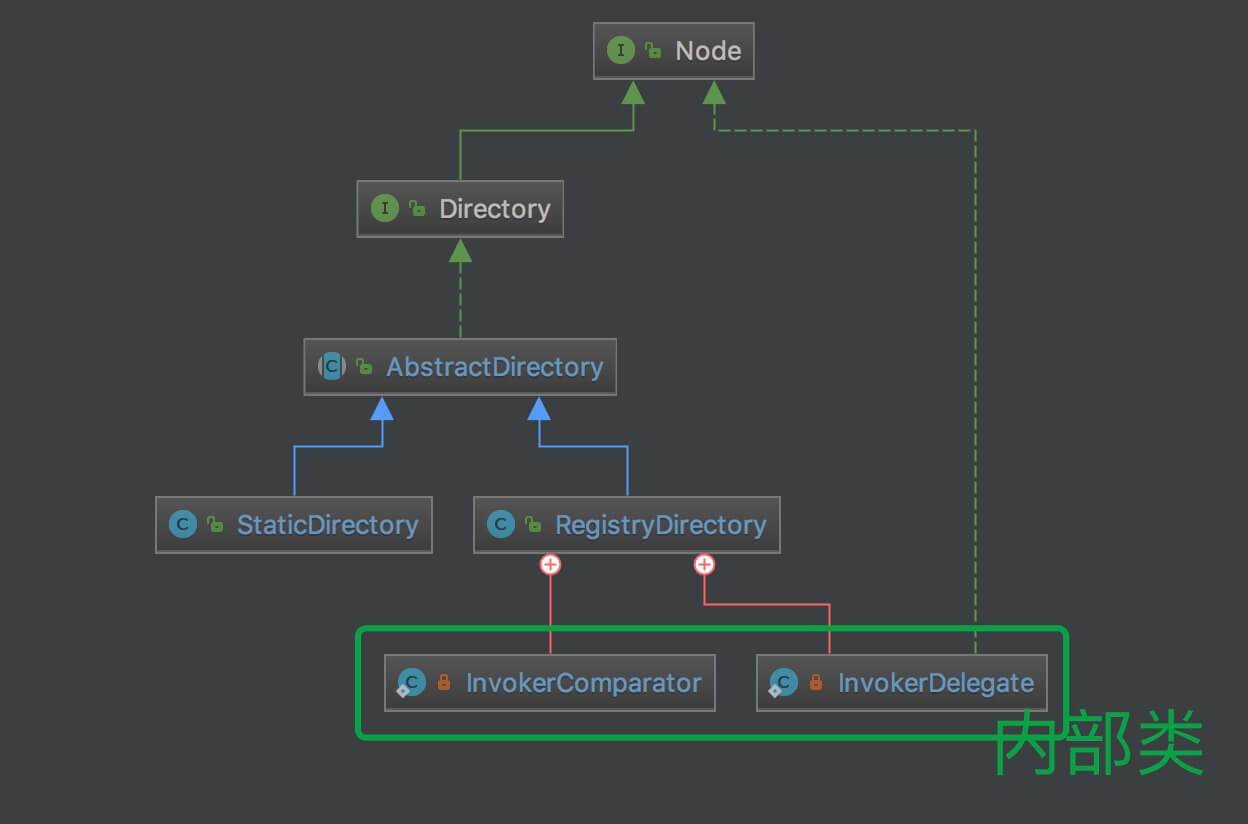
Directory 子类如下图:
Directory 子类
我们看到有两个实现类:
- StaticDirectory ,静态静态 Directory 实现类,从命名上看出它是 的 List 。
- RegistryDirectory ,基于注册中心动态动态 的 Directory 实现类,从命名上看出它是 的,会根据注册中心的推送变更 List 。
2. Directory
com.alibaba.dubbo.rpc.cluster.Directory ,继承 Node 接口,Directory 接口。代码如下:
```plain text plain public interface Directory
1
2
3
4
5
6
7
8
9
10
11
12
13
14
15
16
17
18

---

- 定义了**两个类型Invoker 集合**
接口方法,分别返回服务的
和
。
- 一个 Directory **只对应**
一个服务类型。

# 3. AbstractDirectory

com.alibaba.dubbo.rpc.cluster.directory.AbstractDirectory ,实现 Directory 接口,Directory 抽象实现类,实现了公用的**路由规则( Router )**的逻辑。

## 3.1 构造方法

```plain text
plain /**  * 是否已经销毁  */ private volatile boolean destroyed = false; /**  * 注册中心 URL  */ private final URL url; /**  * 消费者 URL  *  * 若未显示调用 {@link #AbstractDirectory(URL, URL, List)} 构造方法,consumerUrl 等于 {@link #url}  */ private volatile URL consumerUrl; /**  * Router 数组  */ private volatile List<Router> routers;  public AbstractDirectory(URL url) {     this(url, null); }  public AbstractDirectory(URL url, List<Router> routers) {     this(url, url, routers); }  public AbstractDirectory(URL url, URL consumerUrl, List<Router> routers) {     if (url == null) {         throw new IllegalArgumentException("url == null");     }     this.url = url;     this.consumerUrl = consumerUrl;     // 设置 Router 数组     setRouters(routers); }
- consumerUrl 字段,认真看下注释和构造方法。
- 调用 #setRouters(routers) 方法,初始化并设置 Router 数组。
3.2 setRouters
#setRouters(routers) 方法,初始化并设置 Router 数组。详细解析,见 《精尽 Dubbo 源码解析 —— 集群容错(七)之 Router 实现》 中。
3.3 list
#list(Invocation)实现方法,获得所有服务 Invoker 集合。代码如下:
```plain text plain 1: @Override 2: public List<Invoker
1
2
3
4
5
6
7
8
9

---

- 第 7 行:调用 **抽象**
#doList(invocation)
方法,获得所有 Invoker 集合。代码如下:

```plain text
plain protected abstract List<Invoker<T>> doList(Invocation invocation) throws RpcException;
- 第 9 至 20 行:根据路由规则( Router )《精尽 Dubbo 源码解析 —— 集群容错(七)之 Router 实现》 ,进一步筛选合适的 Invoker 集合。详细解析,见 。
4. RegistryDirectory
com.alibaba.dubbo.registry.integration.RegistryDirectory ,实现 NotifyListener 接口,实现 AbstractDirectory 抽象类,基于注册中心的 Directory 实现类。
- RegistryDirectory 在 dubbo-registry 模块, integration 包下,是 Dubbo 注册中心模块集成 Directory 的实现类。
- RegistryDirectory 作为一个 NotifyListener ,订阅监听 注册中心( Registry ) 的数据,实现对变更的 。
4.1 构造方法
RegistryDirectory 的字段有 17 个,比较多,所以胖友请耐心。
```plain text plain // ========== Dubbo SPI Adaptive 对象 BEGIN ========== /** * Cluster$Adaptive 对象 */ private static final Cluster cluster = ExtensionLoader.getExtensionLoader(Cluster.class).getAdaptiveExtension(); /** * RouterFactory$Adaptive 对象 */ private static final RouterFactory routerFactory = ExtensionLoader.getExtensionLoader(RouterFactory.class).getAdaptiveExtension(); /** * ConfiguratorFactory$Adaptive 对象 */ private static final ConfiguratorFactory configuratorFactory = ExtensionLoader.getExtensionLoader(ConfiguratorFactory.class).getAdaptiveExtension(); // ========== 服务消费者相关 BEGIN ========== /** * 服务类型,例如:com.alibaba.dubbo.demo.DemoService */ private final Class
1
2
3
4
5
6
7
8
9
10
11
12
13

---

- 分成**五类**
变量。胖友自己看注释。
- 如果不理解,可以结合下面的具体方法的使用。 当然也可以给我留言,因为确实变量有点多和复杂。

## 4.2 subscribe

#subscribe(URL) 方法,向**注册中心**发起订阅。代码如下:

```plain text
plain public void subscribe(URL url) {     // 设置消费者 URL     setConsumerUrl(url);     // 向注册中心,发起订阅     registry.subscribe(url, this); }
- 调用父 #setConsumerUrl(url) 方法,设置 consumerUrl 消费者 URL 。
- 调用 Registry#subscribe(url, NotifyListener) 方法,向注册中心,发起订阅。
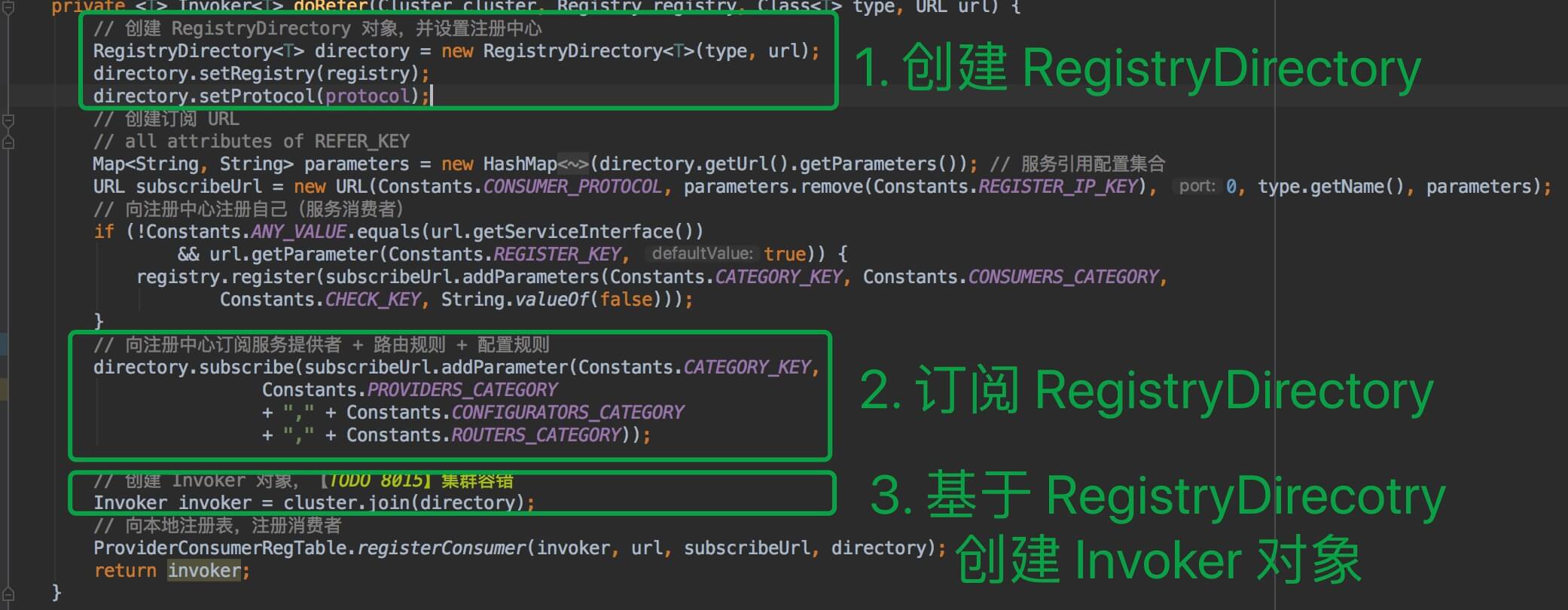
服务消费者,再引用服务时,会创建 RegistryDirectory 对象,并发起1)服务提供者 + 2)路由规则 + 3)配置规则的数据订阅。如下图:
doRefer
- 对应为 RegistryProtocol#doRefer(Cluster, Registry, Class type, URL url) 方法。
4.3 notify
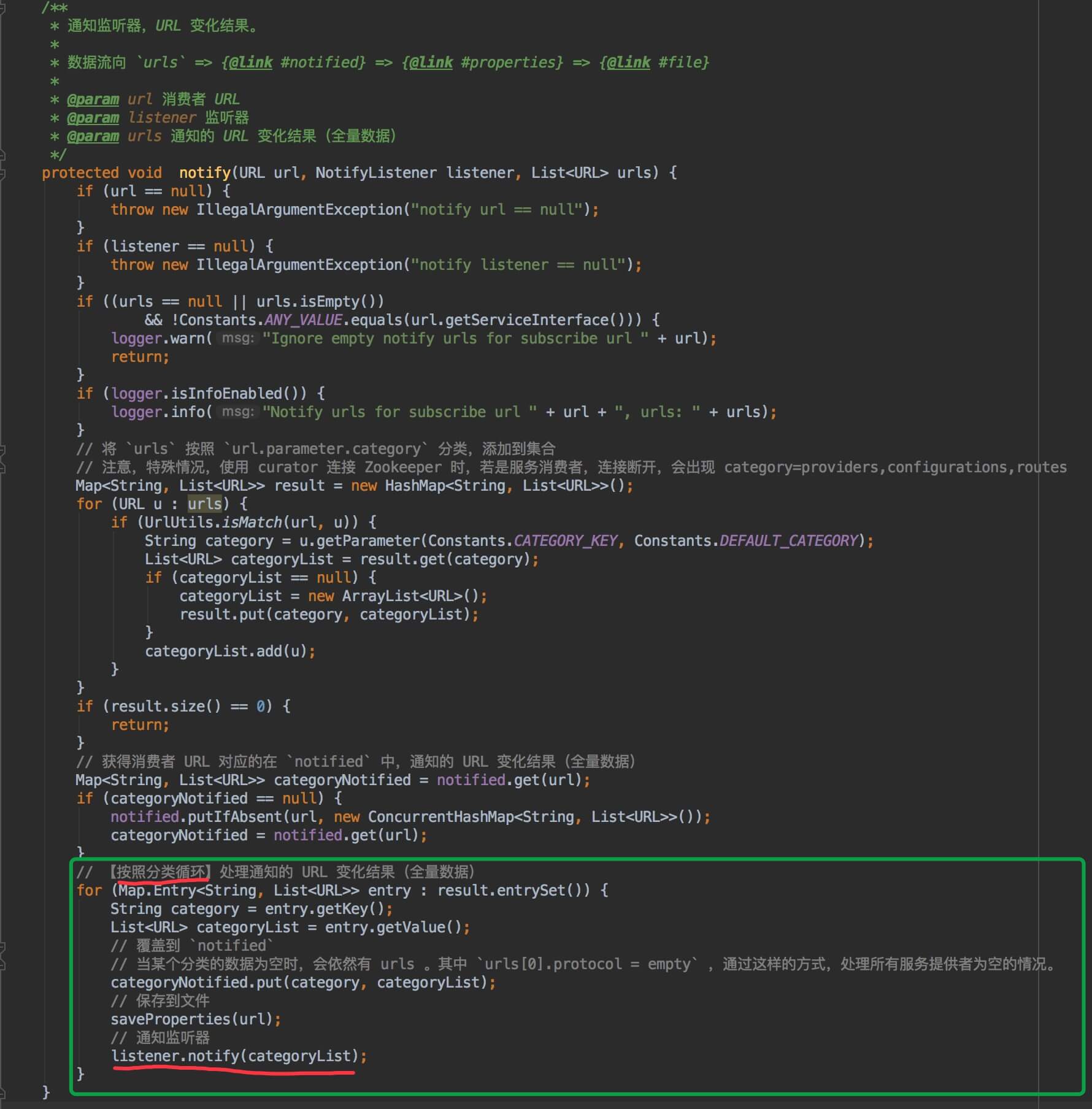
在注册中心( Registry )发现数据发生变化时,会通知对应的 NotifyListener 们。如下图:
notify
- 对应为 AbstractRegistry#notify(URL url, NotifyListener, List urls) 方法。
- 因为 RegistryDirectory 作为一个 NotifyListener ,向注册中心( Registry )发起了订阅,所以此时会被通知。注意,是按照分类循环通知的一次只有一类 URL ,也就是说, 。
#notify(List urls)实现方法,代码如下:
```plain text plain 1: @Override 2: public synchronized void notify(List
1
2
3
4
5
6
7
8
9
10
11
12
13
14
15
16
17
18
19
20
21
22
23
24
25
26
27
28
29
30
31
32
33
34
35
36
37
38
39
40
41
42
43
44
45
46
47
48
49
50
51
52
53
54
55
56

---

- **注意同步**
,这是一个
的方法。
- 第 3 至 19 行:根据 URL 的**分类三个1)服务提供者 + 2)路由规则 + 3)配置规则**
或协议,分成组
集合:
。
- 第 20 至 24 行:非空,调用 **配置规则**[「4.3.1 toConfigurators」](http://svip.iocoder.cn/Dubbo/cluster-3-impl-directory/#)
#toConfigurators(configuratorUrls)
方法,处理
URL 集合。详细解析,见
。
- 第 25 至 32 行:非空,调用 **路由规则**[「4.3.2 toRouters」](http://svip.iocoder.cn/Dubbo/cluster-3-impl-directory/#)
#toRouters(routerUrls)
方法,处理
URL 集合。详细解析,见
。
    - 若转换到 **父**
routers
非空,调用
#setRouters(routers)
方法,设置路由规则。
- 第 33 至 41 行:合并配置规则,到 [《精尽 Dubbo 源码解析 —— 集群容错(六)之 Configurator 实现》](http://svip.iocoder.cn/Dubbo/cluster-6-impl-configurator?self=)[「4.1.2 mergeUrl」](http://svip.iocoder.cn/Dubbo/cluster-3-impl-directory/#)
directoryUrl
中,形成
overrideDirectoryUrl
变量。详细解析,见
的
。
- 第 43 行:调用 **服务提供者**[「4.3.3 refreshInvoker」](http://svip.iocoder.cn/Dubbo/cluster-3-impl-directory/#)
#refreshInvoker(invokerUrls)
方法,处理
URL 集合。详细解析,见
。

### 4.3.1 toConfigurators

详细解析,见 [《精尽 Dubbo 源码解析 —— 集群容错(六)之 Configurator 实现》](http://svip.iocoder.cn/Dubbo/cluster-6-impl-configurator?self=) 的 [「4.1.1 toConfigurators」](http://svip.iocoder.cn/Dubbo/cluster-3-impl-directory/#) 。

### 4.3.2 toRouters

详细解析,见 [《精尽 Dubbo 源码解析 —— 集群容错(七)之 Router 实现》](http://svip.iocoder.cn/Dubbo/cluster-7-impl-router/?self=) 。

## 4.7 内部类

### 4.7.1 InvokerDelegate

InvokerDelegate ,实现 com.alibaba.dubbo.rpc.protocol.InvokerWrapper 类,Invoker 代理类,主要用于存储**注册中心下发的 url 地址**( providerUrl ),用于重新重新 refer 时能够根据 providerURL queryMap overrideMap 重新组装。 代码如下:

老艿艿:目前貌似没看到这块逻辑噢

```plain text
plain private static class InvokerDelegate<T> extends InvokerWrapper<T> {      /**      * 服务提供者 URL      *      * 未经过配置合并      */     private URL providerUrl;      public InvokerDelegate(Invoker<T> invoker, URL url, URL providerUrl) {         super(invoker, url);         this.providerUrl = providerUrl;     }      public URL getProviderUrl() {         return providerUrl;     }  }
4.7.2 InvokerComparator
InvokerComparator ,实现 Comparator 接口,Invoker 排序器实现类,根据 URL 升序 。代码如下:
```plain text plain private static class InvokerComparator implements Comparator<Invoker<?» { /** * 单例 */ private static final InvokerComparator comparator = new InvokerComparator(); private InvokerComparator() { } public static InvokerComparator getComparator() { return comparator; } @Override public int compare(Invoker<?> o1, Invoker<?> o2) { return o1.getUrl().toString().compareTo(o2.getUrl().toString()); } }
1
2
3
4
5
6
7
8
9
10
11
12
13
14
15
16

---

### 4.3.3 refreshInvoker

#refreshInvoker(List invokerUrls) 方法,官方注释其如下:

根据 invokerURL 列表转换为 invoker 列表。转换规则如下:

3. 如果 url 已经被转换为 invoker ,则不在重新引用,直接从缓存中获取,注意如果 url 中任何一个参数变更也会重新引用
4. 如果传入的 invoker 列表不为空,则表示最新的 invoker 列表
5. 如果传入的 invokerUrl 列表是空,则表示只是下发的 override 规则或 route 规则,需要重新交叉对比,决定是否需要重新引用。
- 是不是看起来有点点懵逼?淡定,我们来看看代码。

```plain text
plain 1: private void refreshInvoker(List<URL> invokerUrls) {  2:     if (invokerUrls != null && invokerUrls.size() == 1 && invokerUrls.get(0) != null  3:             && Constants.EMPTY_PROTOCOL.equals(invokerUrls.get(0).getProtocol())) {  4:         // 设置禁止访问  5:         this.forbidden = true; // Forbid to access  6:         // methodInvokerMap 置空  7:         this.methodInvokerMap = null; // Set the method invoker map to null  8:         // 销毁所有 Invoker 集合  9:         destroyAllInvokers(); // Close all invokers 10:     } else { 11:         // 设置允许访问 12:         this.forbidden = false; // Allow to access 13:         // 引用老的 urlInvokerMap 14:         Map<String, Invoker<T>> oldUrlInvokerMap = this.urlInvokerMap; // local reference 15:         // 传入的 invokerUrls 为空,说明是路由规则或配置规则发生改变,此时 invokerUrls 是空的,直接使用 cachedInvokerUrls 。 16:         if (invokerUrls.isEmpty() && this.cachedInvokerUrls != null) { 17:             invokerUrls.addAll(this.cachedInvokerUrls); 18:         // 传入的 invokerUrls 非空,更新 cachedInvokerUrls 。 19:         } else { 20:             this.cachedInvokerUrls = new HashSet<URL>(); 21:             this.cachedInvokerUrls.addAll(invokerUrls); //Cached invoker urls, convenient for comparison //缓存invokerUrls列表,便于交叉对比 22:         } 23:         // 忽略,若无 invokerUrls 24:         if (invokerUrls.isEmpty()) { 25:             return; 26:         } 27:         // 将传入的 invokerUrls ,转成新的 urlInvokerMap 28:         Map<String, Invoker<T>> newUrlInvokerMap = toInvokers(invokerUrls);// Translate url list to Invoker map 29:         // 转换出新的 methodInvokerMap 30:         Map<String, List<Invoker<T>>> newMethodInvokerMap = toMethodInvokers(newUrlInvokerMap); // Change method name to map Invoker Map 31:         // state change 32:         // If the calculation is wrong, it is not processed. 如果计算错误,则不进行处理. 33:         if (newUrlInvokerMap == null || newUrlInvokerMap.size() == 0) { 34:             logger.error(new IllegalStateException("urls to invokers error .invokerUrls.size :" + invokerUrls.size() + ", invoker.size :0. urls :" + invokerUrls.toString())); 35:             return; 36:         } 37:         // 若服务引用多 group ,则按照 method + group 聚合 Invoker 集合 38:         this.methodInvokerMap = multiGroup ? toMergeMethodInvokerMap(newMethodInvokerMap) : newMethodInvokerMap; 39:         this.urlInvokerMap = newUrlInvokerMap; 40:         // 销毁不再使用的 Invoker 集合 41:         try { 42:             destroyUnusedInvokers(oldUrlInvokerMap, newUrlInvokerMap); // Close the unused Invoker 43:         } catch (Exception e) { 44:             logger.warn("destroyUnusedInvokers error. ", e); 45:         } 46:     } 47: }
- ========== 第一部分 ==========
- 第 2 至 3 行:当 1下线 invokerUrls 集合大小为 ,并且协议为 empty:// ,说明所有服务提供者都已经 。若注册中心为 Zookeeper ,可参见 ZookeeperRegistry#toUrlsWithEmpty(URL consumer, String path, List providers) 方法。
- 第 5 行:设置禁止 访问,因为没有服务提供者了。
- 第 7 行: methodInvokerMap 置空。
- 第 9 行:调用 「4.3.3.5 destroyAllInvokers」 #destroyAllInvokers() 方法,销毁所有服务提供者 Invoker 集合。详细解析,见 。
- ========== 第二部分 ==========
- 第 12 行:设置允许 访问,因为有服务提供者了。
- 第 15 至 17 行:传入的 说明是路由规则或配置规则发生改变 invokerUrls 为空, ,此时 invokerUrls 是空的,直接使用 cachedInvokerUrls 。对应官方注释【第 3 点】(部分,不包括“需要重新交叉对比,决定是否需要重新引用”)。
- 第 18 至 22 行:传入的 新的 invokerUrls 非空,更新 cachedInvokerUrls 。考虑到并发的问题,更新的方式为创建 HashSet 。对应官方注释【第 2 点】。
- 为什么【第 15 至 17 行】不需要更新 呢?因为 invokerUrls 为空,直接使用 cachedInvokerUrls ,相当于进行了“更新”。
- 第 23 至 26 行:忽略,若无 invokerUrls 。出现情况为,初始是按照 configurators => routers => providers ,所以前两个会出现这个情况。关于这一点,胖友可以调试感受下。
- 第 28 行:调用 新的「4.3.3.1 toInvokers」 #toInvokers(List urls) 方法,将传入的 invokerUrls ,转换成 urlInvokerMap 。详细解析,见 。
- 第 30 行:调用 新的「4.3.3.2 toMethodInvokers」 #toMethodInvokers(newUrlInvokerMap) 方法,将 urlInvokerMap 转成与方法的映射关系,即 methodInvokerMap 。详细解析,见 。
- 第 31 至 36 行:如果计算错误,则不进行处理。一般来说,是防御性编程。
- 第 38 行:若服务引用多method + group「4.3.3.3 toMethodInvokers」 group ,则调用 #toMergeMethodInvokerMap(newMethodInvokerMap) 方法,按照 聚合 Invoker 集合。详细解析,见 。
- 第 39 行:赋值 urlInvokerMap 属性。
- 第 40 至 45 行:调用 销毁「4.3.3.4 toMethodInvokers」 #destroyUnusedInvokers(oldUrlInvokerMap, newUrlInvokerMap) 方法, 不再使用的 Invoker 集合。详细解析,见 。
4.3.3.1 toInvokers
#toInvokers(List urls) 方法,
```plain text plain 1: private Map<String, Invoker
1
2
3
4
5
6
7
8
9
10
11
12
13
14
15
16
17
18
19
20
21
22
23
24
25
26
27
28
29
30
31
32
33
34
35
36
37
38
39
40
41
42
43
44
45
46
47
48
49
50
51
52
53
54
55
56
57
58
59
60
61
62
63
64
65
66
67
68
69
70
71
72
73
74
75

---

- 第 3 行:
newUrlInvokerMap
变量,新的
urlInvokerMap
字段,后面会赋值给它。
- 第 4 至 7 行:若
urls
为空,直接返回,防御性编程。
- 第 9 行:**已初始化**
keys
变量,
的服务器提供 URL 集合,即服务提供者 URL 已经处理。
- 第 11 行:获得引用服务的协议。一般情况下,我们不会设置
配置项。
- 第 13 行:**循环**
urls
集合,转成 Invoker 集合。
- 协议处理相关
    - 第 14 至 28 行:如果 reference 端配置了 protocol ,则**只选择匹配**
的 protocol 。
    - 第 29 至 32 行:**忽略**
,若为
empty://
协议。
    - 第 33 至 38 行:**忽略**
,若应用程序不支持该协议。
- 第 40 行:调用 **合并**[「4.3.3.1 mergeUrl」](http://svip.iocoder.cn/Dubbo/cluster-3-impl-directory/#)
#mergeUrl(providerUrl)
方法,
URL 参数。详细解析,见
。
- 第 41 至 47 行:**忽略**
,通过
keys
判断已经初始化。
    - 若未初始化,添加到
keys
中。
- 第 48 至 75 行:“创建”服务 Invoker 对象。
    - 第 50 至 51 行:获得
url
对应在
localUrlInvokerMap
缓存的 Invoker 对象。
    - 第 52 至 72 行:不在缓存中,需要重新 refer 引用,创建 Invoker 对象。
        - 第 54 至 60 行:通过配置项
enable
和
disable
判断,服务是否开启。
        - 第 61 至 65 行: 若开启,创建 Invoker 对象。
            - 【重要】**第 64 行:调用 Protocol$Adaptive#refer(serviceType, url) 方法,引用服务,创建服务提供者 Invoker 对象**[《精尽 Dubbo 源码解析 —— 服务引用》](http://svip.iocoder.cn/Dubbo/cluster-3-impl-directory/#)
。详细解析,在
已经有了。
            - 第 64 行:创建 InvokerDelegate 对象。详细解析,见 [「4.7.1 InvokerDelegate」](http://svip.iocoder.cn/Dubbo/cluster-3-impl-directory/#)
。
    - 第 73 至 75 行:在缓存中,直接使用缓存的 Invoker 对象,添加到
newUrlInvokerMap
中。
- 第 78 行:清空
keys
。
- 第 79 行:返回结果
newUrlInvokerMap
。

### 4.3.3.1.1 mergeUrl

#mergeUrl(providerUrl) 方法,合并 URL 参数,**优先级**为配置规则 > 服务消费者配置 > 服务提供者配置。代码如下:

```plain text
plain 1: private URL mergeUrl(URL providerUrl) {  2:     // 合并消费端参数  3:     providerUrl = ClusterUtils.mergeUrl(providerUrl, queryMap); // Merge the consumer side parameters  4:   5:     // 合并配置规则  6:     List<Configurator> localConfigurators = this.configurators; // local reference  7:     if (localConfigurators != null && !localConfigurators.isEmpty()) {  8:         for (Configurator configurator : localConfigurators) {  9:             providerUrl = configurator.configure(providerUrl); 10:         } 11:     } 12:  13:     // 不检查连接是否成功,总是创建 Invoker ! 14:     providerUrl = providerUrl.addParameter(Constants.CHECK_KEY, String.valueOf(false)); // Do not check whether the connection is successful or not, always create Invoker! 15:  16:     // The combination of directoryUrl and override is at the end of notify, which can't be handled here 17:     // 仅合并提供者参数,因为 directoryUrl 与 override 合并是在 notify 的最后,这里不能够处理 18:     this.overrideDirectoryUrl = this.overrideDirectoryUrl.addParametersIfAbsent(providerUrl.getParameters()); // Merge the provider side parameters // 合并提供者参数 19:  20:     // 【忽略】因为是对 1.0 版本的兼容 21:     if ((providerUrl.getPath() == null || providerUrl.getPath().length() == 0) 22:             && "dubbo".equals(providerUrl.getProtocol())) { // Compatible version 1.0 23:         //fix by tony.chenl DUBBO-44 24:         String path = directoryUrl.getParameter(Constants.INTERFACE_KEY); 25:         if (path != null) { 26:             int i = path.indexOf('/'); 27:             if (i >= 0) { 28:                 path = path.substring(i + 1); 29:             } 30:             i = path.lastIndexOf(':'); 31:             if (i >= 0) { 32:                 path = path.substring(0, i); 33:             } 34:             providerUrl = providerUrl.setPath(path); 35:         } 36:     } 37:  38:     // 返回服务提供者 URL 39:     return providerUrl; 40: }
- 【重要「6. ClusterUtils」 】第 3 行:调用 ClusterUtils#mergeUrl(providerUrl, queryMap) 方法,合并服务消费者配置到 providerUrl 。详细解析,见 。
- 第 5 至 11 行:合并配置规则《精尽 Dubbo 源码解析 —— 集群容错(六)之 Configurator 实现》 到 providerUrl 中。详细解析,见
- 第 14 行:设置 providerUrl 不检查连接是否成功,总是创建 Invoker !
- 第 18 行:仅合并提供者参数。详细解析,见 《精尽 Dubbo 源码解析 —— 集群容错(六)之 Configurator 实现》
- 第 20 至 36 行:【忽略 】因为是对 1.0 版本的兼容。
4.3.3.2 toMethodInvokers
#toMethodInvokers(Map<String, Invoker> invokersMap) 方法,将 invokersMap 转成与方法的映射关系。代码如下:
```plain text plain 1: private Map<String, List<Invoker
1
2
3
4
5
6
7
8
9
10
11
12
13
14
15
16
17
18
19
20
21
22
23
24
25
26
27
28
29
30
31
32
33
34
35
36
37
38
39

---

- 第 3 行:
newMethodInvokerMap
变量,新的
methodInvokerMap
字段,后面会赋值给它。
- 第 5 行:创建 Invoker 集合。在【第 29 行】,我们可以看到,实际就是
invokersMap
的值的集合。
- 第 8 至 31 行:按照方法名为**维度对应的 Invoker 集合**
( KEY ) ,聚合
到
newMethodInvokerMap
中。
- 第 33 行:路由全 [《精尽 Dubbo 源码解析 —— 集群容错(七)之 Router 实现》](http://svip.iocoder.cn/Dubbo/cluster-7-impl-router/?self=)
invokersList
,匹配合适的 Invoker 集合。详细解析,见
。
- 第 35 行:添加 **全量**
newInvokersList
到
newMethodInvokerMap
中,表示该服务提供者的
Invoker 集合。
- 第 36 至 45 行:**循环**[《精尽 Dubbo 源码解析 —— 集群容错(七)之 Router 实现》](http://svip.iocoder.cn/Dubbo/cluster-7-impl-router/?self=)
,基于每个方法路由,匹配合适的 Invoker 集合。详细解析,见
。
- 第 46 至 53 行:循环**排序不可变**
每个方法的 Invoker 集合,并设置为
。

### 4.3.3.3 toMergeMethodInvokerMap

#toMergeMethodInvokerMap(Map<String, List<Invoker>> methodMap) ,按照 **method + group** 聚合 Invoker 集合。代码如下:

```plain text
plain 1: private Map<String, List<Invoker<T>>> toMergeMethodInvokerMap(Map<String, List<Invoker<T>>> methodMap) {  2:     Map<String, List<Invoker<T>>> result = new HashMap<String, List<Invoker<T>>>();  3:     // 循环方法,按照 method + group 聚合 Invoker 集合  4:     for (Map.Entry<String, List<Invoker<T>>> entry : methodMap.entrySet()) {  5:         String method = entry.getKey();  6:         List<Invoker<T>> invokers = entry.getValue();  7:         // 按照 Group 聚合 Invoker 集合的结果。其中,KEY:group VALUE:Invoker 集合。  8:         Map<String, List<Invoker<T>>> groupMap = new HashMap<String, List<Invoker<T>>>();  9:         // 循环 Invoker 集合,按照 group 聚合 Invoker 集合 10:         for (Invoker<T> invoker : invokers) { 11:             String group = invoker.getUrl().getParameter(Constants.GROUP_KEY, ""); 12:             List<Invoker<T>> groupInvokers = groupMap.get(group); 13:             if (groupInvokers == null) { 14:                 groupInvokers = new ArrayList<Invoker<T>>(); 15:                 groupMap.put(group, groupInvokers); 16:             } 17:             groupInvokers.add(invoker); 18:         } 19:         // 大小为 1,使用第一个 20:         if (groupMap.size() == 1) { 21:             result.put(method, groupMap.values().iterator().next()); 22:         // 大于 1,将每个 Group 的 Invoker 集合,创建成 Cluster Invoker 对象。 23:         } else if (groupMap.size() > 1) { 24:             List<Invoker<T>> groupInvokers = new ArrayList<Invoker<T>>(); 25:             for (List<Invoker<T>> groupList : groupMap.values()) { 26:                 groupInvokers.add(cluster.join(new StaticDirectory<T>(groupList))); 27:             } 28:             result.put(method, groupInvokers); 29:         // 大小为 0 ,使用原有值 30:         } else { 31:             result.put(method, invokers); 32:         } 33:     } 34:     return result; 35: }
- 第 2 行:新的 result 属性, methodInvokerMap 字段,后面会赋值给它。
- 第 3 终 33 行:循环method + group ,按照 聚合 Invoker 集合。
- 第 8 行: 按照 Group 聚合 Invoker 集合的结果。其中,KEYVALUE :group , :Invoker 集合。
- 第 9 至 18 行:循环group Invoker 集合,按照 聚合 Invoker 集合。
- ========== 结果 groupMap 处理 ==========
- 第 19 至 21 行:若数量为 1 ,使用第一个。
- 第 29 至 32 行:若数量为 0 ,使用原有值 等价 invokers 。实际上,和【第 19 至 21 行】 。
- 第 22 至 28 行:若数量大于每个 1 ,循环 Group 的 Invoker 集合,调用 Cluster$Adaptive#join(Directory) 方法,创建对应的 Cluster Invoker 对象。
- 我们发现,此处创建 StaticDirectory「5. StaticDirectory」 对象。详细解析,见 。
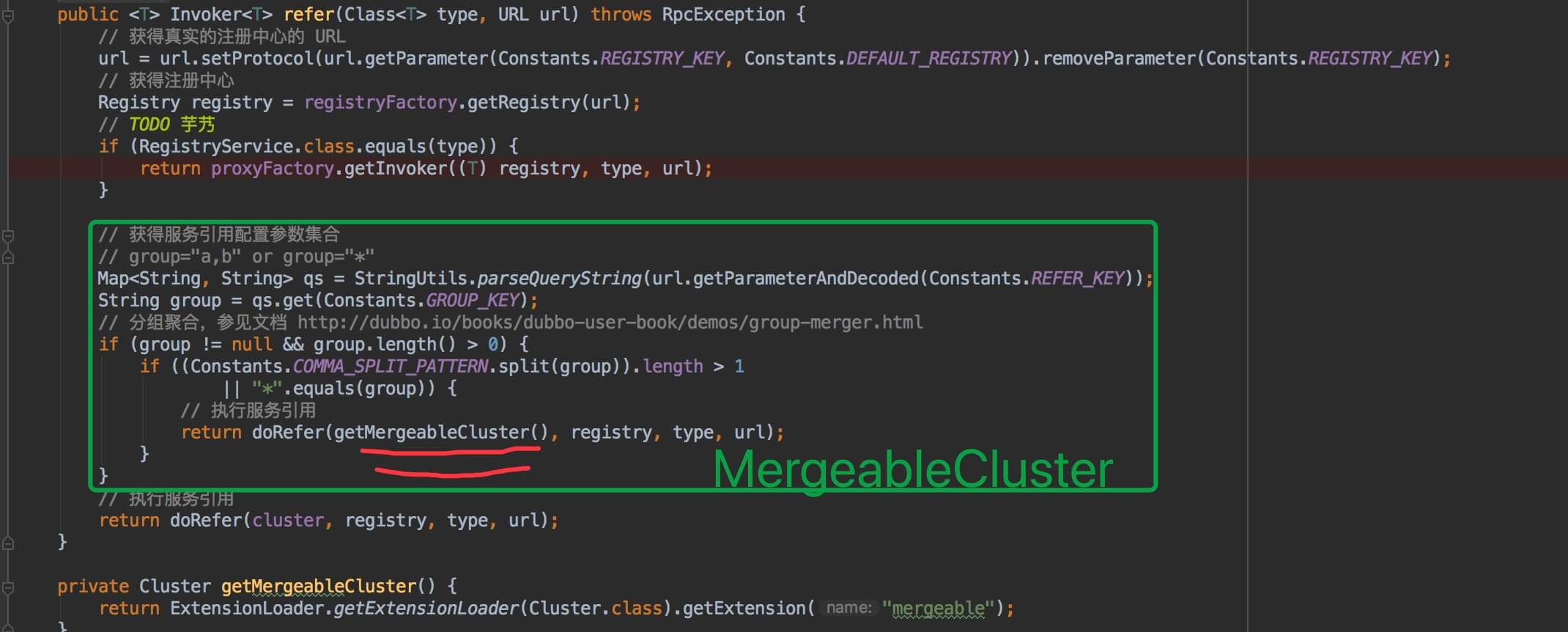
那么,引用多个服务分组有什么用呢?为什么要按照 group 进行聚合,直接调用不可以么?让我们来打开 ProtocolRegistry#refer(Class type, URL url) 方法,如下图所示:
refer
- 当引用多个服务分组时,会自动分组聚合 使用到 的特性。那么之后 MergeableCluster 会怎么做呢?详细解析,见后文 。
4.3.3.4 destroyUnusedInvokers
#destroyUnusedInvokers(oldUrlInvokerMap, newUrlInvokerMap) 方法,销毁不再使用的 Invoker 集合。代码如下:
```plain text plain private void destroyUnusedInvokers(Map<String, Invoker
1
2
3
4
5
6
7
8
9

---

### 4.3.3.5 destroyAllInvokers

#destroyAllInvokers() 方法,销毁所有服务提供者 Invoker 。代码如下:

```plain text
plain private void destroyAllInvokers() {     Map<String, Invoker<T>> localUrlInvokerMap = this.urlInvokerMap; // local reference 本地引用,避免并发问题     if (localUrlInvokerMap != null) {         // 循环 urlInvokerMap ,销毁所有服务提供者 Invoker         for (Invoker<T> invoker : new ArrayList<Invoker<T>>(localUrlInvokerMap.values())) {             try {                 invoker.destroy();             } catch (Throwable t) {                 logger.warn("Failed to destroy service " + serviceKey + " to provider " + invoker.getUrl(), t);             }         }         // urlInvokerMap 清空         localUrlInvokerMap.clear();     }     // methodInvokerMap 置空     methodInvokerMap = null; }
4.4 doList
#doList(Invocation)实现方法,获得对应的 Invoker 集合。代码如下:
```plain text plain 1: @Override 2: public List<Invoker
1
2
3
4
5
6
7
8
9
10
11

---

- 通过四种方式,从
methodInvokerMap
中,获得对应的 Invoker 集合。
- 第一种,可根据**第一个参数**
枚举路由。这是个非常小众的场景,胖友不必理解。例子如下:

```plain text
plain // DemoService 接口定义 public interface DemoService {     void hello(String name);      void hello01(String name);      void hello02(String name); }  // 消费者调用 DemoService demoService = (DemoService) context.getBean("demoService"); demoService.hello("01");
```plain text
- 通过这样的方式,调用到的服务提供者的 DemoServiceImpl#hello01(name) 方法。
- 如果使用该
特性,注意避免出现无关的几个方法,例如 #hello(name) 和 #hello01(name) 是毫无关系的两个方法,而我真的想调用 #hello(name) 方法,结果调用到了 #hello01(name) 方法。
- 如下是 Dubbo Commiter
诣极 的解惑,非常感谢。动态的方法名本身就是接口中已经定义的举个例子吧借口定义了 method, method1,method2, 如果我发起rpc调用method(1, 2, 3), 这个时候会去查找方法method1的invokers, 如果我这个时候发起rpc method(2, 1, 3), 这个时候会去查找方法method2的invokers, 然后调用invokers的method方法
- 另外,经过沟通,【第 19 行】的 "." 是个 BUG ,方法里不能包含该字符,因此,笔者改成了【第 20 行】,去掉了 "." 进行测试。
```
- 另外,经过沟通,【第 19 行】的 "." 是个 BUG ,方法里不能包含该字符,因此,笔者改成了【第 20 行】,去掉了 "." 进行测试。
- 第二种,根据方法名 获得 Invoker 集合。一般情况下,都能匹配到。
- 第三种,使用全量 Invoker 集合。例如, #$echo(name) 回声方法。
- 第四种,使用 methodInvokerMap 第一个 Invoker 集合。防御性编程。
4.5 isAvailable
```plain text plain @Override public boolean isAvailable() { // 若已销毁,返回不可用 if (isDestroyed()) { return false; } // 任意一个 Invoker 可用,则返回可用 Map<String, Invoker
1
2
3
4
5
6
7

---

## 4.6 destroy

```plain text
plain @Override public void destroy() {     if (isDestroyed()) {         return;     }     // 取消订阅     // unsubscribe.     try {         if (getConsumerUrl() != null && registry != null && registry.isAvailable()) {             registry.unsubscribe(getConsumerUrl(), this);         }     } catch (Throwable t) {         logger.warn("unexpeced error when unsubscribe service " + serviceKey + "from registry" + registry.getUrl(), t);     }     // 标记已经销毁     super.destroy(); // must be executed after unsubscribing     // 销毁所有 Invoker      try {         destroyAllInvokers();     } catch (Throwable t) {         logger.warn("Failed to destroy service " + serviceKey, t);     } }
5. StaticDirectory
com.alibaba.dubbo.rpc.cluster.directory.StaticDirectory ,实现 AbstractDirectory 抽象类,静态 Directory 实现类。逻辑比较简单,将传入的 invokers 集合,封装成静态的 Directory 对象。代码如下:
```plain text plain public class StaticDirectory
1
2
3
4
5
6
7
8
9
10
11
12
13
14
15
16
17
18
19
20
21
22
23
24
25
26
27
28
29
30
31
32
33
34
---
- 代码比较易懂,胖友自己看下。
---
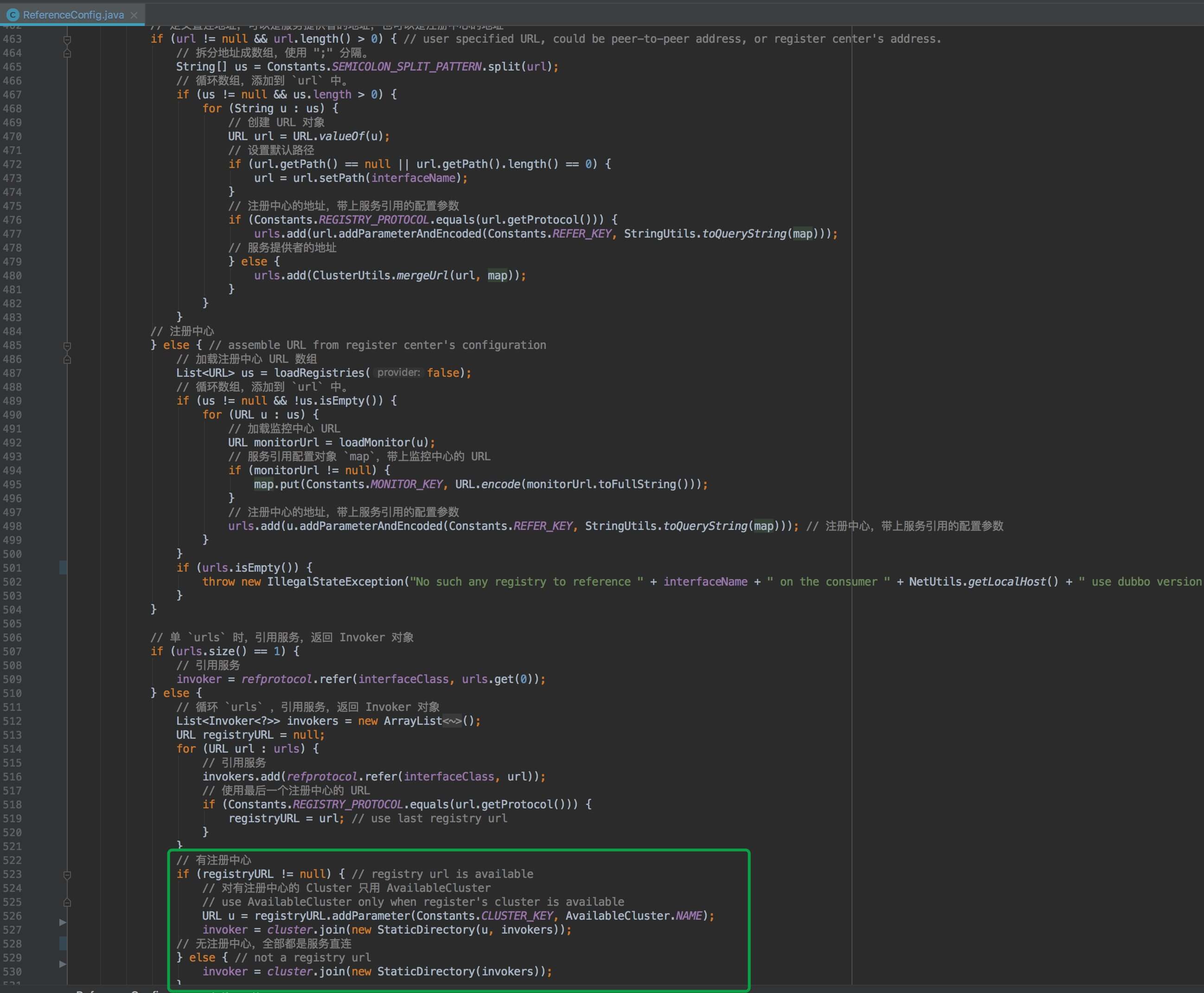
除了在 [「4.3.3.3 toMergeMethodInvokerMap」](http://svip.iocoder.cn/Dubbo/cluster-3-impl-directory/#) 方法中,使用到了 StaticDirectory 对象。我们来看看 ReferenceConfig#createProxy(Map<String, String> map) 的使用,代码如下图:
createProxy
- 第 522 至 527 行:当 **有注册中心仅调用第一个可用的 Invoker 对象**
registryURL
非空时,意味着
,使用
cluster=available
集群方式,并调用
Cluster$Adaptive#join(StaticDirectory)
方法,创建对应的 Cluster Invoker 对象。这意味着,服务调用时,因为使用的是
cluster=available
,
。下面,我们来做一个 YY :
- 目前我们有 A , B 两个机房,分别对应 zk01 集群,zk02 集群。这两个 zk 集群**不互通**
。
- A , B 机房,分别部署了 **User 服务提供者**
,仅注册到自己机房的 zk 集群。
- A , B 机房,部署了对应的 **User 服务消费User 服务提供者**
,那么如果我们希望优先调用本机房。当本机房
全挂的情况下,使用另外一个机房,该如何配置呢?
```plain text
plain // A 机房 <dubbo:reference interface="com.alibaba.dubbo.demo.UserService" registry="zk01,zk02" /> // B 机房 <dubbo:reference interface="com.alibaba.dubbo.demo.UserService" registry="zk02,zk01" />
```plain text * 即在 "registry" 配置项中,将自己的 zk 集群放在前面。 * 当然,大多数情况下,很少会出现一个机房服务提供者全挂,zk 集群还存活着。
1
2
3
4
5
6
7

# 6. ClusterUtils

com.alibaba.dubbo.rpc.cluster.support.ClusterUtils ,Cluster 工具类。代码如下:

```plain text
plain 1: public class ClusterUtils {  2:  3:     private ClusterUtils() {  4:     }  5:  6:     public static URL mergeUrl(URL remoteUrl, Map<String, String> localMap) {  7:         // 合并配置 Map 结果  8:         Map<String, String> map = new HashMap<String, String>();  9:         // 远程配置 Map 结果 10:         Map<String, String> remoteMap = remoteUrl.getParameters(); 11: 12:         // 添加 `remoteMap` 到 `map` 中,并移除不必要的配置 13:         if (remoteMap != null && remoteMap.size() > 0) { 14:             map.putAll(remoteMap); 15: 16:             // Remove configurations from provider, some items should be affected by provider. 线程池配置不使用提供者的 17:             map.remove(Constants.THREAD_NAME_KEY); 18:             map.remove(Constants.DEFAULT_KEY_PREFIX + Constants.THREAD_NAME_KEY); 19: 20:             map.remove(Constants.THREADPOOL_KEY); 21:             map.remove(Constants.DEFAULT_KEY_PREFIX + Constants.THREADPOOL_KEY); 22: 23:             map.remove(Constants.CORE_THREADS_KEY); 24:             map.remove(Constants.DEFAULT_KEY_PREFIX + Constants.CORE_THREADS_KEY); 25: 26:             map.remove(Constants.THREADS_KEY); 27:             map.remove(Constants.DEFAULT_KEY_PREFIX + Constants.THREADS_KEY); 28: 29:             map.remove(Constants.QUEUES_KEY); 30:             map.remove(Constants.DEFAULT_KEY_PREFIX + Constants.QUEUES_KEY); 31: 32:             map.remove(Constants.ALIVE_KEY); 33:             map.remove(Constants.DEFAULT_KEY_PREFIX + Constants.ALIVE_KEY); 34: 35:             map.remove(Constants.TRANSPORTER_KEY); 36:             map.remove(Constants.DEFAULT_KEY_PREFIX + Constants.TRANSPORTER_KEY); 37:         } 38:         // 添加 `localMap` 到 `map` 中 39:         if (localMap != null && localMap.size() > 0) { 40:             map.putAll(localMap); 41:         } 42: 43:         // 添加指定的 `remoteMap` 的配置项到 `map` 中,因为上面被 `localMap` 覆盖了。 44:         if (remoteMap != null && remoteMap.size() > 0) { 45:             // Use version passed from provider side 46:             String dubbo = remoteMap.get(Constants.DUBBO_VERSION_KEY); 47:             if (dubbo != null && dubbo.length() > 0) { 48:                 map.put(Constants.DUBBO_VERSION_KEY, dubbo); 49:             } 50:             String version = remoteMap.get(Constants.VERSION_KEY); 51:             if (version != null && version.length() > 0) { 52:                 map.put(Constants.VERSION_KEY, version); 53:             } 54:             String group = remoteMap.get(Constants.GROUP_KEY); 55:             if (group != null && group.length() > 0) { 56:                 map.put(Constants.GROUP_KEY, group); 57:             } 58:             String methods = remoteMap.get(Constants.METHODS_KEY); 59:             if (methods != null && methods.length() > 0) { 60:                 map.put(Constants.METHODS_KEY, methods); 61:             } 62:             // Reserve timestamp of provider url. 保留 provider 的启动 timestamp 63:             String remoteTimestamp = remoteMap.get(Constants.TIMESTAMP_KEY); 64:             if (remoteTimestamp != null && remoteTimestamp.length() > 0) { 65:                 map.put(Constants.REMOTE_TIMESTAMP_KEY, remoteMap.get(Constants.TIMESTAMP_KEY)); 66:             } 67:             // Combine filters and listeners on Provider and Consumer 合并 filter 和 listener 68:             String remoteFilter = remoteMap.get(Constants.REFERENCE_FILTER_KEY); 69:             String localFilter = localMap.get(Constants.REFERENCE_FILTER_KEY); 70:             if (remoteFilter != null && remoteFilter.length() > 0 71:                     && localFilter != null && localFilter.length() > 0) { 72:                 localMap.put(Constants.REFERENCE_FILTER_KEY, remoteFilter + "," + localFilter); 73:             } 74:             String remoteListener = remoteMap.get(Constants.INVOKER_LISTENER_KEY); 75:             String localListener = localMap.get(Constants.INVOKER_LISTENER_KEY); 76:             if (remoteListener != null && remoteListener.length() > 0 77:                     && localListener != null && localListener.length() > 0) { 78:                 localMap.put(Constants.INVOKER_LISTENER_KEY, remoteListener + "," + localListener); 79:             } 80:         } 81: 82:         // 清空原有配置,使用合并的配置覆盖 83:         return remoteUrl.clearParameters().addParameters(map); 84:     } 85: 86: }
- 将 合并前者指定 localMap 和 remoteUrl.parameters 成 map ,大多数以 为主【第 12 至 41 行】,部分 以后者为主【第 43 至 80 行】。
- 将合并的 覆盖 map 的结果, 设置到 remoteUrl 中。
666. 彩蛋
比想象中,长好多的一篇博客,原本预期会短蛮多的。
顺便吐槽下,中间碰到一些困惑,网络上搜了一圈,都没解释到很多细节的点的源码解析文章,真的是。哎~~~