序列化(三)之Kryo实现
本文基于 Dubbo 2.6.1 版本,望知悉。
1. 概述
本文分享基于 Kryo 的序列化拓展实现。
Java对象序列化框架 Kryo
Kryo 是一个快速高效的Java对象图形序列化框架,主要特点是性能、高效和易用。该项目用来序列化对象到文件、数据库或者网络。
示例代码:
1
2
3
4
5
6
7
8
9
10
Kryo kryo = new Kryo();
// ...
Output output = new Output(new FileOutputStream("file.bin"));
SomeClass someObject = ...
kryo.writeObject(output, someObject);
output.close();
// ...
Input input = new Input(new FileInputStream("file.bin"));
SomeClass someObject = kryo.readObject(input, SomeClass.class);
input.close();
本文涉及,类图如下:
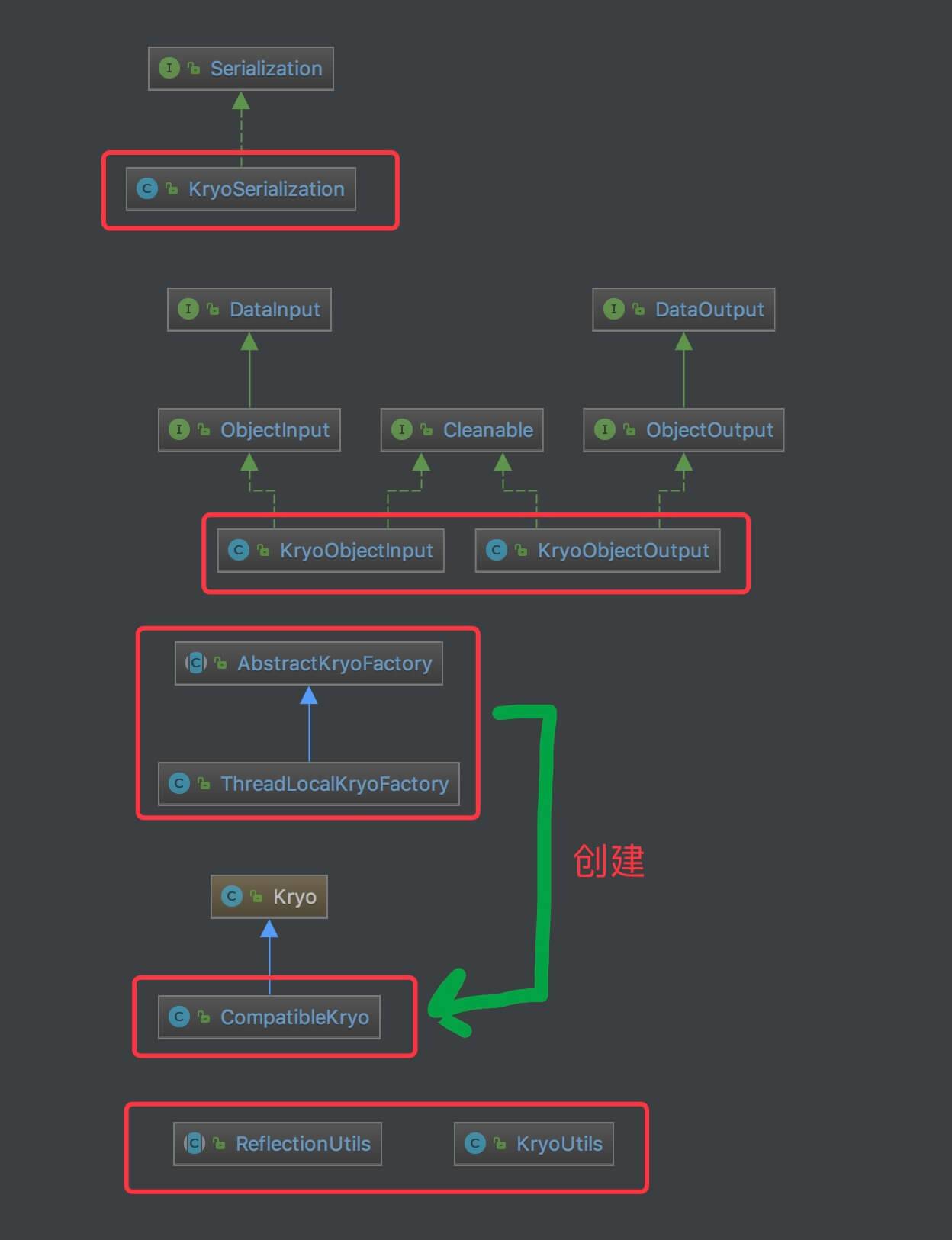
2. KryoSerialization
com.alibaba.dubbo.common.serialize.support.kryo.KryoSerialization ,实现 Serialization 接口,Kryo 序列化实现类。代码如下:
1
2
3
4
5
6
7
8
9
10
11
12
13
14
15
16
17
18
19
20
21
22
23
public class KryoSerialization implements Serialization {

    @Override
    public byte getContentTypeId() {
        return 8;
    }

    @Override
    public String getContentType() {
        return "x-application/kryo";
    }

    @Override
    public ObjectOutput serialize(URL url, OutputStream out) throws IOException {
        return new KryoObjectOutput(out);
    }

    @Override
    public ObjectInput deserialize(URL url, InputStream is) throws IOException {
        return new KryoObjectInput(is);
    }

}
3. KryoObjectInput
com.alibaba.dubbo.common.serialize.support.kryo.KryoObjectInput ,实现 ObjectInput, Cleanable 接口,Kryo 对象输入实现类。
构造方法
1
2
3
4
5
6
7
8
9
10
11
12
13
/**
 * Kryo 对象
 */
private Kryo kryo;
/**
 * Kryo 输入
 */
private Input input;

public KryoObjectInput(InputStream inputStream) {
    input = new Input(inputStream);
    this.kryo = KryoUtils.get();
}
- kryo属性,通过KryoUtils#get()方法,获取。
ObjectInput 实现方法
① 来自 DataInput 的实现方法,调用 input 对应的方法。例如:
1
2
3
4
5
6
7
8
@Override
public boolean readBool() throws IOException {
    try {
        return input.readBoolean();
    } catch (KryoException e) {
        throw new IOException(e);
    }
}
② 来自 ObjectInput 的实现方法,调用 kryo 对应的方法。例如:
1
2
3
4
5
6
7
8
9
@Override
public Object readObject() throws IOException, ClassNotFoundException {
    // TODO optimization
    try {
        return kryo.readClassAndObject(input);
    } catch (KryoException e) {
        throw new IOException(e);
    }
}
- 通过读取类大体《深入理解RPC之序列化篇 – Kryo》「三种读写方式」,在根据类解析具体对象,字节内容”是 [ Class, 对象二进制数据 ] 。在对这块解析的相当不错。
Cleanable 实现方法
1
2
3
4
5
6
7
@Override
public void cleanup() {
    // 释放 Kryo 对象
    KryoUtils.release(kryo);
    // 清空
    kryo = null;
}
4. KryoObjectOutput
com.alibaba.dubbo.common.serialize.support.kryo.KryoObjectOutput ,实现 ObjectOutput, Cleanable 接口,Kryo 对象输出实现类。
构造方法
1
2
3
4
5
6
7
8
9
10
11
12
13
/**
 * Kryo 对象
 */
private Kryo kryo;
/**
 * Kryo 输出
 */
private Output output;

public KryoObjectOutput(OutputStream outputStream) {
    output = new Output(outputStream);
    this.kryo = KryoUtils.get();
}
- kryo属性,通过KryoUtils#get()方法,获取。
ObjectOutput 实现方法
① 来自 DataOutput 的实现方法,调用 input 对应的方法。例如:
1
2
3
4
@Override
public void writeBool(boolean v) throws IOException {
    output.writeBoolean(v);
}
② 来自 ObjectOutput 的实现方法,调用 kryo 对应的方法。例如:
1
2
3
4
5
@Override
public void writeObject(Object v) throws IOException {
    // TODO carries class info every time.
    kryo.writeClassAndObject(output, v);
}
- 通过写入类大体《深入理解RPC之序列化篇 – Kryo》「三种读写方式」+ 具体对象,字节内容”是 [ Class, 对象二进制数据 ] 。在对这块解析的相当不错。
Cleanable 实现方法
1
2
3
4
5
6
7
@Override
public void cleanup() {
    // 释放 Kryo 对象
    KryoUtils.release(kryo);
    // 清空
    kryo = null;
}
5. CompatibleKryo
com.alibaba.dubbo.common.serialize.support.kryo.CompatibleKryo ,实现 Kryo 类,兼容空构造方法的 Kryo 实现类。代码如下:
1
2
3
4
5
6
7
8
9
10
11
12
13
14
15
@Override
public Serializer getDefaultSerializer(Class type) {
    if (type == null) {
        throw new IllegalArgumentException("type cannot be null.");
    }
    // 空构造方法时,使用 JavaSerializer ,Java 原生序列化实现
    if (!type.isArray() && !type.isEnum() && !ReflectionUtils.checkZeroArgConstructor(type)) {
        if (logger.isWarnEnabled()) {
            logger.warn(type + " has no zero-arg constructor and this will affect the serialization performance");
        }
        return new JavaSerializer();
    }
    // 使用 Kryo 默认序列化实现
    return super.getDefaultSerializer(type);
}
- 第 6 至 12 行:Kryo 不支持不包含空构造方法Java 原生序列化的类的序列化,因此,此时使用 Kryo 封装实现类com.esotericsoftware.kryo.serializers.JavaSerializer。
- ReflectionUtils#checkZeroArgConstructor(type)方法,代码如下:
1
2
3
4
5
6
7
8
9
10
11
12
13
14
/**
 * 判断类是否有空构造方法
 *
 * @param clazz 类
 * @return 是否
 */
public static boolean checkZeroArgConstructor(Class clazz) {
    try {
        clazz.getDeclaredConstructor();
        return true;
    } catch (NoSuchMethodException e) {
        return false;
    }
}
- 第 14 行:使用 Kryo 默认序列化实现。
6. KryoFactory
6.1 AbstractKryoFactory
com.alibaba.dubbo.common.serialize.support.kryo.utils.AbstractKryoFactory ,实现 com.esotericsoftware.kryo.pool.KryoFactory 接口,Kryo 工厂抽象类。
构造方法
1
2
3
4
5
6
7
8
9
10
11
12
13
/**
 * 需要注册的类的集合
 */
private final Set<Class> registrations = new LinkedHashSet<Class>();

/**
 * 是否开启注册行为
 */
private boolean registrationRequired;
/**
 * Kryo 是否已经创建
 */
private volatile boolean kryoCreated;
- registrations静态注册属性,需要的类的集合。通过#registerClass(Class)方法,可以添加,代码如下:
1
2
3
4
5
6
7
8
9
10
11
/**
 * only supposed to be called at startup time
 *
 * later may consider adding support for custom serializer, custom id, etc
 */
public void registerClass(Class clazz) {
    if (kryoCreated) {
        throw new IllegalStateException("Can't register class after creating kryo instance");
    }
    registrations.add(clazz);
}
- registrationRequired注册关闭一般关闭注册行为属性,是否开启行为,默认。Kryo 支持对注册行为,如kryo.register(SomeClazz.class);,这会赋予该 Class 一个从 0 开始的编号,但 Kryo 使用注册行为最大的问题在于,其不保证同一个 Class 每一次注册的号码相同,这与注册的顺序有关,也就意味着在不同的机器、同一个机器重启前后都有可能拥有不同的编号,这会导致序列化产生问题,所以在分布式项目中,。
- kryoCreated属性,Kryo 是否已经创建。
抽象方法
1
2
3
4
5
6
7
8
9
10
11
12
13
/**
 * 返还 Kryo 对象
 *
 * @param kryo Kyro
 */
public abstract void returnKryo(Kryo kryo);

/**
 * 获得 Kryo 对象
 *
 * @return Kryo 对象
 */
public abstract Kryo getKryo();
create
1
2
3
4
5
6
7
8
9
10
11
12
13
14
15
16
17
18
19
20
21
22
23
24
25
26
27
28
29
30
31
32
33
34
35
36
37
38
39
40
41
42
43
44
45
46
47
48
49
50
51
52
53
54
55
56
57
58
59
60
61
62
63
64
65
66
@Override
public Kryo create() {
    // 标记已创建
    if (!kryoCreated) {
        kryoCreated = true;
    }

    // 创建 CompatibleKryo 对象
    Kryo kryo = new CompatibleKryo();

    // TODO
//    kryo.setReferences(false);
    kryo.setRegistrationRequired(registrationRequired);

    // 注册常用类
    kryo.register(Collections.singletonList("").getClass(), new ArraysAsListSerializer());
    kryo.register(GregorianCalendar.class, new GregorianCalendarSerializer());
    kryo.register(InvocationHandler.class, new JdkProxySerializer());
    kryo.register(BigDecimal.class, new DefaultSerializers.BigDecimalSerializer());
    kryo.register(BigInteger.class, new DefaultSerializers.BigIntegerSerializer());
    kryo.register(Pattern.class, new RegexSerializer());
    kryo.register(BitSet.class, new BitSetSerializer());
    kryo.register(URI.class, new URISerializer());
    kryo.register(UUID.class, new UUIDSerializer());
    UnmodifiableCollectionsSerializer.registerSerializers(kryo);
    SynchronizedCollectionsSerializer.registerSerializers(kryo);

    // 注册常用数据结构
    // now just added some very common classes
    // TODO optimization
    kryo.register(HashMap.class);
    kryo.register(ArrayList.class);
    kryo.register(LinkedList.class);
    kryo.register(HashSet.class);
    kryo.register(TreeSet.class);
    kryo.register(Hashtable.class);
    kryo.register(Date.class);
    kryo.register(Calendar.class);
    kryo.register(ConcurrentHashMap.class);
    kryo.register(SimpleDateFormat.class);
    kryo.register(GregorianCalendar.class);
    kryo.register(Vector.class);
    kryo.register(BitSet.class);
    kryo.register(StringBuffer.class);
    kryo.register(StringBuilder.class);
    kryo.register(Object.class);
    kryo.register(Object[].class);
    kryo.register(String[].class);
    kryo.register(byte[].class);
    kryo.register(char[].class);
    kryo.register(int[].class);
    kryo.register(float[].class);
    kryo.register(double[].class);

    // `registrations` 的注册
    for (Class clazz : registrations) {
        kryo.register(clazz);
    }

    // SerializableClassRegistry 的注册
    for (Class clazz : SerializableClassRegistry.getRegisteredClasses()) {
        kryo.register(clazz);
    }

    return kryo;
}
- 第 3 至 6 行:标记已创建 kryoCreated = true。
- 第 9 行:创建 CompatibleKryo 对象。
- 第 13 行:调用 Kryo#setRegistrationRequired(registrationRequired) 方法,设置是否要开启注册的功能。
- 开始一顿注册。
- 第 15 至 26 行:注册常用类到 Kryo 对象。
- 第 28 至 53 行:注册常用数据结构到 Kryo 对象。
- 第 55 至 58 行:注册 registrations 到 Kryo 对象。
- 第 60 至 63 行:注册 SerializableClassRegistry 到 Kryo 对象。
6.2 ThreadLocalKryoFactory
com.alibaba.dubbo.common.serialize.support.kryo.utils.ThreadLocalKryoFactory ,实现 AbstractKryoFactory 抽象类,基于 ThreadLocal 的 Kryo 工厂实现类。代码如下:
1
2
3
4
5
6
7
8
9
10
11
12
13
14
15
16
17
18
19
20
21
22
public class ThreadLocalKryoFactory extends AbstractKryoFactory {

    private final ThreadLocal<Kryo> holder = new ThreadLocal<Kryo>() {

        @Override
        protected Kryo initialValue() {
            return create(); // 创建 Kryo
        }

    };

    @Override
    public void returnKryo(Kryo kryo) {
        // do nothing
    }

    @Override
    public Kryo getKryo() {
        return holder.get();
    }

}
- Kryo 的序列化和反序列的过程,是非线程安全的。所以通过 ThreadLocal 来保证,每个线程拥有一个 Kryo 对象。
6.3 KryoUtils
com.alibaba.dubbo.common.serialize.support.kryo.utils.KryoUtils ,Kryo 工具类,目前仅仅对 KryoFactory 进行操作。代码如下:
1
2
3
4
5
6
7
8
9
10
11
12
13
14
15
16
17
18
19
20
21
public class KryoUtils {

    private static AbstractKryoFactory kryoFactory = new ThreadLocalKryoFactory();

    public static Kryo get() {
        return kryoFactory.getKryo();
    }

    public static void release(Kryo kryo) {
        kryoFactory.returnKryo(kryo);
    }

    public static void register(Class<?> clazz) {
        kryoFactory.registerClass(clazz);
    }

    public static void setRegistrationRequired(boolean registrationRequired) {
        kryoFactory.setRegistrationRequired(registrationRequired);
    }

}
666. 彩蛋
推荐阅读: