动态代理(一)之Javassist
本文基于 Dubbo 2.6.1 版本,望知悉。
1. 概述
本文分享 Dubbo 动态代理的实现。
在 《Dubbo 用户指南 —— schema 配置参考手册》 中,我们可以看到 <dubbo:service> 和 <dubbo:reference> 标签中,可以通过 “proxy” 属性,可以配置动态代理的生成方式:
生成动态代理方式,可选:jdk / javassist
从说明中,我们可以看到,Dubbo 实现了两种方式生成代理:
- Javassist
- JDK
本文分享 Javassist 实现动态代理的源码;涉及代码如下:
- dubbo-common 模块的 bytecode 包。
- dubbo-rpc-api 模块的 proxy 包。
下一篇文章分享 JDK 实现动态代理的源码。
2. 性能
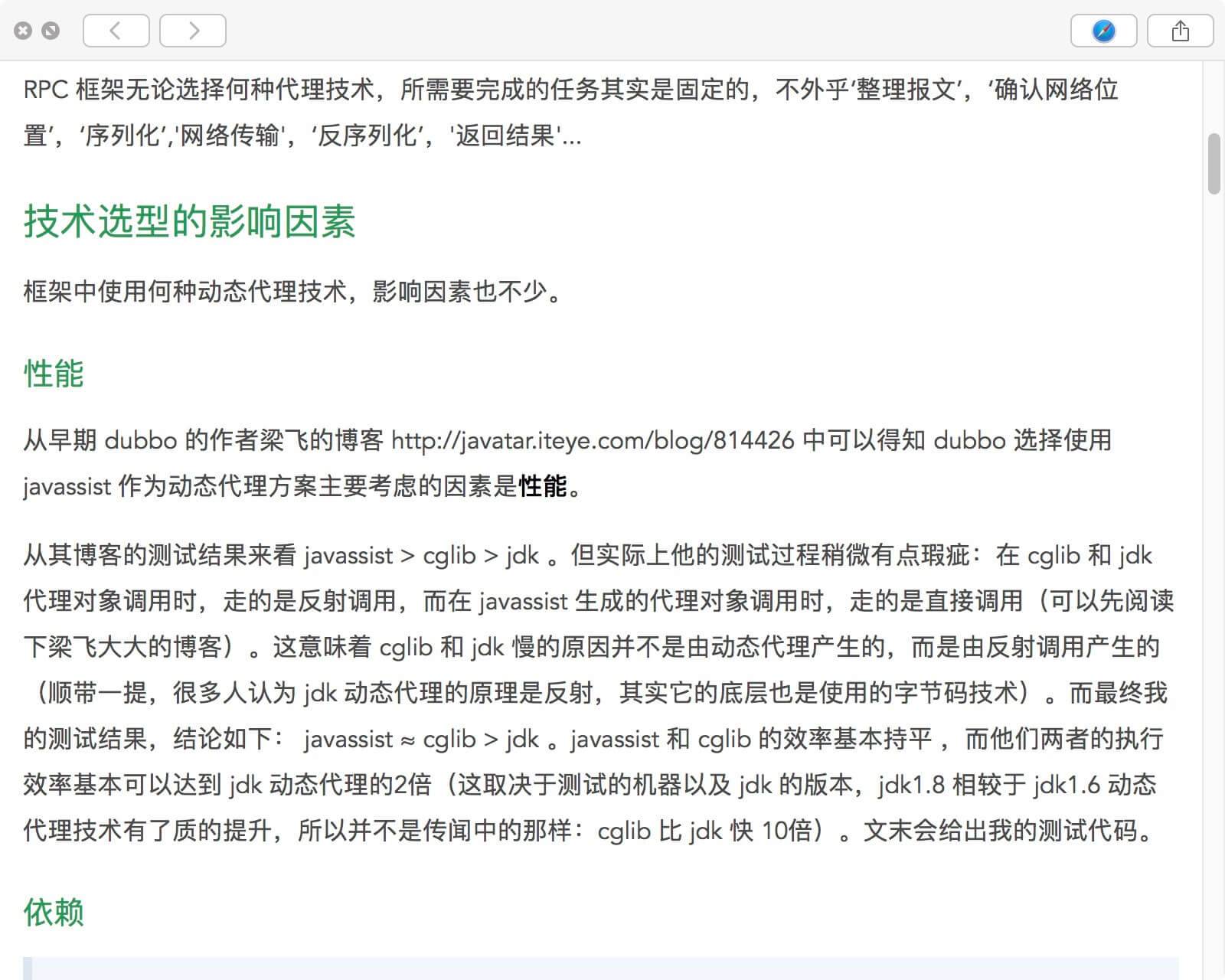
在分享具体实现之前,可能有胖友对性能方面感兴趣,可以看看如下的内容:
- 《动态代理方案性能对比》
- 来自老徐的某篇文章
菜逼老徐
3. 整体流程
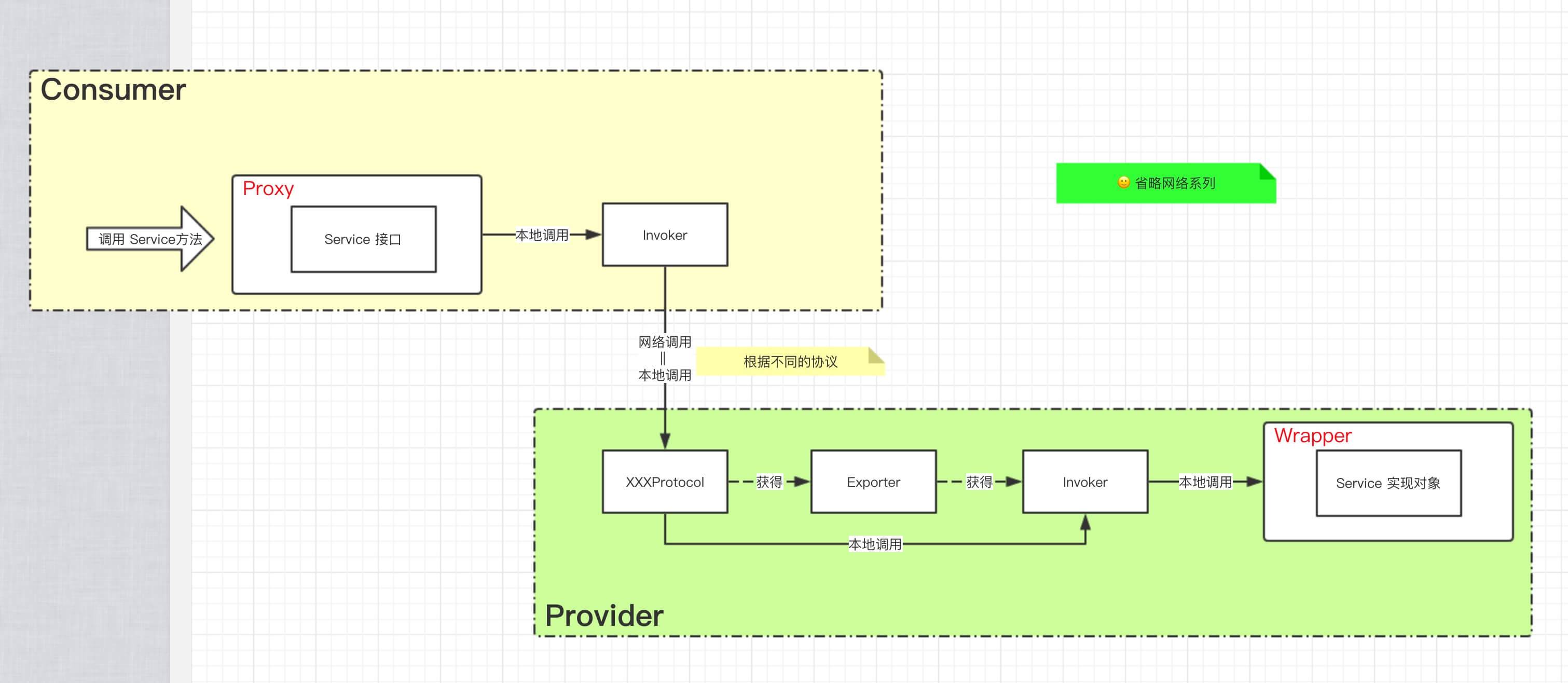
瞎比比了这么多,我们开始进入正题了。相信很多胖友对动态代理的概念已经理解(如果暂时不理解,请 Google 下),那么 Dubbo 对它们使用在哪呢?见下图:
菜逼老王
旁白君:本图暂不考虑集群容错、网络调用、序列化反序列等。
- 在 Dubbo 中,我们使用 Service 接口,作为服务 API 的契约。
- 在 Consumer 中,我们调用 Service 接口的方法时,实际调用的是 Dubbo 动态代理。下面先一起来看一个生成的 proxy 代码的示例:
1
2
3
4
5
6
7
8
9
10
11
12
13
14
15
16
17
18
19
20
21
22
23
24
25
26
27
28
29
30
31
32
33
34
35
36
37
38
39
40
41
42
43
package com.alibaba.dubbo.common.bytecode;

import com.alibaba.dubbo.demo.DemoService;
import com.alibaba.dubbo.rpc.service.EchoService;
import java.lang.reflect.InvocationHandler;
import java.lang.reflect.Method;

public class proxy0
  implements ClassGenerator.DC, EchoService, DemoService
{
  public static Method[] methods;
  private InvocationHandler handler;

  public void bye(Object paramObject)
  {
    Object[] arrayOfObject = new Object[1];
    arrayOfObject[0] = paramObject;
    Object localObject = this.handler.invoke(this, methods[0], arrayOfObject);
  }

  public String sayHello(String paramString)
  {
    Object[] arrayOfObject = new Object[1];
    arrayOfObject[0] = paramString;
    Object localObject = this.handler.invoke(this, methods[1], arrayOfObject);
    return (String)localObject;
  }

  public Object $echo(Object paramObject)
  {
    Object[] arrayOfObject = new Object[1];
    arrayOfObject[0] = paramObject;
    Object localObject = this.handler.invoke(this, methods[2], arrayOfObject);
    return (Object)localObject;
  }

  public proxy0() {}

  public proxy0(InvocationHandler paramInvocationHandler)
  {
    this.handler = paramInvocationHandler;
  }
}
- 该类通过 dubbo-common 模块的 bytecode 模块的 Proxy 类,自动生成,使用 Javassist 技术。
- 生成的 proxy 类会实现我们定义的 Service 接口( 例如,此处是 DemoService )。
#bye(Object)和#sayHello(Object)方法,是我们定义在 DemoService 的接口方法,在生成的 proxy 类中,实现这些定义在接口中的方法,收拢统一调用java.lang.reflect.InvocationHandler#invoke(proxy, method, args)方法。通过这样的方式,可以调用到最终的Invoker#invoke(Invocation)方法,实现 RPC 调用。注意,此处我们一直用的 proxy 一直是小写的,这是为什么呢?请见下文大写的 Proxy 类。
- 在 Provider 中,XXXProtocol 会获得被调用的 Exporter 对象,从而获得到 Invoker 对象。但是呢,Invoker 对象实际和 Service 实现对象,是无法直接调用,需要有中间的一层 Wrapper 来代理分发到 Service 对应的方法。下面我们来看一个生成的 Wrapper 代码的示例:
1
2
3
4
5
6
7
8
9
10
11
12
13
14
15
16
17
18
19
20
21
22
23
24
25
26
27
28
29
30
31
32
33
34
35
36
37
38
39
40
41
42
43
44
45
46
47
48
49
50
51
52
53
54
55
56
57
58
59
60
61
62
63
64
65
66
67
68
69
70
71
72
73
74
75
76
77
78
79
80
81
82
83
84
85
86
87
88
89
90
91
92
93
94
95
96
97
98
99
100
101
102
103
104
105
106
107
108
109
110
111
112
113
114
115
116
117
118
119
120
package com.alibaba.dubbo.common.bytecode;

import com.alibaba.dubbo.demo.provider.DemoDAO;
import com.alibaba.dubbo.demo.provider.DemoServiceImpl;
import java.lang.reflect.InvocationTargetException;
import java.util.Map;

public class Wrapper1
  extends Wrapper
  implements ClassGenerator.DC
{
  public static String[] pns;
  public static Map pts;
  public static String[] mns;
  public static String[] dmns;
  public static Class[] mts0;
  public static Class[] mts1;
  public static Class[] mts2;

  public String[] getPropertyNames()
  {
    return pns;
  }

  public boolean hasProperty(String paramString)
  {
    return pts.containsKey(paramString);
  }

  public Class getPropertyType(String paramString)
  {
    return (Class)pts.get(paramString);
  }

  public String[] getMethodNames()
  {
    return mns;
  }

  public String[] getDeclaredMethodNames()
  {
    return dmns;
  }

  public void setPropertyValue(Object paramObject1, String paramString, Object paramObject2)
  {
    DemoServiceImpl w;
    try
    {
      w = (DemoServiceImpl)paramObject1;
    }
    catch (Throwable localThrowable)
    {
      throw new IllegalArgumentException(localThrowable);
    }
    if (paramString.equals("test01"))
    {
      w.test01 = ((String)paramObject2);
      return;
    }
    if (paramString.equals("demoDAO"))
    {
      localDemoServiceImpl.setDemoDAO((DemoDAO)paramObject2);
      return;
    }
    throw new NoSuchPropertyException("Not found property \"" + paramString + "\" filed or setter method in class com.alibaba.dubbo.demo.provider.DemoServiceImpl.");
  }

  public Object getPropertyValue(Object paramObject, String paramString)
  {
    DemoServiceImpl w;
    try
    {
      w = (DemoServiceImpl)paramObject;
    }
    catch (Throwable localThrowable)
    {
      throw new IllegalArgumentException(localThrowable);
    }
    if (paramString.equals("test01")) {
      return localDemoServiceImpl.test01;
    }
    throw new NoSuchPropertyException("Not found property \"" + paramString + "\" filed or setter method in class com.alibaba.dubbo.demo.provider.DemoServiceImpl.");
  }

  public Object invokeMethod(Object paramObject, String paramString, Class[] paramArrayOfClass, Object[] paramArrayOfObject)
    throws InvocationTargetException
  {
    DemoServiceImpl w;
    try
    {
      w = (DemoServiceImpl)paramObject;
    }
    catch (Throwable localThrowable1)
    {
      throw new IllegalArgumentException(localThrowable1);
    }
    try
    {
      if ("sayHello".equals(paramString) && paramArrayOfClass.length == 1) {
        return w.sayHello((String)paramArrayOfObject[0]);
      }
      if ("bye".equals(paramString) && paramArrayOfClass.length == 1)
      {
        w.bye((Object)paramArrayOfObject[0]);
        return null;
      }
      if ("setDemoDAO".equals(paramString) && paramArrayOfClass.length == 1)
      {
        w.setDemoDAO((DemoDAO)paramArrayOfObject[0]);
        return null;
      }
    }
    catch (Throwable localThrowable2)
    {
      throw new InvocationTargetException(localThrowable2);
    }
    throw new NoSuchMethodException("Not found method \"" + paramString + "\" in class com.alibaba.dubbo.demo.provider.DemoServiceImpl.");
  }
}
- 该类通过 dubbo-common 模块的 bytecode 模块的 Wrapper 类,自动生成,使用 Javassist 技术。
- 不同于生成的 proxy类,不实现 Service 接口类,而是在
#invokeMethod(paramObject, paramString, paramArrayOfClass, paramArrayOfObject)方法,提供给Invoker#invoke(invocation)中调用,统一分发请求到 Service 对应的方法。从职能上来看,有一点像硬编码的 Controller。 - 一个生成的 Wrapper类,只对应一个 Service ,从第 75 行的代码,我们也可以看出。
4. ProxyFactory
com.alibaba.dubbo.rpc.ProxyFactory ,代理工厂接口。
在 《精尽 Dubbo 源码分析 —— 核心流程一览》 的 「4.5 ProxyFactory」,已经分享,胖友点击查看。
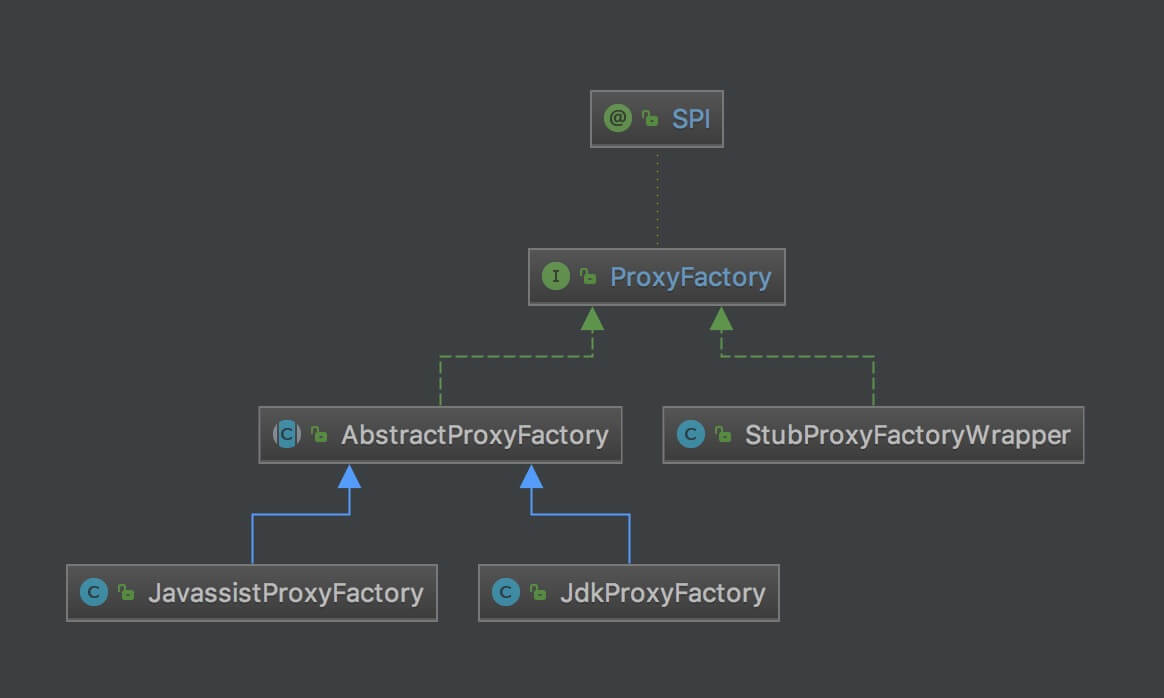
ProxyFactory 子类
4.1 AbstractProxyFactory
com.alibaba.dubbo.rpc.proxy.AbstractProxyFactory ,实现 ProxyFactory 接口,代理工厂抽象类。代码如下:
1
2
3
4
5
6
7
8
9
10
11
12
13
14
15
16
17
18
19
20
21
22
23
24
25
26
27
public abstract class AbstractProxyFactory implements ProxyFactory {

    public <T> T getProxy(Invoker<T> invoker) throws RpcException {
        Class<?>[] interfaces = null;
        // TODO 8022 芋艿
        String config = invoker.getUrl().getParameter("interfaces");
        if (config != null && config.length() > 0) {
            String[] types = Constants.COMMA_SPLIT_PATTERN.split(config);
            if (types != null && types.length > 0) {
                interfaces = new Class<?>[types.length + 2];
                interfaces[0] = invoker.getInterface();
                interfaces[1] = EchoService.class;
                for (int i = 0; i < types.length; i++) {
                    interfaces[i + 1] = ReflectUtils.forName(types[i]);
                }
            }
        }
        // 增加 EchoService 接口,用于回生测试。参见文档《回声测试》http://dubbo.apache.org/zh-cn/docs/user/demos/echo-service.html
        if (interfaces == null) {
            interfaces = new Class<?>[]{invoker.getInterface(), EchoService.class};
        }
        return getProxy(invoker, interfaces);
    }

    public abstract <T> T getProxy(Invoker<T> invoker, Class<?>[] types);

}
- 可以看到,该抽象类,主要是实现了
#getProxy(invoker)方法,获得需要生成代理的接口们。- 第 5 至 17 行:TODO 8022 芋艿
- 第 18 至 21 行:在原有 Invoker 对应关联的 Service 接口之上,增加 EchoService 接口。FROM 《Dubbo 用户指南 —— 回声测试》回声测试用于检测服务是否可用,回声测试按照正常请求流程执行,能够测试整个调用是否通畅,可用于监控。所有服务自动实现 EchoService 接口,只需将任意服务引用强制转型为 EchoService,即可使用。
- 第 22 行:调用 抽象
#getProxy(invoker, types)方法,获得 Proxy 对象。
4.2 StubProxyFactoryWrapper
com.alibaba.dubbo.rpc.proxy.wrapper.StubProxyFactoryWrapper ,实现 ProxyFactory 接口,Stub 代理工厂 Wrapper 实现类,基于 Dubbo SPI Wrapper 机制加载。
该类,不在本文的范畴内,感兴趣的胖友可以先看下 《Dubbo 用户指南 —— 本地存根》。后续,我们单独开文章分享。
4.3 JavassistProxyFactory
com.alibaba.dubbo.rpc.proxy.javassist.JavassistProxyFactory ,实现 AbstractProxyFactory 抽象类,基于 Javassist 代理工厂实现类。代码如下:
1
2
3
4
5
6
7
8
9
10
11
12
13
14
15
16
17
18
19
20
21
22
public class JavassistProxyFactory extends AbstractProxyFactory {

    @SuppressWarnings("unchecked")
    public <T> T getProxy(Invoker<T> invoker, Class<?>[] interfaces) {
        return (T) Proxy.getProxy(interfaces).newInstance(new InvokerInvocationHandler(invoker));
    }

    public <T> Invoker<T> getInvoker(T proxy, Class<T> type, URL url) {
        // TODO Wrapper cannot handle this scenario correctly: the classname contains '$'
        // TODO Wrapper类不能正确处理带$的类名
        final Wrapper wrapper = Wrapper.getWrapper(proxy.getClass().getName().indexOf('$') < 0 ? proxy.getClass() : type);
        return new AbstractProxyInvoker<T>(proxy, type, url) {
            @Override
            protected Object doInvoke(T proxy, String methodName,
                                      Class<?>[] parameterTypes,
                                      Object[] arguments) throws Throwable {
                return wrapper.invokeMethod(proxy, methodName, parameterTypes, arguments);
            }
        };
    }

}
#getProxy(invoker, interfaces)方法- 第 5 行:调用 Proxy
Proxy#getProxy(interface)方法,获得对象。 - 第 5 行:调用 proxy
Proxy#newInstance(InvocationHandler)方法,获得对象。其中传入的参数是 InvokerInvocationHandler 类,通过这样的方式,让 proxy 和真正的逻辑代码解耦。- Proxy 和 proxy ,在 「7.3 Proxy」中,详细解析。
- InvokerInvocationHandler ,在 「5. InvokerInvocationHandler」中,详细解析。
- 第 5 行:调用 Proxy
#getInvoker(proxy, type, url)方法- 第 11 行:调用 Wrapper
Wrapper#getWrapper(Class<?>)方法,获得对象。- Wrapper ,在 「7.4 Wrapper」中,详细解析。
- 第 12 至 19 行:创建 AbstractProxyInvoker 对象,实现
#doInvoke(…)方法。在该方法中,调用Wrapper#invokeMethod(…)方法,从而调用 Service 的方法。- AbstractProxyInvoker ,在 「6. AbstractProxyInvoker」中,详细解析。
- 第 11 行:调用 Wrapper
5. InvokerInvocationHandler
com.alibaba.dubbo.rpc.proxy.InvokerInvocationHandler ,实现 java.lang.reflect.InvocationHandler 接口,代码如下:
1
2
3
4
5
6
7
8
9
10
11
12
13
14
15
16
17
18
19
20
21
22
23
24
25
26
27
28
29
30
31
32
33
public class InvokerInvocationHandler implements InvocationHandler {

    /**
     * Invoker 对象
     */
    private final Invoker<?> invoker;

    public InvokerInvocationHandler(Invoker<?> handler) {
        this.invoker = handler;
    }

    @Override public Object invoke(Object proxy, Method method, Object[] args) throws Throwable {
        String methodName = method.getName();
        Class<?>[] parameterTypes = method.getParameterTypes();
        // wait 等方法,直接反射调用
        if (method.getDeclaringClass() == Object.class) {
            return method.invoke(invoker, args);
        }
        // 基础方法,不使用 RPC 调用
        if ("toString".equals(methodName) && parameterTypes.length == 0) {
            return invoker.toString();
        }
        if ("hashCode".equals(methodName) && parameterTypes.length == 0) {
            return invoker.hashCode();
        }
        if ("equals".equals(methodName) && parameterTypes.length == 1) {
            return invoker.equals(args[0]);
        }
        // RPC 调用
        return invoker.invoke(new RpcInvocation(method, args)).recreate();
    }

}
- invoker 属性,Invoker 对象,用于在
#invoke()方法调用。 #invoke(proxy, method, args)实现方法,核心逻辑是调用Invoker#invoke(invocation)方法,进行 RPC 调用。- 第 16 至 18 行:处理
#wait()#notify()等方法,进行反射调用。 - 第 20 至 28 行:处理
#toString()#hashCode()等方法,使用 Invoker 对象的方法,不进行 RPC 调用。 - 第 30 行:调用 核心逻辑
Invoker#invoke(invocation)方法,进行 RPC 调用。 - 第 30 行:调用
Result#recreate()方法,回放调用结果。代码如下:
- 第 16 至 18 行:处理
1
2
3
4
5
6
7
8
9
// RpcResult.java
public Object recreate() throws Throwable {
    // 有异常,抛出异常
    if (exception != null) {
        throw exception;
    }
    // 无异常,返回结果
    return result;
}
通过 InvokerInvocationHandler ,可以实现 Proxy 和真正的逻辑解耦。
6. AbstractProxyInvoker
com.alibaba.dubbo.rpc.proxy.AbstractProxyInvoker ,实现 Invaker 接口,代理 Invoker 对象的抽象类。
6.1 属性
1
2
3
4
5
6
7
8
9
10
11
12
13
14
15
16
17
18
19
20
21
22
23
24
25
26
27
/**
 * 代理的对象,一般是 Service 实现对象
 */
private final T proxy;
/**
 * 接口类型,一般是 Service 接口
 */
private final Class<T> type;
/**
 * URL 对象,一般是暴露服务的 URL 对象
 */
private final URL url;

public AbstractProxyInvoker(T proxy, Class<T> type, URL url) {
    if (proxy == null) {
        throw new IllegalArgumentException("proxy == null");
    }
    if (type == null) {
        throw new IllegalArgumentException("interface == null");
    }
    if (!type.isInstance(proxy)) {
        throw new IllegalArgumentException(proxy.getClass().getName() + " not implement interface " + type);
    }
    this.proxy = proxy;
    this.type = type;
    this.url = url;
}
胖友,请看代码上的注释。
6.2 invoke
1
2
3
4
5
6
7
8
9
public Result invoke(Invocation invocation) throws RpcException {
    try {
        return new RpcResult(doInvoke(proxy, invocation.getMethodName(), invocation.getParameterTypes(), invocation.getArguments()));
    } catch (InvocationTargetException e) {
        return new RpcResult(e.getTargetException());
    } catch (Throwable e) {
        throw new RpcException("Failed to invoke remote proxy method " + invocation.getMethodName() + " to " + getUrl() + ", cause: " + e.getMessage(), e);
    }
}
- 第 3 行:调用 抽象
#doInvoke(..)方法,执行调用,返回调用结果。#doInvoke(…)方法,代码如下:
1
2
3
4
5
6
7
8
9
10
11
/**
 * 执行调用
 *
 * @param proxy 代理的对象
 * @param methodName 方法名
 * @param parameterTypes 方法参数类型数组
 * @param arguments 方法参数数组
 * @return 调用结果
 * @throws Throwable 发生异常
 */
protected abstract Object doInvoke(T proxy, String methodName, Class<?>[] parameterTypes, Object[] arguments) throws Throwable;
- 第 3 行:创建 RpcResult 对象,将结果包装返回。
- 第 5 行:发生 InvocationTargetException 异常,创建 RpcResult 对象包装。
7. bytecode
在 dubbo-common 模块的 bytecode 包,基于 Javassist 库,动态编译,实现提供了通用的的动态代理实现。所以本小节,从动态编译的角度上来看,在内容上,和 《精尽 Dubbo 源码分析 —— 动态编译(一)之 Javassist》 有一定的相似。
7.1 ClassGenerator
com.alibaba.dubbo.common.bytecode.ClassGenerator ,类生成器,基于 Javassist 实现。
笔者在 《TCC-Transaction 源码分析 —— Dubbo 支持》 的 「2.1.3 TccProxy & TccClassGenerator」 已经详细分享,基本类似,胖友瞅瞅噢。
7.3 Proxy
com.alibaba.dubbo.common.bytecode.Proxy ,代理抽象类,用于创建 Proxy 和 proxy 对象。
笔者在 《TCC-Transaction 源码分析 —— Dubbo 支持》 的 「2.1.3 TccProxy & TccClassGenerator」 已经详细分享,基本类似,胖友瞅瞅噢。
如下是一个生成的 Proxy 代码的示例,代码如下:
1
2
3
4
5
6
7
public class Proxy0 extends Proxy implements ClassGenerator.DC {

    public Object newInstance(InvocationHandler paramInvocationHandler) {
        return new proxy0(paramInvocationHandler);
    }

}
- 生成的Proxy 实现 Proxy 抽象类,是创建生成的proxy的工厂(一一对应)。例如,Proxy0 创建 proxy0 对象。
#newInstance(InvocationHandler)方法,创建生成的proxy的方法。
7.4 Wrapper
com.alibaba.dubbo.common.bytecode.Wrapper ,Wrapper 抽象类,用于创建某个对象的方法调用的包装器,以避免反射调用,提高性能。即:
1
2
3
// 反射 Method#invoke(Object instance, Object[] args)
// 优化成===>
// Wrapper Wrapper#invokeMethod(Object instance, String mn, Class<?>[] types, Object[] args)
- 为什么会提高性能呢?看到上文的 Wrapper 代理的示例,相信胖友已经明白。
7.4.1 抽象方法
在自动生成 Wrapper 类时,需要实现如下抽象方法:
1
2
3
4
5
6
7
8
9
10
11
12
13
14
15
16
17
18
19
20
21
22
23
24
25
26
abstract public String[] getPropertyNames();
abstract public Class<?> getPropertyType(String pn);

abstract public boolean hasProperty(String name);
abstract public Object getPropertyValue(Object instance, String pn) throws NoSuchPropertyException, IllegalArgumentException;
abstract public void setPropertyValue(Object instance, String pn, Object pv) throws NoSuchPropertyException, IllegalArgumentException;

abstract public String[] getMethodNames();
abstract public String[] getDeclaredMethodNames();

/**
 * invoke method.
 *
 * 调用方法
 *
 * @param instance instance.
 *                 被调用的对象
 * @param mn       method name.
 *                 方法名
 * @param types 参数类型数组
 * @param args     argument array.
 *                 参数数组
 * @return return value.
 *                  返回值
 */
abstract public Object invokeMethod(Object instance, String mn, Class<?>[] types, Object[] args) throws NoSuchMethodException, InvocationTargetException;
7.4.2 getWrapper
#getWrapper(c) 方法,根据指定类,获得 Wrapper 对象。代码如下:
1
2
3
4
5
6
7
8
9
10
11
12
13
14
15
16
17
18
public static Wrapper getWrapper(Class<?> c) {
    // 判断是否继承 ClassGenerator.DC.class ,如果是,拿到父类,避免重复包装
    while (ClassGenerator.isDynamicClass(c)) // can not wrapper on dynamic class.
        c = c.getSuperclass();

    // 指定类为 Object.class
    if (c == Object.class)
        return OBJECT_WRAPPER;

    // 从缓存中获得 Wrapper 对象
    Wrapper ret = WRAPPER_MAP.get(c);
    // 创建 Wrapper 对象,并添加到缓存
    if (ret == null) {
        ret = makeWrapper(c);
        WRAPPER_MAP.put(c, ret);
    }
    return ret;
}
- 第 3 至 4 行:判断是否已经继承了 ClassGenerator.DC.class,如果是,拿到父类,避免重复包装。
- 第 7 至 8 行:若指定类为 Object.class ,返回 OBJECT_WRAPPER 对象。
- 第 11 行:从缓存 WRAPPER_MAP 中,获得 Wrapper 对象。WRAPPER_MAP 代码如下:
1
2
3
4
5
6
/**
 * Wrapper 对象缓存
 * key :Wrapper 类。
 * value :Proxy 对象
 */
private static final Map<Class<?>, Wrapper> WRAPPER_MAP = new ConcurrentHashMap<Class<?>, Wrapper>(); //class wrapper map
- 第 13 至 16 行:调用
#makeWrapper(Class<?>)方法,创建 Wrapper 对象,并添加到缓存。
7.4.3 makeWrapper
#makeWrapper(Class<?>) 方法,创建 Wrapper 对象。代码如下:
旁白君:实现上,和 Proxy 差不过的,只生成一个 Wrapper 类。
1
2
3
4
5
6
7
8
9
10
11
12
13
14
15
16
17
18
19
20
21
22
23
24
25
26
27
28
29
30
31
32
33
34
35
36
37
38
39
40
41
42
43
44
45
46
47
48
49
50
51
52
53
54
55
56
57
58
59
60
61
62
63
64
65
66
67
68
69
70
71
72
73
74
75
76
77
78
79
80
81
82
83
84
85
86
87
88
89
90
91
92
93
94
95
96
97
98
99
100
101
102
103
104
105
106
107
108
109
110
111
112
113
114
115
116
117
118
119
120
121
122
123
124
125
126
127
128
129
130
131
132
133
134
135
136
137
138
139
140
141
142
143
144
145
146
147
148
149
150
151
152
153
154
155
156
157
158
159
160
161
162
163
164
165
166
167
168
169
170
171
172
173
174
175
176
177
178
179
180
181
182
183
184
185
186
187
188
189
190
191
192
193
194
195
196
197
198
199
200
201
private static Wrapper makeWrapper(Class<?> c) {
    // 非私有类
    if (c.isPrimitive())
        throw new IllegalArgumentException("Can not create wrapper for primitive type: " + c);

    // 类名
    String name = c.getName();
    // 类加载器
    ClassLoader cl = ClassHelper.getClassLoader(c);

    // 设置属性方法 `#setPropertyValue(o, n, v)` 的开头的代码
    StringBuilder c1 = new StringBuilder("public void setPropertyValue(Object o, String n, Object v){ ");
    // 获得属性方法 `#getPropertyValue(o, n)` 的开头的代码
    StringBuilder c2 = new StringBuilder("public Object getPropertyValue(Object o, String n){ ");
    // 调用方法 `#invokeMethod(o, n, p, v)` 的开头的代码
    StringBuilder c3 = new StringBuilder("public Object invokeMethod(Object o, String n, Class[] p, Object[] v) throws " + InvocationTargetException.class.getName() + "{ ");

    // 添加每个方法的,被调用对象的类型转换的代码
    c1.append(name).append(" w; try{ w = ((").append(name).append(")$1); }catch(Throwable e){ throw new IllegalArgumentException(e); }");
    c2.append(name).append(" w; try{ w = ((").append(name).append(")$1); }catch(Throwable e){ throw new IllegalArgumentException(e); }");
    c3.append(name).append(" w; try{ w = ((").append(name).append(")$1); }catch(Throwable e){ throw new IllegalArgumentException(e); }");

    // 属性名与属性名的集合,用于 `#hasProperty(...)` `#setPropertyValue(...)` `getPropertyValue(...)` 方法。
    Map<String, Class<?>> pts = new HashMap<String, Class<?>>(); // <property name, property types>
    // 方法签名与方法对象的集合,用于 `#invokeMethod(..)` 方法。
    Map<String, Method> ms = new LinkedHashMap<String, Method>(); // <method desc, Method instance>
    // 方法名数组用于 `#getMethodNames()` 方法。
    List<String> mns = new ArrayList<String>(); // method names.
    // 定义的方法名数组,用于 `#getDeclaredMethodNames()` 方法。
    List<String> dmns = new ArrayList<String>(); // declaring method names.

    // 循环 public 属性,添加每个属性的设置和获得分别到 `#setPropertyValue(o, n, v)` 和 `#getPropertyValue(o, n)` 的代码
    // get all public field.
    for (Field f : c.getFields()) {
        String fn = f.getName();
        Class<?> ft = f.getType();
        if (Modifier.isStatic(f.getModifiers()) || Modifier.isTransient(f.getModifiers())) // 排除 static 和 transient
            continue;

        c1.append(" if( $2.equals(\"").append(fn).append("\") ){ w.").append(fn).append("=").append(arg(ft, "$3")).append("; return; }");
        c2.append(" if( $2.equals(\"").append(fn).append("\") ){ return ($w)w.").append(fn).append("; }");
        // 添加到 `pts` 中
        pts.put(fn, ft);
    }

    Method[] methods = c.getMethods();
    // 如果有方法,添加 `#invokeMethod(o, n, p, v)` 的 try 的代码
    // get all public method.
    boolean hasMethod = hasMethods(methods);
    if (hasMethod) {
        c3.append(" try{");
    }
    for (Method m : methods) {
        // 跳过来自 Object 的内置方法
        if (m.getDeclaringClass() == Object.class) //ignore Object's method.
            continue;

        String mn = m.getName(); // 方法名
        // 使用方法名 + 方法参数长度来判断
        c3.append(" if( \"").append(mn).append("\".equals( $2 ) ");
        int len = m.getParameterTypes().length;
        c3.append(" && ").append(" $3.length == ").append(len);

        // 若相同方法名存在多个,增加参数类型数组的比较判断
        boolean override = false;
        for (Method m2 : methods) {
            if (m != m2 && m.getName().equals(m2.getName())) {
                override = true;
                break;
            }
        }
        if (override) {
            if (len > 0) {
                for (int l = 0; l < len; l++) {
                    c3.append(" && ").append(" $3[").append(l).append("].getName().equals(\"")
                            .append(m.getParameterTypes()[l].getName()).append("\")");
                }
            }
        }

        c3.append(" ) { ");

        // 添加调用对象的对应方法的代码
        if (m.getReturnType() == Void.TYPE)
            c3.append(" w.").append(mn).append('(').append(args(m.getParameterTypes(), "$4")).append(");").append(" return null;");
        else
            c3.append(" return ($w)w.").append(mn).append('(').append(args(m.getParameterTypes(), "$4")).append(");");

        c3.append(" }");

        // 添加到 `mns` 中
        mns.add(mn);
        // 添加到 `dmns` 中
        if (m.getDeclaringClass() == c)
            dmns.add(mn);
        // 添加到 `ms` 中
        ms.put(ReflectUtils.getDesc(m), m);
    }
    // 如果有方法,添加 `#invokeMethod(o, n, p, v)` 的 catch 的代码
    if (hasMethod) {
        c3.append(" } catch(Throwable e) { ");
        c3.append("     throw new java.lang.reflect.InvocationTargetException(e); ");
        c3.append(" }");
    }
    // 添加 `#invokeMethod(o, n, p, v)` 的未匹配到方法的代码
    c3.append(" throw new " + NoSuchMethodException.class.getName() + "(\"Not found method \\\"\"+$2+\"\\\" in class " + c.getName() + ".\"); }");

    // 循环 setting/getting 方法,添加每个属性的设置和获得分别到 `#setPropertyValue(o, n, v)` 和 `#getPropertyValue(o, n)` 的代码
    // deal with get/set method.
    Matcher matcher;
    for (Map.Entry<String, Method> entry : ms.entrySet()) {
        String md = entry.getKey();
        Method method = entry.getValue();
        if ((matcher = ReflectUtils.GETTER_METHOD_DESC_PATTERN.matcher(md)).matches()) {
            String pn = propertyName(matcher.group(1));
            c2.append(" if( $2.equals(\"").append(pn).append("\") ){ return ($w)w.").append(method.getName()).append("(); }");
            // 添加到 `pts` 中
            pts.put(pn, method.getReturnType());
        } else if ((matcher = ReflectUtils.IS_HAS_CAN_METHOD_DESC_PATTERN.matcher(md)).matches()) {
            String pn = propertyName(matcher.group(1));
            c2.append(" if( $2.equals(\"").append(pn).append("\") ){ return ($w)w.").append(method.getName()).append("(); }");
            // 添加到 `pts` 中
            pts.put(pn, method.getReturnType());
        } else if ((matcher = ReflectUtils.SETTER_METHOD_DESC_PATTERN.matcher(md)).matches()) { // 不支持 public T setName(String name) { this.name = name; return this;} 这种返回 this 的形式。
            Class<?> pt = method.getParameterTypes()[0];
            String pn = propertyName(matcher.group(1));
            c1.append(" if( $2.equals(\"").append(pn).append("\") ){ w.").append(method.getName()).append("(").append(arg(pt, "$3")).append("; return; }");
            // 添加到 `pts` 中
            pts.put(pn, pt);
        }
    }
    c1.append(" throw new " + NoSuchPropertyException.class.getName() + "(\"Not found property \\\"\"+$2+\"\\\" filed or setter method in class " + c.getName() + ".\"); }");
    c2.append(" throw new " + NoSuchPropertyException.class.getName() + "(\"Not found property \\\"\"+$2+\"\\\" filed or setter method in class " + c.getName() + ".\"); }");

    // make class
    long id = WRAPPER_CLASS_COUNTER.getAndIncrement();
    // 创建 ClassGenerator 对象
    ClassGenerator cc = ClassGenerator.newInstance(cl);
    // 设置类名
    cc.setClassName((Modifier.isPublic(c.getModifiers()) ? Wrapper.class.getName() : c.getName() + "$sw") + id);
    // 设置父类为 Wrapper.class
    cc.setSuperClass(Wrapper.class);

    // 添加构造方法,参数 空
    cc.addDefaultConstructor();
    // 添加静态属性 `pns` 的代码
    cc.addField("public static String[] pns;"); // property name array.
    // 添加静态属性 `pts` 的代码
    cc.addField("public static " + Map.class.getName() + " pts;"); // property type map.
    // 添加静态属性 `pts` 的代码
    cc.addField("public static String[] mns;"); // all method name array.
    // 添加静态属性 `dmns` 的代码
    cc.addField("public static String[] dmns;"); // declared method name array.
    // 添加静态属性 `mts` 的代码。每个方法的参数数组。
    for (int i = 0, len = ms.size(); i < len; i++)
        cc.addField("public static Class[] mts" + i + ";");

    // ======= 添加抽象方法的实现,到 `cc` 中
    // 添加 `#getPropertyNames()` 的代码到 `cc`
    cc.addMethod("public String[] getPropertyNames(){ return pns; }");
    // 添加 `#hasProperty(n)` 的代码到 `cc`
    cc.addMethod("public boolean hasProperty(String n){ return pts.containsKey($1); }");
    // 添加 `#getPropertyType(n)` 的代码到 `cc`
    cc.addMethod("public Class getPropertyType(String n){ return (Class)pts.get($1); }");
    // 添加 `#getMethodNames()` 的代码到 `cc`
    cc.addMethod("public String[] getMethodNames(){ return mns; }");
    // 添加 `#getDeclaredMethodNames()` 的代码到 `cc`
    cc.addMethod("public String[] getDeclaredMethodNames(){ return dmns; }");
    // 添加 `#setPropertyValue(o, n, v)` 的代码到 `cc`
    cc.addMethod(c1.toString());
    // 添加 `#getPropertyValue(o, n)` 的代码到 `cc`
    cc.addMethod(c2.toString());
    // 添加 `#invokeMethod(o, n, p, v)` 的代码到 `cc`
    cc.addMethod(c3.toString());

    try {
        // 生成类
        Class<?> wc = cc.toClass();
        // 反射,设置静态变量的值
        // setup static field.
        wc.getField("pts").set(null, pts);
        wc.getField("pns").set(null, pts.keySet().toArray(new String[0]));
        wc.getField("mns").set(null, mns.toArray(new String[0]));
        wc.getField("dmns").set(null, dmns.toArray(new String[0]));
        int ix = 0;
        for (Method m : ms.values())
            wc.getField("mts" + ix++).set(null, m.getParameterTypes());
        // 创建对象
        return (Wrapper) wc.newInstance();
    } catch (RuntimeException e) {
        throw e;
    } catch (Throwable e) {
        throw new RuntimeException(e.getMessage(), e);
    } finally {
        // 释放资源
        cc.release();
        ms.clear();
        mns.clear();
        dmns.clear();
    }
}
- 上文生成的 Wrapper1 的代码,对应的 DempServiceImpl 的代码如下:
1
2
3
4
5
6
7
8
9
10
11
12
13
14
15
16
17
18
19
20
21
22
23
24
25
public class DemoServiceImpl implements DemoService {

    /**
     * 测试属性,{@link com.alibaba.dubbo.common.bytecode.Wrapper}
     */
    public String test01;

    private DemoDAO demoDAO;

    public String sayHello(String name) {
        System.out.println("[" + new SimpleDateFormat("HH:mm:ss").format(new Date()) + "] Hello " + name + ", request from consumer: " + RpcContext.getContext().getRemoteAddress());
        return "Hello " + name + ", response form provider: " + RpcContext.getContext().getLocalAddress();
    }

    @Override
    public void bye(Object o) {
        System.out.println(JSON.toJSONString(o));
        System.out.println(o.getClass());
    }

    public void setDemoDAO(DemoDAO demoDAO) {
        this.demoDAO = demoDAO;
    }

}
- 下面,我们的解析,会结合这个类一起讲。
- ========== 生成代码 ==========
- 第 11 至 16 行:创建方法的开头的代码:
#setPropertyValue(o, n, v)的【Wrapper1 第 45 至 46 行】#getPropertyValue(o, n)的【Wrapper1 第 69 至 70 行】#invokeMethod(o, n, p, v)的【Wrapper1 第 86 至 88 行】
- 第 19 至 21 行:设置方法的被调用对象的类型转换的代码:
#setPropertyValue(o, n, v)的【Wrapper1 第 47 至 55 行】#getPropertyValue(o, n)的【Wrapper1 第 71 至 79 行】#invokeMethod(o, n, p, v)的【Wrapper1 第 89 至 97 行】
- 第 23 至 30 行:声明 pts、ms、mn、dmns 变量。每个变量的用途,已经添加到代码的注释上。
- 第 32 至 44 行:循环 public 属性,添加每个属性的设置和获得分别代码:
- 【DemoServiceImpl 第 6 行】
#setPropertyValue(o, n, v)的【Wrapper1 第 56 至 60 行】#getPropertyValue(o, n)的【Wrapper1 第 80 至 62 行】
- 第 46 至 106 行:设置方法
#invokeMethod(o, n, p, v)的调用代码:- 【DemoServiceImpl 第 10 至 23 行】
- 【Wrapper1 第 98 至 119 行】
- 第 108 至 131 行:循环 setting / getting 属性,添加每个属性的设置和获得分别代码:
#setPropertyValue(o, n, v)- 【DemoServiceImpl 第 21 至 23 行】【DemoServiceImpl 第 8 行】
- 【Wrapper1 第 61 至 62 行】
#getPropertyValue(o, n)没举例子,胖友自己看代码脑补。
- ========== 生成类 ==========
- 第 138 行:创建 ClassGenerator 对象。
- 第 140 行:设置类名。
- 第 142 行:设置父类为 Wrapper.class
- 第 145 行:添加构造方法,参数为空
- 第 146 至 156 行:添加静态属性 pns、pts、mns、dmns、mts。
- 第 158 至 174 行:添加抽象方法的实现。
- 第 178 行:生成类。
- ========== 创建对象 ==========
- 第 179 至 187 行:反射,设置静态属性的值。
- 第 189 行:创建 Wrapper 对象。
- ========== 释放 ==========
- 第 195 至 199 行:释放资源。
666. 彩蛋

知识星球
趁着我球结婚的日子,写完了小文一篇。
祝福我球。
感慨我们离张牙舞爪的中二少年越来越远,身旁站着妻子或未婚妻,手上抱着一脸懵逼的孩子。