拓展机制SPI
1. 概述
艿艿的友情提示:
这是一篇相对长的文章。
胖友可以带着这样的思维来理解 Dubbo SPI ,它提供了 Spring IOC、AOP 的功能。
本文主要分享 Dubbo 的拓展机制 SPI。
想要理解 Dubbo ,理解 Dubbo SPI 是非常必须的。在 Dubbo 中,提供了大量的拓展点,基于 Dubbo SPI 机制加载。如下图所示:
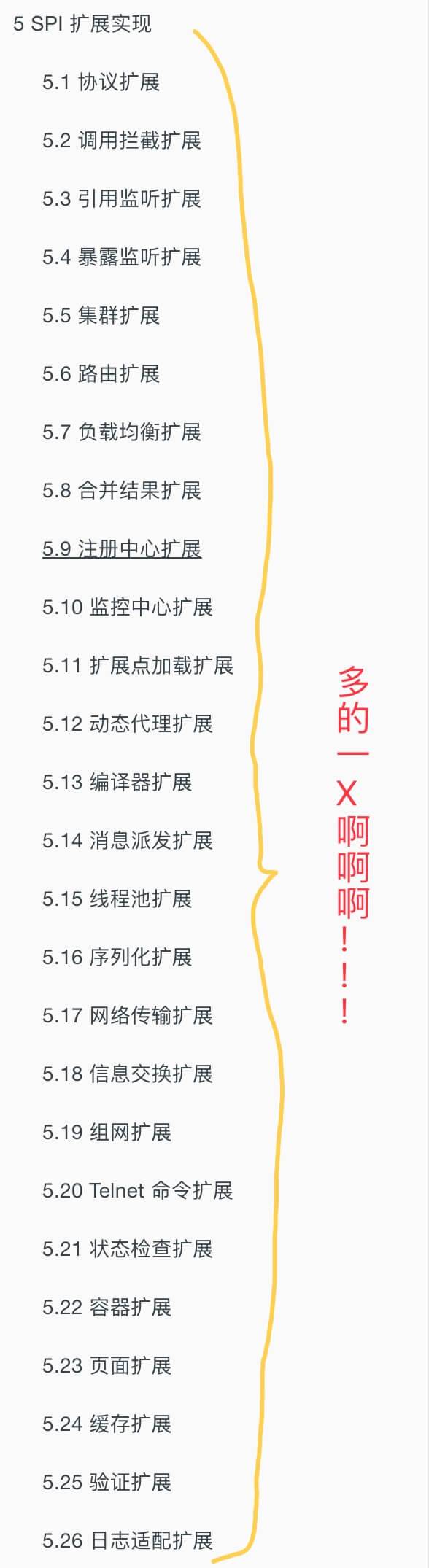
Dubbo 拓展点
2. 改进
在看具体的 Dubbo SPI 实现之前,我们先理解 Dubbo SPI 产生的背景:
Dubbo 的扩展点加载从 JDK 标准的 SPI (Service Provider Interface) 扩展点发现机制加强而来。
Dubbo 改进了 JDK 标准的 SPI 的以下问题:
- JDK 标准的 SPI 会一次性实例化扩展点所有实现,如果有扩展实现初始化很耗时,但如果没用上也加载,会很浪费资源。
- 如果扩展点加载失败,连扩展点的名称都拿不到了。比如:JDK 标准的 ScriptEngine,通过 getName() 获取脚本类型的名称,但如果 RubyScriptEngine 因为所依赖的 jruby.jar 不存在,导致 RubyScriptEngine 类加载失败,这个失败原因被吃掉了,和 ruby 对应不起来,当用户执行 ruby 脚本时,会报不支持 ruby,而不是真正失败的原因。
- 增加了对扩展点 IoC 和 AOP 的支持,一个扩展点可以直接 setter 注入其它扩展点。
- Dubbo 自己实现了一套 SPI 机制,而不是使用 Java 标准的 SPI 。
- 第一点问题,Dubbo 有很多的拓展点,例如 Protocol、Filter 等等。并且每个拓展点有多种的实现,例如 Protocol 有 DubboProtocol、InjvmProtocol、RestProtocol 等等。那么使用 JDK SPI 机制,会初始化无用的拓展点及其实现,造成不必要的耗时与资源浪费。
- 如果无法理解的胖友,跟着 《Java SPI(Service Provider Interface)简介》写多个拓展实现 文章, ,就很容易理解了。 这就是概念呀。 - 第二点问题,【TODO 8009】ScriptEngine 没看明白,不影响本文理解。 - 第三点问题,严格来说,这不算问题,而是增加了功能特性 ,在下文我们会看到。
3. 代码结构
Dubbo SPI 在 dubbo-common 的 extension 包实现,如下图所示:
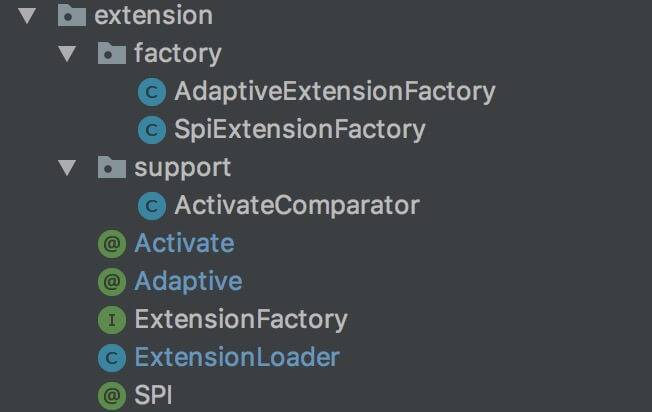
代码结构
4. ExtensionLoader
com.alibaba.dubbo.common.extension.ExtensionLoader ,拓展加载器。这是 Dubbo SPI 的核心。
4.1 属性
```plain text 1: private static final String SERVICES_DIRECTORY = “META-INF/services/”; 2: 3: private static final String DUBBO_DIRECTORY = “META-INF/dubbo/”; 4: 5: private static final String DUBBO_INTERNAL_DIRECTORY = DUBBO_DIRECTORY + “internal/”; 6: 7: private static final Pattern NAME_SEPARATOR = Pattern.compile(“\s[,]+\s”); 8: 9: // ============================== 静态属性 ============================== 10: 11: /** 12: * 拓展加载器集合 13: * 14: * key:拓展接口 15: */ 16: private static final ConcurrentMap<Class<?>, ExtensionLoader<?» EXTENSION_LOADERS = new ConcurrentHashMap<Class<?>, ExtensionLoader<?»(); 17: /** 18: * 拓展实现类集合 19: * 20: * key:拓展实现类 21: * value:拓展对象。 22: * 23: * 例如,key 为 Class
1
2
3
4
5
6
7
8
9
10
11
12
13
14
15
16
17
18
19
20
21
22
23
24
25
26
27
28
29
30
31
32
33
34
35
36
37
38
39
40
41
42
43
44
45
46
47
48
49
50
51
52
53
54
55
56
57
58
59
60
61
62
63
64
65
66
67
68
69
70
71
72
73
74
75
76
77
78
79
80
81
82
83
84
85
86
87
88
89
90
91
- 第 1 至 5 行:在 **接口全限定名每行拓展名=拓展实现类全限定名**
META-INF/dubbo/internal/
和
META-INF/dubbo/
目录下,放置
配置文件,
内容为:
。
- META-INF/dubbo/internal/**内部**
目录下,从名字上可以看出,用于 Dubbo
提供的拓展实现。下图是一个例子:
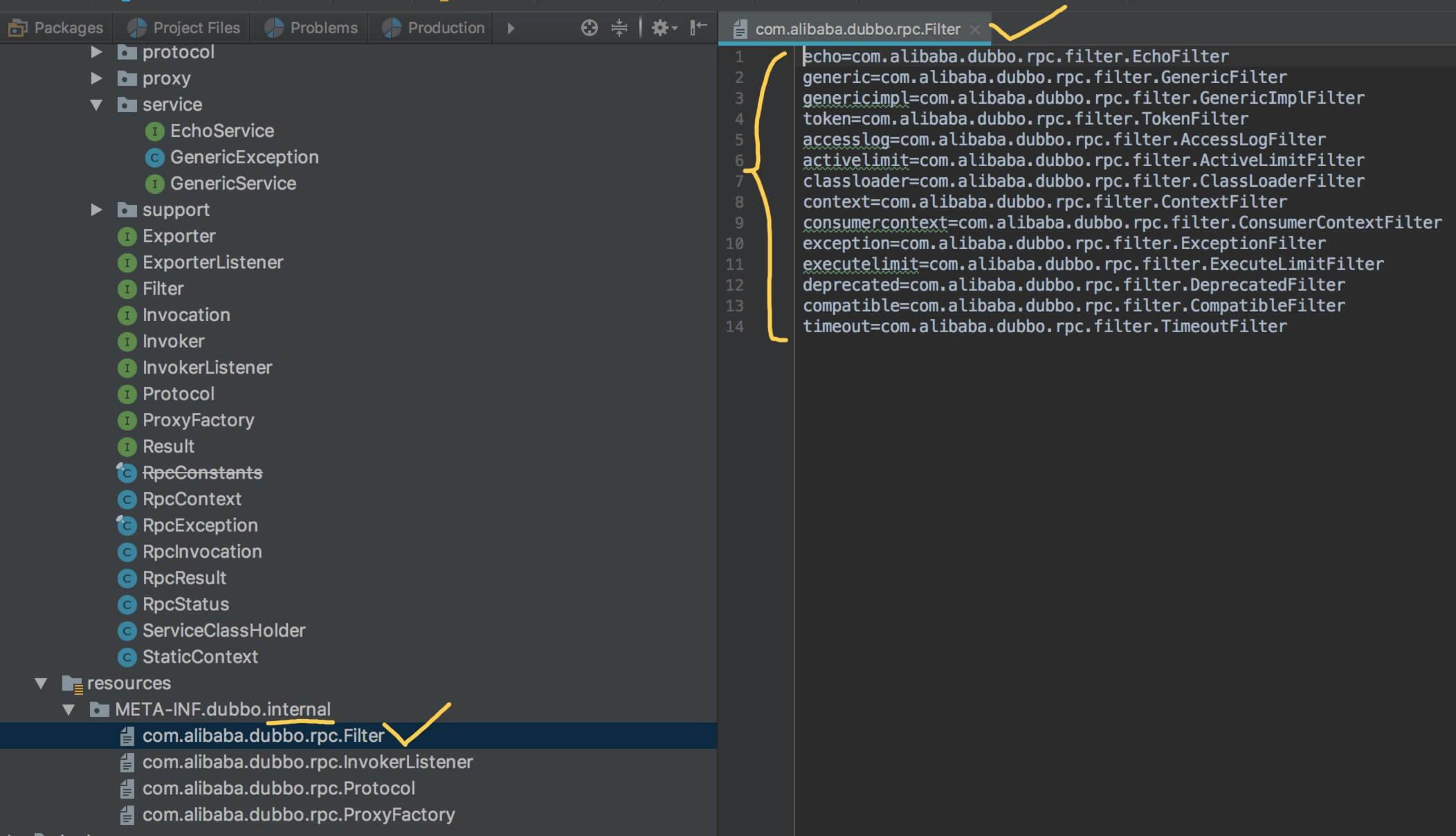
META-INF/dubbo/internal/ 例子
- META-INF/dubbo/**自定义**
目录下,用于用户
的拓展实现。
- META-INF/service/[「4.2 加载拓展配置」](http://svip.iocoder.cn/Dubbo/spi/#)**兼容**
目录下,Java SPI 的配置目录。在
中,我们会看到 Dubbo SPI 对 Java SPI 做了
。
- 第 7 行:**逗号**
NAME_SEPARATOR
,拓展名分隔符,使用
。
- **第 9 至 124 行**
,我们将属性分成了两类:1)静态属性;2)对象属性。这是为啥呢?
- 【静态属性】一方面,ExtensionLoader 是 ExtensionLoader 的**管理容器分别**
。一个拓展( 拓展接口 )对应一个 ExtensionLoader 对象。例如,Protocol 和 Filter
对应一个 ExtensionLoader 对象。
- 【对象属性】另一方面,一个拓展通过其 ExtensionLoader 对象,加载它的**拓展实现们cached缓存真正缓存**
。我们会发现多个属性都是 “
“ 开头。ExtensionLoader 考虑到性能和资源的优化,读取拓展配置后,会首先进行
。等到 Dubbo 代码
用到对应的拓展实现时,进行拓展实现的对象的初始化。并且,初始化完成后,也会进行
。也就是说:
- 缓存加载的拓展配置
- 缓存创建的拓展实现对象
- 胖友先看下属性的代码注释,有一个整体的印象。下面我们在读实现代码时,会进一步解析说明。
---
考虑到胖友能更好的理解下面的代码实现,推荐先阅读下 [《Dubbo 开发指南 —— 扩展点加载》](http://dubbo.apache.org/zh-cn/docs/dev/SPI.html) 文档,建立下对 ExtensionLoader 特点的初步理解:
- 扩展点自动包装
- 在 [「4.4.2 createExtension」](http://svip.iocoder.cn/Dubbo/spi/#)
详细解析。
- 扩展点自动装配
- 在 [「4.4.3 injectExtension」](http://svip.iocoder.cn/Dubbo/spi/#)
详细解析。
- 扩展点自适应
- 在 [「4.5 获得自适应的拓展对象」](http://svip.iocoder.cn/Dubbo/spi/#)
详细解析。
- 扩展点自动激活
- 在 [「4.6 获得激活的拓展对象数组」](http://svip.iocoder.cn/Dubbo/spi/#)
详细解析。
## 4.2 获得拓展配置
### 4.2.1 getExtensionClasses
#getExtensionClasses() 方法,获得拓展实现类数组。
```plain text
private final Holder<Map<String, Class<?>>> cachedClasses = new Holder<Map<String, Class<?>>>();
private volatile Class<?> cachedAdaptiveClass = null;
private Set<Class<?>> cachedWrapperClasses;
1: /**
2: * 获得拓展实现类数组
3: *
4: * @return 拓展实现类数组
5: */
6: private Map<String, Class<?>> getExtensionClasses() {
7: // 从缓存中,获得拓展实现类数组
8: Map<String, Class<?>> classes = cachedClasses.get();
9: if (classes == null) {
10: synchronized (cachedClasses) {
11: classes = cachedClasses.get();
12: if (classes == null) {
13: // 从配置文件中,加载拓展实现类数组
14: classes = loadExtensionClasses();
15: // 设置到缓存中
16: cachedClasses.set(classes);
17: }
18: }
19: }
20: return classes;
21: }
- cachedClasses 属性,缓存的拓展实现类集合。它不包含如下两种类型的拓展实现:
- 自适应 拓展实现类。例如 AdaptiveExtensionFactory 。
- 拓展 Adaptive 实现类,会添加到 cachedAdaptiveClass 属性中。
- 带唯一参数为拓展接口 的构造方法的实现类,或者说拓展 Wrapper 实现类。例如,ProtocolFilterWrapper 。
- 拓展 Wrapper 实现类,会添加到 cachedWrapperClasses 属性中。
- 总结来说,完整 cachedClasses + cachedAdaptiveClass + cachedWrapperClasses 才是 缓存的拓展实现类的配置。
- 自适应 拓展实现类。例如 AdaptiveExtensionFactory 。
- 第 7 至 11 行:从缓存中,获得拓展实现类数组。
- 第 12 至 14 行:当缓存不存在时,调用 #loadExtensionClasses() 方法,从配置文件中,加载拓展实现类数组。
- 第 16 行:设置加载的实现类数组,到缓存中。
4.2.2 loadExtensionClasses
#loadExtensionClasses() 方法,从多个配置文件中,加载拓展实现类数组。
1
2
/** * 加载拓展实现类数组 * * 无需声明 synchronized ,因为唯一调用该方法的 {@link #getExtensionClasses()} 已经声明。 * // synchronized in getExtensionClasses
 * * @return 拓展实现类数组 */private Map<String, Class<?>> loadExtensionClasses() {    // 通过 @SPI 注解,获得默认的拓展实现类名    final SPI defaultAnnotation = type.getAnnotation(SPI.class);    if (defaultAnnotation != null) {        String value = defaultAnnotation.value();        if ((value = value.trim()).length() > 0) {            String[] names = NAME_SEPARATOR.split(value);            if (names.length > 1) {                throw new IllegalStateException("more than 1 default extension name on extension " + type.getName()                                                + ": " + Arrays.toString(names));            }            if (names.length == 1) cachedDefaultName = names[0];        }    }    // 从配置文件中,加载拓展实现类数组    Map<String, Class<?>> extensionClasses = new HashMap<String, Class<?>>();    loadFile(extensionClasses, DUBBO_INTERNAL_DIRECTORY);    loadFile(extensionClasses, DUBBO_DIRECTORY);    loadFile(extensionClasses, SERVICES_DIRECTORY);    return extensionClasses;}
- 第 10 至 22 行:通过 默认的「5. @SPI」 @SPI 注解,获得拓展接口对应的 拓展实现类名。在 详细解析。
- 第 25 至 29 行:调用 注意 #loadFile(extensionClasses, dir) 方法,从配置文件中,加载拓展实现类数组。 ,此处配置文件的加载顺序。
4.2.3 loadFile
#loadFile(extensionClasses, dir) 方法,从一个配置文件中,加载拓展实现类数组。代码如下:
1
/** * 缓存的自适应拓展对象的类 * * {@link #getAdaptiveExtensionClass()} */private volatile Class<?> cachedAdaptiveClass = null;/** * 拓展 Wrapper 实现类集合 * * 带唯一参数为拓展接口的构造方法的实现类 * * 通过 {@link #loadExtensionClasses} 加载 */private Set<Class<?>> cachedWrapperClasses;/** * 拓展名与 @Activate 的映射 * * 例如,AccessLogFilter。 * * 用于 {@link #getActivateExtension(URL, String)} */private final Map<String, Activate> cachedActivates = new ConcurrentHashMap<String, Activate>();/** * 缓存的拓展名与拓展类的映射。 * * 和 {@link #cachedClasses} 的 KV 对调。 * * 通过 {@link #loadExtensionClasses} 加载 */private final ConcurrentMap<Class<?>, String> cachedNames = new ConcurrentHashMap<Class<?>, String>();/** * 拓展名 与 加载对应拓展类发生的异常 的 映射 * * key:拓展名 * value:异常 * * 在 {@link #loadFile(Map, String)} 时,记录 */private Map<String, IllegalStateException> exceptions = new ConcurrentHashMap<String, IllegalStateException>();
1
/** * 从一个配置文件中,加载拓展实现类数组。 * * @param extensionClasses 拓展类名数组 * @param dir 文件名 */private void loadFile(Map<String, Class<?>> extensionClasses, String dir) {    // 完整的文件名    String fileName = dir + type.getName();    try {        Enumeration<java.net.URL> urls;        // 获得文件名对应的所有文件数组        ClassLoader classLoader = findClassLoader();        if (classLoader != null) {            urls = classLoader.getResources(fileName);        } else {            urls = ClassLoader.getSystemResources(fileName);        }        // 遍历文件数组        if (urls != null) {            while (urls.hasMoreElements()) {                java.net.URL url = urls.nextElement();                try {                    BufferedReader reader = new BufferedReader(new InputStreamReader(url.openStream(), "utf-8"));                    try {                        String line;                        while ((line = reader.readLine()) != null) {                            // 跳过当前被注释掉的情况,例如 #spring=xxxxxxxxx                            final int ci = line.indexOf('#');                            if (ci >= 0) line = line.substring(0, ci);                            line = line.trim();                            if (line.length() > 0) {                                try {                                    // 拆分,key=value 的配置格式                                    String name = null;                                    int i = line.indexOf('=');                                    if (i > 0) {                                        name = line.substring(0, i).trim();                                        line = line.substring(i + 1).trim();                                    }                                    if (line.length() > 0) {                                        // 判断拓展实现,是否实现拓展接口                                        Class<?> clazz = Class.forName(line, true, classLoader);                                        if (!type.isAssignableFrom(clazz)) {                                            throw new IllegalStateException("Error when load extension class(interface: " +                                                    type + ", class line: " + clazz.getName() + "), class "                                                    + clazz.getName() + "is not subtype of interface.");                                        }                                        // 缓存自适应拓展对象的类到 `cachedAdaptiveClass`                                        if (clazz.isAnnotationPresent(Adaptive.class)) {                                            if (cachedAdaptiveClass == null) {                                                cachedAdaptiveClass = clazz;                                            } else if (!cachedAdaptiveClass.equals(clazz)) {                                                throw new IllegalStateException("More than 1 adaptive class found: "                                                        + cachedAdaptiveClass.getClass().getName()                                                        + ", " + clazz.getClass().getName());                                            }                                        } else {                                            // 缓存拓展 Wrapper 实现类到 `cachedWrapperClasses`                                            try {                                                clazz.getConstructor(type);                                                Set<Class<?>> wrappers = cachedWrapperClasses;                                                if (wrappers == null) {                                                    cachedWrapperClasses = new ConcurrentHashSet<Class<?>>();                                                    wrappers = cachedWrapperClasses;                                                }                                                wrappers.add(clazz);                                            // 缓存拓展实现类到 `extensionClasses`                                            } catch (NoSuchMethodException e) {                                                clazz.getConstructor();                                                // 未配置拓展名,自动生成。例如,DemoFilter 为 demo 。主要用于兼容 Java SPI 的配置。                                                if (name == null || name.length() == 0) {                                                    name = findAnnotationName(clazz);                                                    if (name == null || name.length() == 0) {                                                        if (clazz.getSimpleName().length() > type.getSimpleName().length()                                                                && clazz.getSimpleName().endsWith(type.getSimpleName())) {                                                            name = clazz.getSimpleName().substring(0, clazz.getSimpleName().length() - type.getSimpleName().length()).toLowerCase();                                                        } else {                                                            throw new IllegalStateException("No such extension name for the class " + clazz.getName() + " in the config " + url);                                                        }                                                    }                                                }                                                // 获得拓展名,可以是数组,有多个拓展名。                                                String[] names = NAME_SEPARATOR.split(name);                                                if (names != null && names.length > 0) {                                                    // 缓存 @Activate 到 `cachedActivates` 。                                                    Activate activate = clazz.getAnnotation(Activate.class);                                                    if (activate != null) {                                                        cachedActivates.put(names[0], activate);                                                    }                                                    for (String n : names) {                                                        // 缓存到 `cachedNames`                                                        if (!cachedNames.containsKey(clazz)) {                                                            cachedNames.put(clazz, n);                                                        }                                                        // 缓存拓展实现类到 `extensionClasses`                                                        Class<?> c = extensionClasses.get(n);                                                        if (c == null) {                                                            extensionClasses.put(n, clazz);                                                        } else if (c != clazz) {                                                            throw new IllegalStateException("Duplicate extension " + type.getName() + " name " + n + " on " + c.getName() + " and " + clazz.getName());                                                        }                                                    }                                                }                                            }                                        }                                    }                                } catch (Throwable t) {                                    // 发生异常,记录到异常集合                                    IllegalStateException e = new IllegalStateException("Failed to load extension class(interface: " + type + ", class line: " + line + ") in " + url + ", cause: " + t.getMessage(), t);                                    exceptions.put(line, e);                                }                            }                        } // end of while read lines                    } finally {                        reader.close();                    }                } catch (Throwable t) {                    logger.error("Exception when load extension class(interface: " +                            type + ", class file: " + url + ") in " + url, t);                }            } // end of while urls        }    } catch (Throwable t) {        logger.error("Exception when load extension class(interface: " +                type + ", description file: " + fileName + ").", t);    }}
- 第 9 行:获得完整的文件名( 相对路径 )。例如: “META-INF/dubbo/internal/com.alibaba.dubbo.common.extension.ExtensionFactory” 。
- 第 12 至 18 行:获得文件名对应的所有文件 URL 数组。例如:
 ExtensionFactory 的配置文件
 - 第 21 至 24 行:逐个文件 URL 遍历。
- 第 27 行:逐行 遍历。
- 第 29 至 32 行:跳过当前被 “#” 注释掉的情况,例如 #spring=xxxxxxxxx 。
- 第 34 至 40 行:按照 注意 key=value 的配置拆分。其中 name 为拓展名, line 为拓展实现类名。 ,上文我们提到过 Dubbo SPI 会兼容 Java SPI 的配置格式,那么按照此处的解析方式, name 会为空。这种情况下,拓展名会自动生成,详细见第 71 至 82 行的代码。
- 第 42 至 48 行:判断拓展实现类,需要实现拓展接口。
- 第 50 至 57 行:缓存自适应拓展对象的类到 「6. @Adaptive」 cachedAdaptiveClass 属性。在 详细解析。
- 第 59 至 67 行:缓存拓展 Wrapper 实现类到 cachedWrapperClasses 属性。
- 第 61 行:调用 反射拓展 Wrapper 实现类ProtocolFilterWrapper(Protocol protocol) Class#getConstructor(Class<?>… parameterTypes) 方法,通过 的方式,参数为拓展接口,判断当前配置的拓展实现类为 。若成功(未抛出异常),则代表符合条件。例如, 这个构造方法。
- 第 69 至 105 行:若获得构造方法失败,则代表是普通的拓展实现类,缓存到 变量 extensionClasses 中。
- 第 70 行:调用 Class#getConstructor(Class<?>… parameterTypes) 方法,获得参数为空的构造方法。
- 第 72 至 82 行:未配置拓展名,自动生成。适用于 Java SPI 的配置方式 。例如,xxx.yyy.DemoFilter 生成的拓展名为 demo 。
- 第 73 行:通过 废弃 @Extension 注解的方式设置拓展名的方式已经 ,胖友可以无视该方法。
- 第 84 行:获得拓展名。使用逗号进行分割,即多个拓展名可以对应同一个拓展实现类。
- 第 86 至 90 行:缓存 「7. @Activate」 @Activate 到 cachedActivates 。在 详细解析。
- 第 93 至 95 行:缓存到 cachedNames 属性。
- 第 96 至 102 行:缓存拓展实现类到 注意 extensionClasses 变量。 ,相同拓展名,不能对应多个不同的拓展实现。
- 第 108 至 112 行:若发生异常,记录到异常集合 exceptions 属性。
4.2.4 其他方法
如下方法,和该流程无关,胖友可自行查看。
- #getExtensionClass(name)
- #findException(name)
- #getExtensionName(extensionInstance)
- #getExtensionName(extensionClass)
- #getSupportedExtensions()
- #getDefaultExtensionName()
- #hasExtension(name)
4.3 获得拓展加载器
在 Dubbo 的代码里,常常能看到如下的代码:
```plain text plain ExtensionLoader.getExtensionLoader(Protocol.class).getExtension(name)
1
2
3
4
5
6
7
8
9

---

### 4.3.1 getExtensionLoader

#getExtensionLoader(type)**静态**方法,根据拓展点的接口,获得拓展加载器。代码如下:

```plain text
plain /**  * 拓展加载器集合  *  * key:拓展接口  */  // 【静态属性】 private static final ConcurrentMap<Class<?>, ExtensionLoader<?>> EXTENSION_LOADERS = new ConcurrentHashMap<Class<?>, ExtensionLoader<?>>();     1: /**   2:  * 根据拓展点的接口,获得拓展加载器   3:  *   4:  * @param type 接口   5:  * @param <T> 泛型   6:  * @return 加载器   7:  */   8: @SuppressWarnings("unchecked")   9: public static <T> ExtensionLoader<T> getExtensionLoader(Class<T> type) {  10:     if (type == null)  11:         throw new IllegalArgumentException("Extension type == null");  12:     // 必须是接口  13:     if (!type.isInterface()) {  14:         throw new IllegalArgumentException("Extension type(" + type + ") is not interface!");  15:     }  16:     // 必须包含 @SPI 注解  17:     if (!withExtensionAnnotation(type)) {  18:         throw new IllegalArgumentException("Extension type(" + type +  19:                 ") is not extension, because WITHOUT @" + SPI.class.getSimpleName() + " Annotation!");  20:     }  21:   22:     // 获得接口对应的拓展点加载器  23:     ExtensionLoader<T> loader = (ExtensionLoader<T>) EXTENSION_LOADERS.get(type);  24:     if (loader == null) {  25:         EXTENSION_LOADERS.putIfAbsent(type, new ExtensionLoader<T>(type));  26:         loader = (ExtensionLoader<T>) EXTENSION_LOADERS.get(type);  27:     }  28: }
- 第 12 至 15 行:必须是接口。
- 第 16 至 20 行:调用 #withExtensionAnnotation() 方法,校验必须使用 @SPI 注解标记。
- 第 22 至 27 行:从 静态 EXTENSION_LOADERS 中获取拓展接口对应的 ExtensionLoader 对象。若不存在,则创建 ExtensionLoader 对象,并添加到 EXTENSION_LOADERS 。
4.3.2 构造方法
构造方法,代码如下:
```plain text plain /** * 拓展接口。 * 例如,Protocol */ private final Class<?> type; /** * 对象工厂 * * 用于调用 {@link #injectExtension(Object)} 方法,向拓展对象注入依赖属性。 * * 例如,StubProxyFactoryWrapper 中有 Protocol protocol 属性。 */ private final ExtensionFactory objectFactory; 1: private ExtensionLoader(Class<?> type) { 2: this.type = type; 3: objectFactory = (type == ExtensionFactory.class ? null : ExtensionLoader.getExtensionLoader(ExtensionFactory.class).getAdaptiveExtension()); 4: }
1
2
3
4
5
6
7
8
9
10
11
12
13
14
15
16
17
18
19
20
21
22

---

- objectFactory**功能上和 Spring IOC 一致**
属性,对象工厂,
。
    - 用于调用 [#injectExtension(instance)](https://github.com/YunaiV/dubbo/blob/6b8e51ac55880a0f10a34f297d0869fcdbb42369/dubbo-common/src/main/java/com/alibaba/dubbo/common/extension/ExtensionLoader.java#L510-L535)[CacheFilter.cacheFactory](https://github.com/YunaiV/dubbo/blob/6b8e51ac55880a0f10a34f297d0869fcdbb42369/dubbo-filter/dubbo-filter-cache/src/main/java/com/alibaba/dubbo/cache/filter/CacheFilter.java#L38)
方法时,向创建的拓展注入其依赖的属性。例如,
属性。
    - 第 3 行:当拓展接口非 ExtensionFactory 时( 如果不加这个判断,会是一个死循环 ),调用 **自适应为什么呢**[「8. ExtensionFactory」](http://svip.iocoder.cn/Dubbo/spi/#)
ExtensionLoader#getAdaptiveExtension()
方法,获得 ExtensionFactory 拓展接口的
拓展实现对象。
?在
详细解析。

## 4.4 获得指定拓展对象

在 Dubbo 的代码里,常常能看到如下的代码:

```plain text
plain ExtensionLoader.getExtensionLoader(Protocol.class).getExtension(name)
4.4.1 getExtension
#getExtension() 方法,返回指定名字的扩展对象。如果指定名字的扩展不存在,则抛异常 IllegalStateException 。代码如下:
```plain text plain /** * 缓存的拓展对象集合 * * key:拓展名 * value:拓展对象 * * 例如,Protocol 拓展 * key:dubbo value:DubboProtocol * key:injvm value:InjvmProtocol * * 通过 {@link #loadExtensionClasses} 加载 */ private final ConcurrentMap<String, Holder
1
2
3
4
5
6
7
8
9
10
11
12
13
14
15
16
17
18
19
20
21

---

- 第 15 至 18 行:调用 **默认的**
#getDefaultExtension()
方法,查询
拓展对象。在该方法的实现代码中,简化代码为
getExtension(cachedDefaultName);
。
- 第 19 至 28 行:从缓存中,获得拓展对象。
- 第 29 至 31 行:当缓存不存在时,调用
#createExtension(name)
方法,创建拓展对象。
- 第 33 行:添加创建的拓展对象,到缓存中。

### 4.4.2 createExtension

#createExtension(name) 方法,创建拓展名的拓展对象,并缓存。代码如下:

```plain text
plain /**  * 拓展实现类集合  *  * key:拓展实现类  * value:拓展对象。  *  * 例如,key 为 Class<AccessLogFilter>  *      value 为 AccessLogFilter 对象  */ private static final ConcurrentMap<Class<?>, Object> EXTENSION_INSTANCES = new ConcurrentHashMap<Class<?>, Object>();        1: /**   2:  * 创建拓展名的拓展对象,并缓存。   3:  *   4:  * @param name 拓展名   5:  * @return 拓展对象   6:  */   7: @SuppressWarnings("unchecked")   8: private T createExtension(String name) {   9:     // 获得拓展名对应的拓展实现类  10:     Class<?> clazz = getExtensionClasses().get(name);  11:     if (clazz == null) {  12:         throw findException(name); // 抛出异常  13:     }  14:     try {  15:         // 从缓存中,获得拓展对象。  16:         T instance = (T) EXTENSION_INSTANCES.get(clazz);  17:         if (instance == null) {  18:             // 当缓存不存在时,创建拓展对象,并添加到缓存中。  19:             EXTENSION_INSTANCES.putIfAbsent(clazz, clazz.newInstance());  20:             instance = (T) EXTENSION_INSTANCES.get(clazz);  21:         }  22:         // 注入依赖的属性  23:         injectExtension(instance);  24:         // 创建 Wrapper 拓展对象  25:         Set<Class<?>> wrapperClasses = cachedWrapperClasses;  26:         if (wrapperClasses != null && !wrapperClasses.isEmpty()) {  27:             for (Class<?> wrapperClass : wrapperClasses) {  28:                 instance = injectExtension((T) wrapperClass.getConstructor(type).newInstance(instance));  29:             }  30:         }  31:         return instance;  32:     } catch (Throwable t) {  33:         throw new IllegalStateException("Extension instance(name: " + name + ", class: " +  34:                 type + ")  could not be instantiated: " + t.getMessage(), t);  35:     }  36: }
- 第 9 至 13 行:获得拓展名对应的拓展实现类。若不存在,调用 #findException(name) 方法,抛出异常。
- 第 16 行:从缓存 静态 EXTENSION_INSTANCES 属性中,获得拓展对象。
- 第 17 至 21 行:当缓存不存在时,创建拓展对象,并添加到 EXTENSION_INSTANCES 中。因为 #getExtension(name) 方法中已经加 synchronized 修饰,所以此处不用同步。
- 第 23 行:调用 #injectExtension(instance) 方法,向创建的拓展注入其依赖的属性。
- 第 24 至 30 行:创建 Wrapper 拓展对象,将 包装在其中《Dubbo 开发指南 —— 扩展点加载》 instance 。在 文章中,如此介绍 Wrapper 类: Wrapper 类同样实现了扩展点接口,但是 Wrapper 不是扩展点的真正实现。它的用途主要是用于从 ExtensionLoader 返回扩展点时,包装在真正的扩展点实现外。即从 ExtensionLoader 中返回的实际上是 Wrapper 类的实例,Wrapper 持有了实际的扩展点实现类。 扩展点的 Wrapper 类可以有多个,也可以根据需要新增。 通过 Wrapper 类可以把所有扩展点公共逻辑移至 Wrapper 中。新加的 Wrapper 在所有的扩展点上添加了逻辑,有些类似 AOP,即 Wrapper 代理了扩展点。
4.4.3 injectExtension
#injectExtension(instance) 方法,注入依赖的属性。代码如下:
```plain text plain 1: /** 2: * 注入依赖的属性 3: * 4: * @param instance 拓展对象 5: * @return 拓展对象 6: */ 7: private T injectExtension(T instance) { 8: try { 9: if (objectFactory != null) { 10: for (Method method : instance.getClass().getMethods()) { 11: if (method.getName().startsWith(“set”) 12: && method.getParameterTypes().length == 1 13: && Modifier.isPublic(method.getModifiers())) { // setting && public 方法 14: // 获得属性的类型 15: Class<?> pt = method.getParameterTypes()[0]; 16: try { 17: // 获得属性 18: String property = method.getName().length() > 3 ? method.getName().substring(3, 4).toLowerCase() + method.getName().substring(4) : “”; 19: // 获得属性值 20: Object object = objectFactory.getExtension(pt, property); 21: // 设置属性值 22: if (object != null) { 23: method.invoke(instance, object); 24: } 25: } catch (Exception e) { 26: logger.error(“fail to inject via method “ + method.getName() 27: + “ of interface “ + type.getName() + “: “ + e.getMessage(), e); 28: } 29: } 30: } 31: } 32: } catch (Exception e) { 33: logger.error(e.getMessage(), e); 34: } 35: return instance; 36: }
1
2
3
4
5
6
7
8
9
10
11
12
13
14
15
16
17
18
19
20
21
22
23
24
25
26
27
28
29
30
31
32

---

- 第 9 行:必须有
objectFactory
属性,即 ExtensionFactory 的拓展对象,不需要注入依赖的属性。
- 第 10 至 13 行:反射获得所有的方法,仅仅处理
public setting
方法。
- 第 15 行:获得属性的类型。
- 第 18 行:获得属性名。
- 第 20 行:获得**属性值注意**[「8. ExtensionFactory」](http://svip.iocoder.cn/Dubbo/spi/#)
。
,此处虽然调用的是
ExtensionFactory#getExtension(type, name)
方法,实际获取的不仅仅是拓展对象,也可以是 Spring Bean 对象。答案在
揭晓。
- 第 21 至 24 行:设置属性值。

### 4.4.4 其他方法

如下方法,和该流程无关,胖友可自行查看。

- [#getLoadedExtension(name)](https://github.com/YunaiV/dubbo/blob/6b8e51ac55880a0f10a34f297d0869fcdbb42369/dubbo-common/src/main/java/com/alibaba/dubbo/common/extension/ExtensionLoader.java#L257-L275)
- [#getLoadedExtensions()](https://github.com/YunaiV/dubbo/blob/6b8e51ac55880a0f10a34f297d0869fcdbb42369/dubbo-common/src/main/java/com/alibaba/dubbo/common/extension/ExtensionLoader.java#L277-L286)

## 4.5 获得自适应的拓展对象

在 Dubbo 的代码里,常常能看到如下的代码:

```plain text
plain ExtensionLoader.getExtensionLoader(Protocol.class).getAdaptiveExtension()
友情提示,胖友先看下 「6. Adaptive」 的内容,在回到此处。
4.5.1 getAdaptiveExtension
#getAdaptiveExtension() 方法,获得自适应拓展对象。
```plain text plain /** * 缓存的自适应( Adaptive )拓展对象 */ private final Holder
1
2
3
4
5
6
7
8
9
10
11
12
13
14
15
16
17
18
19
20
21
22

---

- 第 9 行:从缓存
cachedAdaptiveInstance
属性中,获得自适应拓展对象。
- 第 28 至 30 行:若之前创建报错,则抛出异常 IllegalStateException 。
- 第 14 至 20 行:当缓存不存在时,调用
#createAdaptiveExtension()
方法,创建自适应拓展对象,并添加到
cachedAdaptiveInstance
中。
- 第 22 至 24 行:若创建发生异常,记录异常到
createAdaptiveInstanceError
,并抛出异常 IllegalStateException 。

### 4.5.2 createAdaptiveExtension

#createAdaptiveExtension() 方法,创建自适应拓展对象。代码如下:

```plain text
plain /**  * 创建自适应拓展对象  *  * @return 拓展对象  */ @SuppressWarnings("unchecked") private T createAdaptiveExtension() {     try {         return injectExtension((T) getAdaptiveExtensionClass().newInstance());     } catch (Exception e) {         throw new IllegalStateException("Can not create adaptive extension " + type + ", cause: " + e.getMessage(), e);     } }
- 调用 #getAdaptiveExtensionClass() 方法,获得自适应拓展类。
- 调用 Class#newInstance() 方法,创建自适应拓展对象。
- 调用 #injectExtension(instance) 方法,向创建的自适应拓展对象,注入依赖的属性。
4.5.3 getAdaptiveExtensionClass
#getAdaptiveExtensionClass() 方法,获得自适应拓展类。代码如下:
```plain text plain 1: /** 2: * @return 自适应拓展类 3: */ 4: private Class<?> getAdaptiveExtensionClass() { 5: getExtensionClasses(); 6: if (cachedAdaptiveClass != null) { 7: return cachedAdaptiveClass; 8: } 9: return cachedAdaptiveClass = createAdaptiveExtensionClass(); 10: }
1
2
3
4
5
6
7
8
9
10
11
12
13
14
15
16
17
18
19
20
21
22

---

- 【
@Adaptive
的第一种】第 6 至 8 行:若
cachedAdaptiveClass
已存在,直接返回。的第一种情况。
- 【**自动生成编译**
@Adaptive
的第二种】第 9 行:调用
#createAdaptiveExtensionClass()
方法,
自适应拓展的代码实现,并
后返回该类。

### 4.5.4 createAdaptiveExtensionClassCode

#createAdaptiveExtensionClassCode() 方法,自动生成自适应拓展的代码实现,并编译后返回该类。

```plain text
plain 1: /**  2:  * 自动生成自适应拓展的代码实现,并编译后返回该类。  3:  *  4:  * @return 类  5:  */  6: private Class<?> createAdaptiveExtensionClass() {  7:     // 自动生成自适应拓展的代码实现的字符串  8:     String code = createAdaptiveExtensionClassCode();  9:     // 编译代码,并返回该类 10:     ClassLoader classLoader = findClassLoader(); 11:     com.alibaba.dubbo.common.compiler.Compiler compiler = ExtensionLoader.getExtensionLoader(com.alibaba.dubbo.common.compiler.Compiler.class).getAdaptiveExtension(); 12:     return compiler.compile(code, classLoader); 13: }
- 第 8 行:调用 #createAdaptiveExtensionClassCode 方法,自动生成自适应拓展的代码实现的字符串。
- 代码比较简单,已经添加详细注释,胖友点击查看。
- 如下是 ProxyFactory 的自适应拓展的代码实现的字符串生成例子
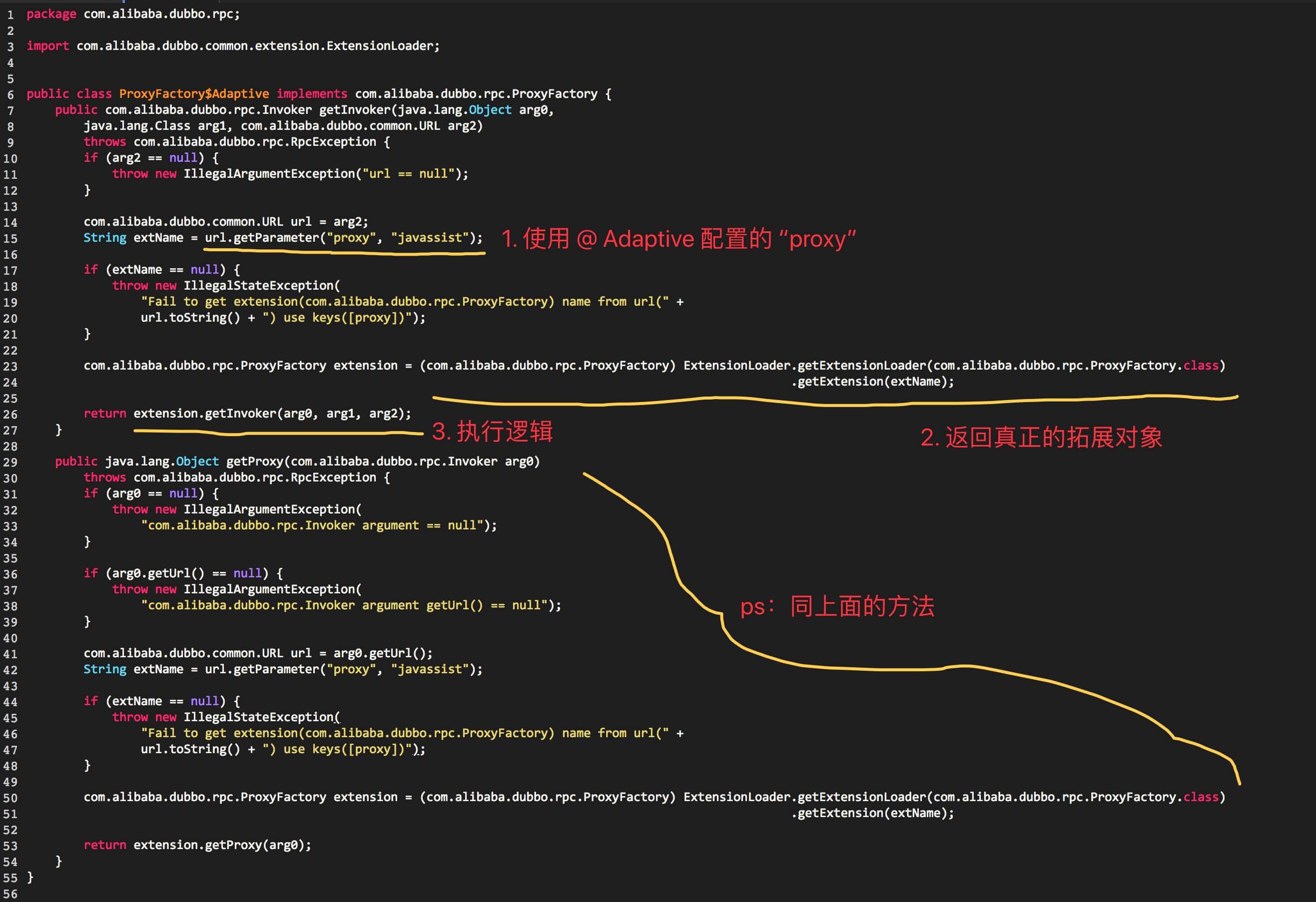 自适应拓展的代码实现的字符串生成例子
- 第 9 至 12 行:使用 Dubbo SPI 加载 Compier 拓展接口对应的拓展实现对象,后调用 Compiler#compile(code, classLoader) 方法,进行编译。 因为不是本文的重点,后续另开文章分享。
4.6 获得激活的拓展对象数组
在 Dubbo 的代码里,看到使用代码如下:
```plain text plain List
1
2
3
4
5
6
7
8
9

---

### 4.6.1 getExtensionLoader

#getExtensionLoader(url, key, group) 方法,获得符合自动激活条件的拓展对象数组。

```plain text
plain 1: /**  2:  * This is equivalent to {@code getActivateExtension(url, url.getParameter(key).split(","), null)}  3:  *  4:  * 获得符合自动激活条件的拓展对象数组  5:  *  6:  * @param url   url  7:  * @param key   url parameter key which used to get extension point names  8:  *              Dubbo URL 参数名  9:  * @param group group 10:  *              过滤分组名 11:  * @return extension list which are activated. 12:  * @see #getActivateExtension(com.alibaba.dubbo.common.URL, String[], String) 13:  */ 14: public List<T> getActivateExtension(URL url, String key, String group) { 15:     // 从 Dubbo URL 获得参数值 16:     String value = url.getParameter(key); 17:     // 获得符合自动激活条件的拓展对象数组 18:     return getActivateExtension(url, value == null || value.length() == 0 ? null : Constants.COMMA_SPLIT_PATTERN.split(value), group); 19: } 20:  21: /** 22:  * Get activate extensions. 23:  * 24:  * 获得符合自动激活条件的拓展对象数组 25:  * 26:  * @param url    url 27:  * @param values extension point names 28:  * @param group  group 29:  * @return extension list which are activated 30:  * @see com.alibaba.dubbo.common.extension.Activate 31:  */ 32: public List<T> getActivateExtension(URL url, String[] values, String group) { 33:     List<T> exts = new ArrayList<T>(); 34:     List<String> names = values == null ? new ArrayList<String>(0) : Arrays.asList(values); 35:     // 处理自动激活的拓展对象们 36:     // 判断不存在配置 `"-name"` 。例如,<dubbo:service filter="-default" /> ,代表移除所有默认过滤器。 37:     if (!names.contains(Constants.REMOVE_VALUE_PREFIX + Constants.DEFAULT_KEY)) { 38:         // 获得拓展实现类数组 39:         getExtensionClasses(); 40:         // 循环 41:         for (Map.Entry<String, Activate> entry : cachedActivates.entrySet()) { 42:             String name = entry.getKey(); 43:             Activate activate = entry.getValue(); 44:             if (isMatchGroup(group, activate.group())) { // 匹配分组 45:                 // 获得拓展对象 46:                 T ext = getExtension(name); 47:                 if (!names.contains(name) // 不包含在自定义配置里。如果包含,会在下面的代码处理。 48:                         && !names.contains(Constants.REMOVE_VALUE_PREFIX + name) // 判断是否配置移除。例如 <dubbo:service filter="-monitor" />,则 MonitorFilter 会被移除 49:                         && isActive(activate, url)) { // 判断是否激活 50:                     exts.add(ext); 51:                 } 52:             } 53:         } 54:         // 排序 55:         Collections.sort(exts, ActivateComparator.COMPARATOR); 56:     } 57:     // 处理自定义配置的拓展对象们。例如在 <dubbo:service filter="demo" /> ,代表需要加入 DemoFilter (这个是笔者自定义的)。 58:     List<T> usrs = new ArrayList<T>(); 59:     for (int i = 0; i < names.size(); i++) { 60:         String name = names.get(i); 61:         if (!name.startsWith(Constants.REMOVE_VALUE_PREFIX) && !names.contains(Constants.REMOVE_VALUE_PREFIX + name)) { // 判断非移除的 62:             // 将配置的自定义在自动激活的拓展对象们前面。例如,<dubbo:service filter="demo,default,demo2" /> ,则 DemoFilter 就会放在默认的过滤器前面。 63:             if (Constants.DEFAULT_KEY.equals(name)) { 64:                 if (!usrs.isEmpty()) { 65:                     exts.addAll(0, usrs); 66:                     usrs.clear(); 67:                 } 68:             } else { 69:                 // 获得拓展对象 70:                 T ext = getExtension(name); 71:                 usrs.add(ext); 72:             } 73:         } 74:     } 75:     // 添加到结果集 76:     if (!usrs.isEmpty()) { 77:         exts.addAll(usrs); 78:     } 79:     return exts; 80: }
- 第 16 行:从 Dubbo URL 获得参数值。例如说,若 XML 配置 Service 逗号 ,并且在获得 Filter 自动激活拓展时,此处就能解析到 value=demo,demo2 。另外, value 可以根据 拆分。
- 第 18 行:调用 #getActivateExtension(url, values, group) 方法,获得符合自动激活条件的拓展对象数组。
- 第 35 至 56 行:处理自动激活的拓展对象们。
- #isMatchGroup(group, groups) 方法,匹配分组。
- #isActive(Activate, url)[
@Activate.value](http://svip.iocoder.cn/Dubbo/spi/mailto:%60@Activate.value)<font style="color:rgb(51, 51, 51);">,并且参数值非空。 方法,是否激活,通过 Dubbo URL 中是否存在参数名为
- 第 57 至 74 行:处理自定义配置的拓展对象们。
- 第 75 至 78 行:将 尾部 usrs 合并到 exts 。
- 代码比较简单,胖友直接看注释。
4.6.2 ActivateComparator
com.alibaba.dubbo.common.extension.support.ActivateComparator ,自动激活拓展对象排序器。
- 代码比较简单,胖友直接看注释。
5. @SPI
com.alibaba.dubbo.common.extension.@SPI ,扩展点接口的标识。代码如下:
```plain text plain @Documented @Retention(RetentionPolicy.RUNTIME) @Target({ElementType.TYPE}) public @interface SPI { /** * default extension name */ String value() default “”; }
1
2
3
4
5
6
7
8

---

- value
,默认拓展实现类的名字。例如,Protocol 拓展接口,代码如下:

```plain text
plain @SPI("dubbo") public interface Protocol {     // ... 省略代码 }
```plain text
- 其中 "dubbo" 指的是 DubboProtocol ,Protocol 默认的拓展实现类。
```
6. @Adaptive
com.alibaba.dubbo.common.extension.@Adaptive ,自适应拓展信息的标记。代码如下:
```plain text plain @Documented @Retention(RetentionPolicy.RUNTIME) @Target({ElementType.TYPE, ElementType.METHOD}) public @interface Adaptive { /** * Decide which target extension to be injected. The name of the target extension is decided by the parameter passed * in the URL, and the parameter names are given by this method. * <p> * If the specified parameters are not found from {@link URL}, then the default extension will be used for * dependency injection (specified in its interface’s {@link SPI}). * <p> * For examples, given String[] {"key1", "key2"}: * <ol> * <li>find parameter ‘key1’ in URL, use its value as the extension’s name</li> * <li>try ‘key2’ for extension’s name if ‘key1’ is not found (or its value is empty) in URL</li> * <li>use default extension if ‘key2’ doesn’t appear either</li> * <li>otherwise, throw {@link IllegalStateException}</li> * </ol> * If default extension’s name is not give on interface’s {@link SPI}, then a name is generated from interface’s * class name with the rule: divide classname from capital char into several parts, and separate the parts with * dot ‘.’, for example: for {@code com.alibaba.dubbo.xxx.YyyInvokerWrapper}, its default name is * String[] {"yyy.invoker.wrapper"}. This name will be used to search for parameter from URL. * * @return parameter key names in URL */ /** * 从 {@link URL }的 Key 名,对应的 Value 作为要 Adapt 成的 Extension 名。 * <p> * 如果 {@link URL} 这些 Key 都没有 Value ,使用 缺省的扩展(在接口的{@link SPI}中设定的值)。
* 比如,String[] {"key1", "key2"},表示 * <ol> * <li>先在URL上找key1的Value作为要Adapt成的Extension名; * <li>key1没有Value,则使用key2的Value作为要Adapt成的Extension名。 * <li>key2没有Value,使用缺省的扩展。 * <li>如果没有设定缺省扩展,则方法调用会抛出{@link IllegalStateException}。 * </ol> * <p> * 如果不设置则缺省使用Extension接口类名的点分隔小写字串。
* 即对于Extension接口 {@code com.alibaba.dubbo.xxx.YyyInvokerWrapper} 的缺省值为 String[] {"yyy.invoker.wrapper"} * * @see SPI#value() */ String[] value() default {}; }
1
2
3
4
5
6
7
8
9
10
11
12
13
14
15
16
17
18
19
20
21
22
23
24
25
26
27
28
29
30
31
32

---

@Adaptive 注解,可添加**类**或**方法**上,分别代表了两种不同的使用方式。

友情提示:一个拓展接口,有且仅有一个 Adaptive 拓展实现类。

- 第一种,标记在**类手动实现**[「8.1 AdaptiveExtensionFactory」](http://svip.iocoder.cn/Dubbo/spi/#)
上,代表
它是一个拓展接口的 Adaptive 拓展实现类。目前 Dubbo 项目里,只有 ExtensionFactory 拓展的实现类 AdaptiveExtensionFactory 有这么用。详细解析见
。
- 第二种,标记在拓展接口的**方法自动生成代码实现**
上,代表
该接口的 Adaptive 拓展实现类。
    - value**真正的**
,从 Dubbo URL 获取参数中,使用键名( Key ),获取键值。该值为
拓展名。
        - 自适应拓展实现类,会获取拓展名对应的**真正**
的拓展对象。通过该对象,执行真正的逻辑。
        - 可以设置**多个有值默认拓展名**
键名( Key ),顺序获取直到
。若最终获取不到,使用
。
    - 在 [「4.5.4 createAdaptiveExtensionClassCode」](http://svip.iocoder.cn/Dubbo/spi/#)
详细解析。

# 7. @Activate

[com.alibaba.dubbo.common.extension.@Activate](https://github.com/YunaiV/dubbo/blob/6b8e51ac55880a0f10a34f297d0869fcdbb42369/dubbo-common/src/main/java/com/alibaba/dubbo/common/extension/Activate.java) ,自动激活条件的标记。代码如下:

```plain text
plain @Documented @Retention(RetentionPolicy.RUNTIME) @Target({ElementType.TYPE, ElementType.METHOD}) public @interface Activate {     /**      * Activate the current extension when one of the groups matches. The group passed into      * {@link ExtensionLoader#getActivateExtension(URL, String, String)} will be used for matching.      *      * @return group names to match      * @see ExtensionLoader#getActivateExtension(URL, String, String)      */     /**      * Group过滤条件。      * <br />      * 包含{@link ExtensionLoader#getActivateExtension}的group参数给的值,则返回扩展。      * <br />      * 如没有Group设置,则不过滤。      */     String[] group() default {};      /**      * Activate the current extension when the specified keys appear in the URL's parameters.      * <p>      * For example, given <code>@Activate("cache, validation")</code>, the current extension will be return only when      * there's either <code>cache</code> or <code>validation</code> key appeared in the URL's parameters.      * </p>      *      * @return URL parameter keys      * @see ExtensionLoader#getActivateExtension(URL, String)      * @see ExtensionLoader#getActivateExtension(URL, String, String)      */     /**      * Key过滤条件。包含{@link ExtensionLoader#getActivateExtension}的URL的参数Key中有,则返回扩展。      * <p/>      * 示例:<br/>      * 注解的值 <code>@Activate("cache,validatioin")</code>,      * 则{@link ExtensionLoader#getActivateExtension}的URL的参数有<code>cache</code>Key,或是<code>validatioin</code>则返回扩展。      * <br/>      * 如没有设置,则不过滤。      */     String[] value() default {};      /**      * Relative ordering info, optional      *      * @return extension list which should be put before the current one      */     /**      * 排序信息,可以不提供。      */     String[] before() default {};      /**      * Relative ordering info, optional      *      * @return extension list which should be put after the current one      */     /**      * 排序信息,可以不提供。      */     String[] after() default {};      /**      * Absolute ordering info, optional      *      * @return absolute ordering info      */     /**      * 排序信息,可以不提供。      */     int order() default 0; }
- 对于可以被框架中自动激活加载扩展,条件 @Activate 用于配置扩展被自动激活加载条件。比如,Filter 扩展,有多个实现,使用 @Activate 的扩展可以根据 被自动加载。
- 这块的例子,可以看下 《Dubbo 开发指南 —— 扩展点加载》「扩展点自动激活」 文档提供的。
- 分成过滤条件和排序信息两类属性 ,胖友看下代码里的注释。
- 在 「4.6 获得激活的拓展对象数组」 详细解析。
8. ExtensionFactory
com.alibaba.dubbo.common.extension.ExtensionFactory ,拓展工厂接口。代码如下:
```plain text plain /** * ExtensionFactory * * 拓展工厂接口 */ @SPI public interface ExtensionFactory { /** * Get extension. * * 获得拓展对象 * * @param type object type. 拓展接口 * @param name object name. 拓展名 * @return object instance. 拓展对象 */
1
2
3
4
5
6
7
8
9
10
11
12
13
14
15
16
17
18
---
- ExtensionFactory 自身也是拓展接口,基于 Dubbo SPI 加载具体拓展实现类。
- #getExtension(type, name)[「4.4.3 injectExtension」](http://svip.iocoder.cn/Dubbo/spi/#)**注入依赖属性**
方法,在
中,获得拓展对象,向创建的拓展对象
。在实际代码中,我们可以看到不仅仅获得的是拓展对象,也可以是 Spring 中的 Bean 对象。
- ExtensionFactory 子类类图如下:
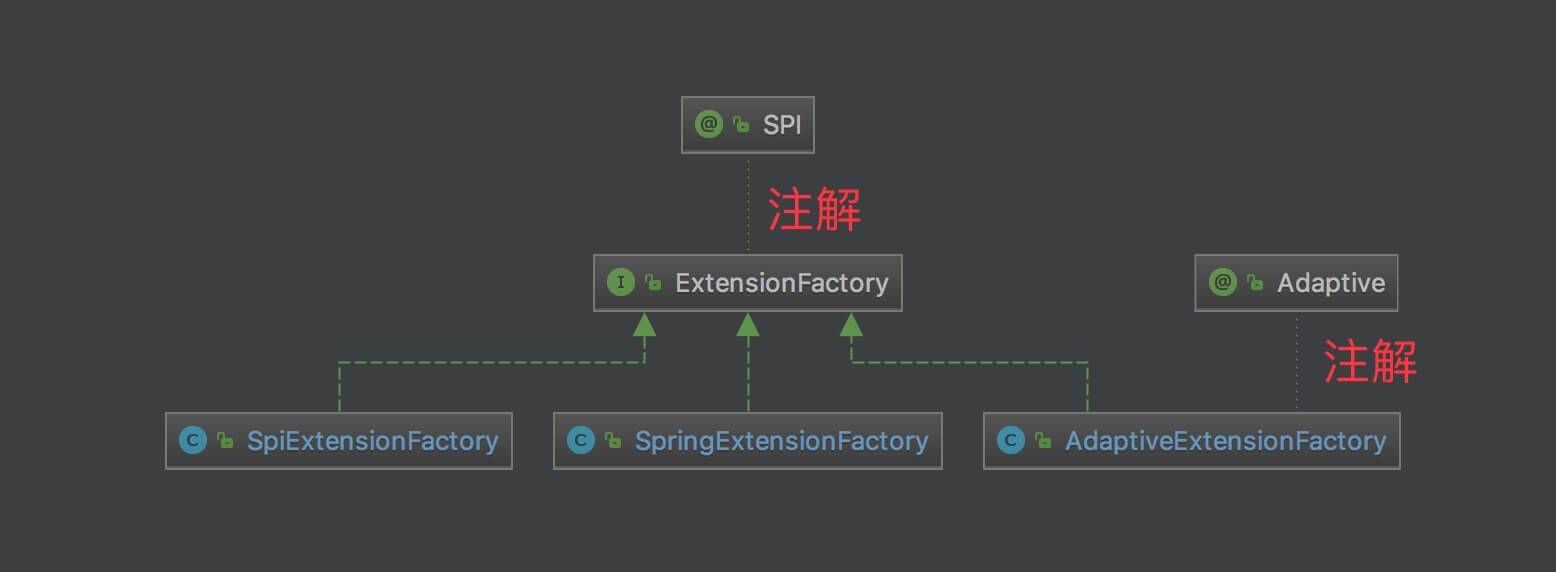
ExtensionFactory 类图
## 8.1 AdaptiveExtensionFactory
[com.alibaba.dubbo.common.extension.factory.AdaptiveExtensionFactory](https://github.com/YunaiV/dubbo/blob/4a877ee283af70c3f6a19c3b8b8e6918696540e6/dubbo-common/src/main/java/com/alibaba/dubbo/common/extension/factory/AdaptiveExtensionFactory.java) ,自适应 ExtensionFactory 拓展实现类。代码如下:
```plain text
plain 1: @Adaptive 2: public class AdaptiveExtensionFactory implements ExtensionFactory { 3: 4: /** 5: * ExtensionFactory 拓展对象集合 6: */ 7: private final List<ExtensionFactory> factories; 8: 9: public AdaptiveExtensionFactory() { 10: // 使用 ExtensionLoader 加载拓展对象实现类。 11: ExtensionLoader<ExtensionFactory> loader = ExtensionLoader.getExtensionLoader(ExtensionFactory.class); 12: List<ExtensionFactory> list = new ArrayList<ExtensionFactory>(); 13: for (String name : loader.getSupportedExtensions()) { 14: list.add(loader.getExtension(name)); 15: } 16: factories = Collections.unmodifiableList(list); 17: } 18: 19: public <T> T getExtension(Class<T> type, String name) { 20: // 遍历工厂数组,直到获得到属性 21: for (ExtensionFactory factory : factories) { 22: T extension = factory.getExtension(type, name); 23: if (extension != null) { 24: return extension; 25: } 26: } 27: return null; 28: } 29: 30: }
- @Adaptive自适应 注解,为 ExtensionFactory 的 拓展实现类。
- 构造 方法,使用 ExtensionLoader 加载 ExtensionFactory 拓展对象的实现类。若胖友没自己实现 ExtensionFactory 的情况下, factories 为 SpiExtensionFactory 和 SpringExtensionFactory 。
- #getExtension(type, name) 方法,遍历 factories ,调用其 #getExtension(type, name) 方法,直到获得到属性值。
8.2 SpiExtensionFactory
com.alibaba.dubbo.common.extension.factory.SpiExtensionFactory ,SPI ExtensionFactory 拓展实现类。代码如下:
```plain text plain public class SpiExtensionFactory implements ExtensionFactory { /** * 获得拓展对象 * * @param type object type. 拓展接口 * @param name object name. 拓展名 * @param
1
2
3
4
5
6
7
8
9

---

## 8.3 SpringExtensionFactory

[com.alibaba.dubbo.config.spring.extension.SpringExtensionFactory](http://svip.iocoder.cn/Dubbo/spi/SpringExtensionFactory) ,Spring ExtensionFactory 拓展实现类。代码如下:

```plain text
plain public class SpringExtensionFactory implements ExtensionFactory {      /**      * Spring Context 集合      */     private static final Set<ApplicationContext> contexts = new ConcurrentHashSet<ApplicationContext>();      public static void addApplicationContext(ApplicationContext context) {         contexts.add(context);     }      public static void removeApplicationContext(ApplicationContext context) {         contexts.remove(context);     }      @Override     @SuppressWarnings("unchecked")     public <T> T getExtension(Class<T> type, String name) {         for (ApplicationContext context : contexts) {             if (context.containsBean(name)) {                 // 获得属性                 Object bean = context.getBean(name);                 // 判断类型                 if (type.isInstance(bean)) {                     return (T) bean;                 }             }         }         return null;     }  }
- #getExtension(type, name) 方法,遍历 contexts ,调用其 ApplicationContext#getBean(name) 方法,获得 Bean 对象,直到成功并且值类型正确。
8.3.1 例子
DemoFilter 是笔者实现的 Filter 拓展实现类,代码如下:
```plain text plain public class DemoFilter implements Filter { private DemoDAO demoDAO; @Override public Result invoke(Invoker<?> invoker, Invocation invocation) throws RpcException { return invoker.invoke(invocation); } public DemoFilter setDemoDAO(DemoDAO demoDAO) { this.demoDAO = demoDAO; return this; } }
1
2
3
4
5
6
7

---

- DemoDAO ,笔者在 Spring 中声明对应的 Bean 对象。

```plain text
plain <bean id="demoDAO" class="com.alibaba.dubbo.demo.provider.DemoDAO" />
- 在 「4.4.3 injectExtension」 中,会调用 #setDemoDAO(demo) 方法,将 DemoFilter 依赖的属性 demoDAO 注入。
666. 彩蛋
比想象中的长的多的多。初始理解会比较辛苦,梳理干净后实际很简单。
能够耐心到此处的胖友,为你点赞。