核心流程一览
本文基于 Dubbo 2.6.1 版本,望知悉。
1. 概述
本文主要分享 Dubbo 的核心流程。希望通过本文能让胖友对 Dubbo 的核心流程有个简单的了解。
另外,笔者会相对大量引用 《Dubbo 开发指南 —— 框架设计》 和 《Dubbo 开发指南 —— 实现细节》 ,写的真的挺好的。 或者说,本文是该文章的细化和解说。ps:限于排版,部分地方引用会存在未标明的情况。
2. 整体设计
本小节,基本为引用 + 重新排版。
下面我们先来看看整体设计图,相对比较复杂:
FROM 《Dubbo 开发指南 —— 框架设计》
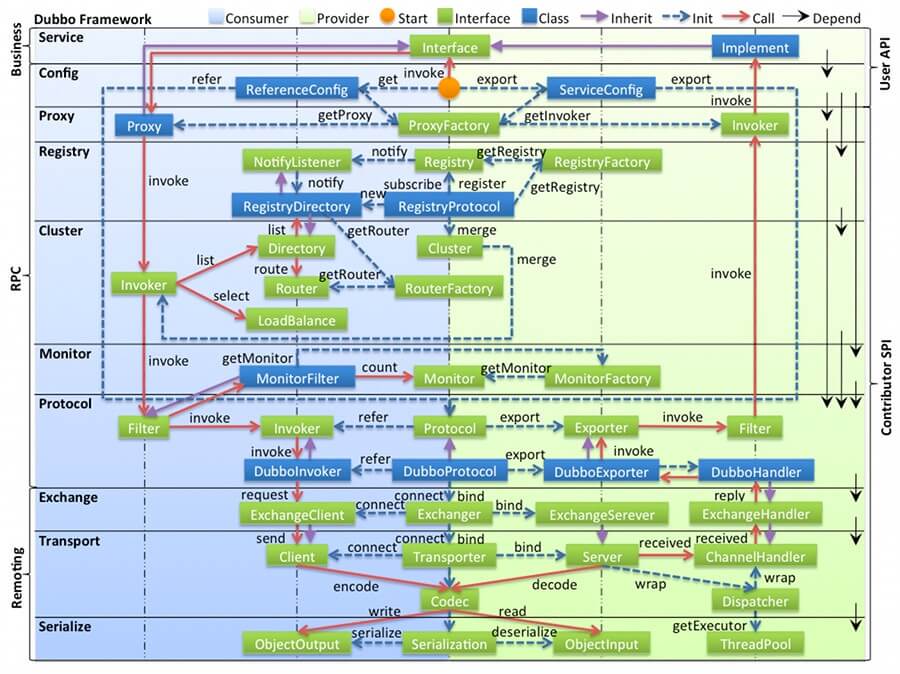
2.1 图例说明
- 最顶上九个图标,代表本图中的对象与流程。
- 图中左边 淡蓝背景淡绿色背景( Consumer ) 的为服务消费方使用的接口,右边( Provider ) 的为服务提供方使用的接口,位于中轴线上的为双方都用到的接口。
- 图中从下至上分为十层,各层均为单向黑色箭头SPI依赖,右边的( Depend ) 代表层之间的依赖关系,每一层都可以剥离上层被复用。其中,Service 和 Config 层为 API,其它各层均为。
- 图中 绿色小块蓝色小块( Interface ) 的为扩展接口,( Class ) 为实现类,图中只显示用于关联各层的实现类。
- 图中 蓝色虚线红色实线紫色三角箭头( Init ) 为初始化过程,即启动时组装链。( Call )为方法调用过程,即运行时调时链。( Inherit )为继承,可以把子类看作父类的同一个节点,线上的文字为调用的方法。
2.2 各层说明
友情提示:建议可以先阅读 《精尽 Dubbo 源码分析 —— 项目结构一览》 文章。
- ==================== Business ====================
- Service 业务层:业务代码的接口与实现。我们实际使用 Dubbo
- ==================== RPC ====================
- config 配置层:对外配置接口,以 ServiceConfig, ReferenceConfig 为中心,可以直接初始化配置类,也可以通过 Spring 解析配置生成配置类。
- dubbo-config模块实现。
- 这层的代码,在 《精尽 Dubbo 源码分析 —— API 配置》、《精尽 Dubbo 源码分析 —— XML 配置》,等等文章,已经详细解析。
- proxy 服务代理层
以 ServiceProxy 为中心:服务接口透明代理,生成服务的客户端 Stub 和服务器端 Skeleton,,扩展接口为 ProxyFactory 。 - registry注册中心层:封装服务地址的注册与发现,以服务 URL 为中心,扩展接口为 RegistryFactory, Registry, RegistryService 。
- dubbo-registry模块实现。
- cluster 路由层:封装多个提供者的路由及负载均衡,并桥接注册中心,以 Invoker 为中心,扩展接口为 Cluster, Directory, Router, LoadBalance 。
- dubbo-cluster模块实现。
- 这层的代码,在 《精尽 Dubbo 源码分析 —— 项目结构一览》「3.4 dubbo-cluster」章节,有简单介绍。
- monitor 监控层:RPC 调用次数和调用时间监控,以 Statistics 为中心,扩展接口为 MonitorFactory, Monitor, MonitorService 。
- dubbo-monitor模块实现。
- ==================== Remoting ====================
- protocol 远程调用层:封将 RPC 调用,以 Invocation, Result 为中心,扩展接口为 Protocol, Invoker, Exporter 。
- exchange 信息交换层:封装请求响应模式,同步转异步,以 Request, Response 为中心,扩展接口为 Exchanger, ExchangeChannel, ExchangeClient, ExchangeServer 。
- transport 网络传输层:抽象 mina 和 netty 为统一接口,以 Message 为中心,扩展接口为 Channel, Transporter, Client, Server, Codec 。
- serialize 数据序列化层:可复用的一些工具,扩展接口为 Serialization, ObjectInput, ObjectOutput, ThreadPool 。
2.3 关系说明
在 RPC 中,Protocol 是核心层,也就是只要有 Protocol + Invoker + Exporter 就可以完成非透明的 RPC 调用,然后在 Invoker 的主过程上 Filter 拦截点。
- 解说:dubbo-rpc-rpc独立模块即可完成该功能。
图中的 Consumer 和 Provider 是抽象概念,只是想让看图者更直观的了解哪些类分属于客户端与服务器端,不用 Client 和 Server 的原因是 Dubbo 在很多场景下都使用 Provider, Consumer, Registry, Monitor 划分逻辑拓普节点,保持统一概念。
- x
而 Cluster 是外围概念,所以 Cluster 的目的是将多个 Invoker 伪装成一个 Invoker,这样其它人只要关注 Protocol 层 Invoker 即可,加上 Cluster 或者去掉 Cluster 对其它层都不会造成影响,因为只有一个提供者时,是不需要 Cluster 的。
- 解说:dubbo-cluster非必须模块提供的是的功能。移除该模块,RPC 亦可正常运行。
Proxy 层封装了所有接口的透明化代理,而在其它层都以 Invoker 为中心,只有到了暴露给用户使用时,才用 Proxy 将 Invoker 转成接口,或将接口实现转成 Invoker,也就是去掉 Proxy 层 RPC 是可以 Run 的,只是不那么透明,不那么看起来像调本地服务一样调远程服务。
- 解说:简单粗暴的说,Proxy 会拦截透明化service.doSomething(args)的调用,”转发”给该 Service 对应的 Invoker ,从而实现的代理。
而 Remoting 实现是 Dubbo 协议的实现,如果你选择 RMI 协议,整个 Remoting 都不会用上。Remoting 内部再划为 Transport 传输层和 Exchange 信息交换层,Transport 层只负责单向消息传输,是对 Mina, Netty, Grizzly 的抽象,它也可以扩展 UDP 传输;而 Exchange 层是在传输层之上封装了 Request-Response 语义。
- x
Registry 和 Monitor 实际上不算一层,而是一个独立的节点,只是为了全局概览,用层的方式画在一起。
- x
3. 核心流程
3.1 调用链
展开总设计图的红色调用链( Call ),如下:
FROM 《Dubbo 开发指南 —— 框架设计》
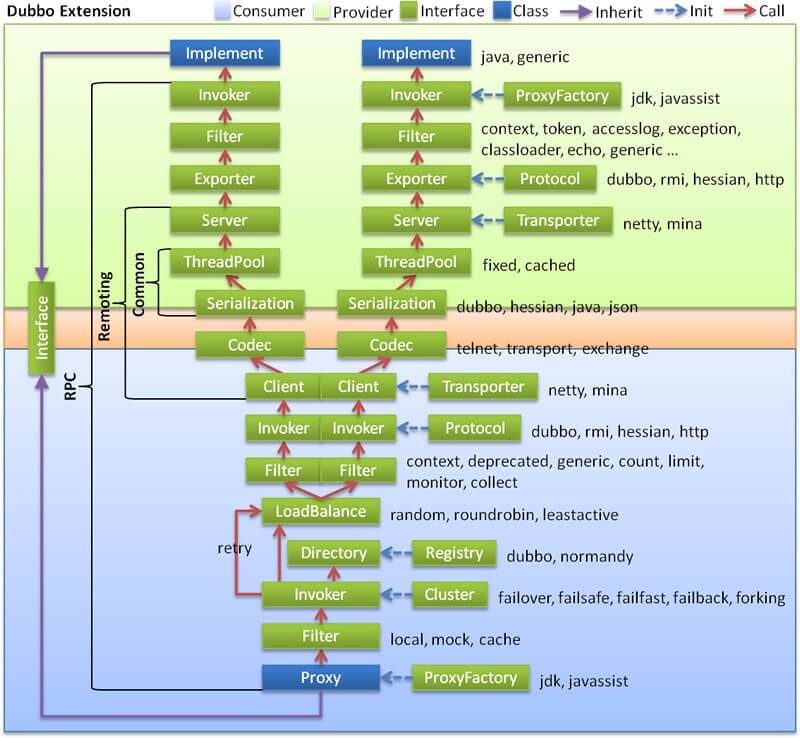
- 垂直分层如下:
- 下方 淡蓝背景( Consumer ):服务消费方使用的接口
- 上方 淡绿色背景( Provider ):服务提供方使用的接口
- 中间 粉色背景( Remoting ):通信部分的接口
- 自 LoadBalance 向上,每一行分成了多个负载均衡相同的 Interface ,指的是后,向 Provider 发起调用。
- 左边 括号细化部分,代表了垂直部分更的分层,依次是:Common、Remoting、RPC、Interface 。
- 右边 蓝色虚线( Init ) 为初始化过程,通过对应的组件进行初始化。例如,ProxyFactory 初始化出 Proxy 。
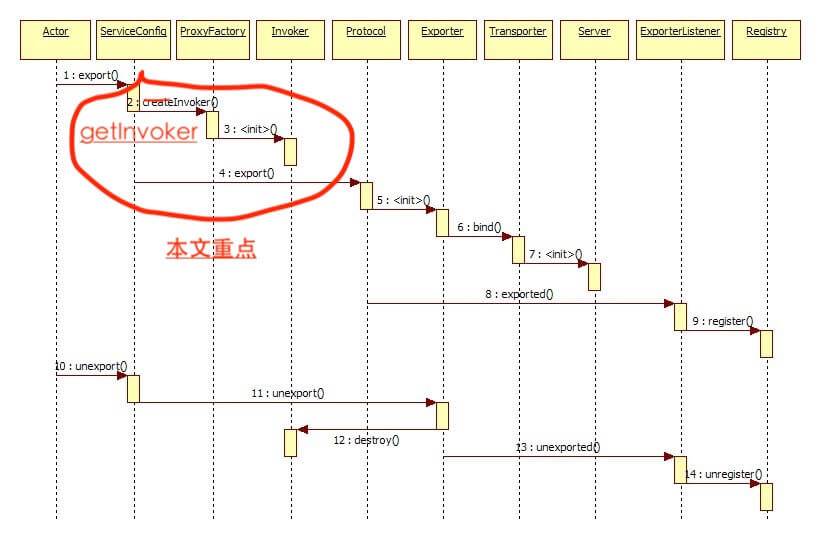
3.2 暴露服务
展开总设计图左边服务提供方暴露服务的蓝色初始化链( Init ),时序图如下:
FROM 《Dubbo 开发指南 —— 框架设计》
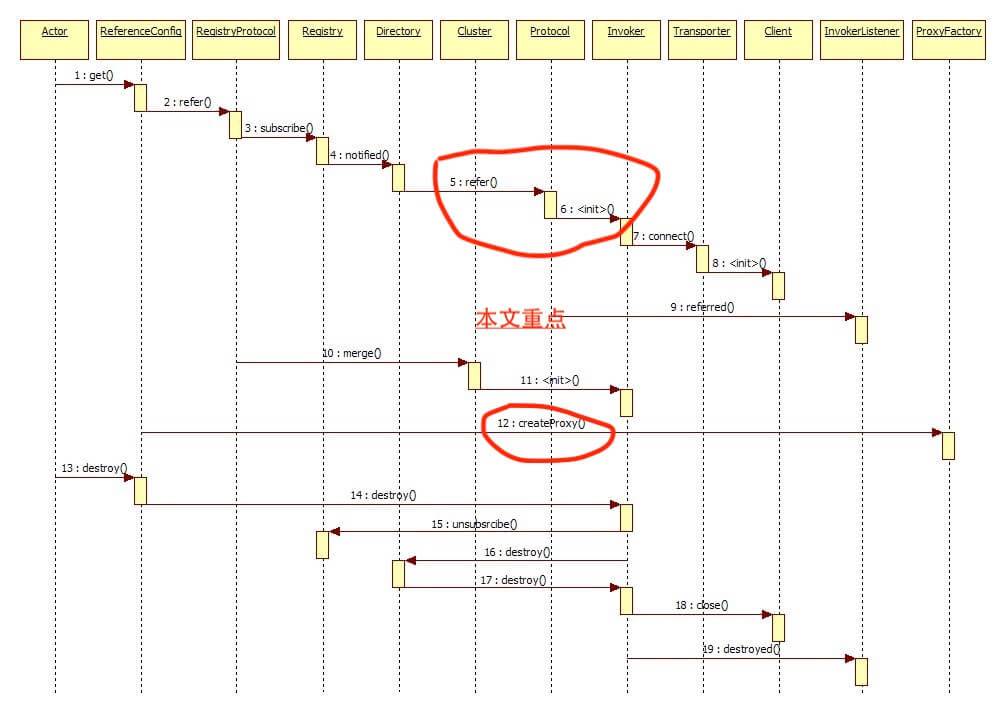
3.3 引用服务
展开总设计图右边服务消费方引用服务的蓝色初始化链( Init ),时序图如下:
FROM 《Dubbo 开发指南 —— 框架设计》
4. 领域模型
本小节分享的,在 dubbo-rpc-api 目录中,如下图红框部分:
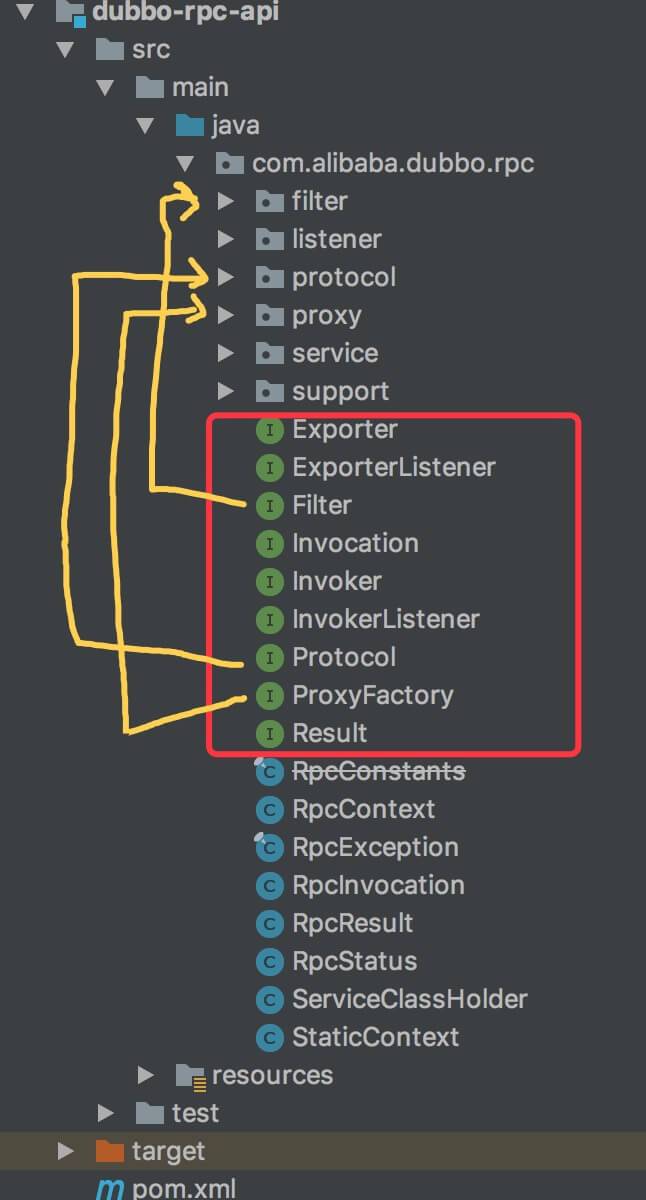
4.1 Invoker
com.alibaba.dubbo.rpc.Invoker 。
Invoker 是实体域,它是 Dubbo 的核心模型,其它模型都向它靠拢,或转换成它。它代表一个可执行体,可向它发起 invoke 调用。它有可能是一个本地的实现,也可能是一个远程的实现,也可能一个集群实现。
代码如下:
1
2
3
4
5
6
7
8
9
10
11
12
13
14
15
16
17
public interface Invoker<T> extends Node {
    /**
     * get service interface.
     *
     * @return service interface.
     */
    Class<T> getInterface();

    /**
     * invoke.
     *
     * @param invocation
     * @return result
     * @throws RpcException
     */
    Result invoke(Invocation invocation) throws RpcException;
}
- #getInterface() 方法,获得 Service 接口。
- #invoke(Invocation) 方法,调用方法。
4.1.1 满眼都是 Invoker
下面,我们要引用 《Dubbo 开发指南 —— 实现细节》 的 满眼都是 Invoker 小节的内容,来进一步理解 Invoker :
由于 Invoker 是 Dubbo 领域模型中非常重要的一个概念,很多设计思路都是向它靠拢。这就使得 Invoker 渗透在整个实现代码里,对于刚开始接触 Dubbo 的人,确实容易给搞混了。
下面我们用一个精简的图来说明最重要的两种 Invoker:服务提供 Invoker 和服务消费 Invoker:
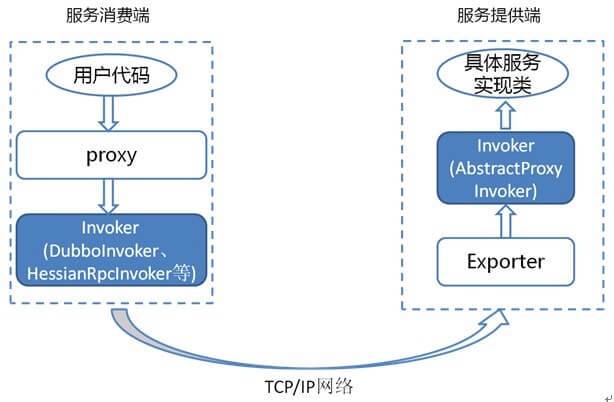
为了更好的解释上面这张图,我们结合服务消费和提供者的代码示例来进行说明:
- 服务消费者代码:
1
2
3
4
5
6
7
8
9
10
11
public class DemoClientAction {
    private DemoService demoService;

    public void setDemoService(DemoService demoService) {
        this.demoService = demoService;
    }

    public void start() {
        String hello = demoService.sayHello("world" + i);
    }
}
上面代码中的 DemoService 就是上图中服务消费端的 Proxy,用户代码通过这个 Proxy 调用其对应的 Invoker,而该 Invoker 实现了真正的远程服务调用。
服务提供者代码:
1
2
3
4
5
public class DemoServiceImpl implements DemoService {
    public String sayHello(String name) throws RemoteException {
        return "Hello " + name;
    }
}
- 上面这个类会被封装成为一个 AbstractProxyInvoker 实例,并新生成一个 Exporter 实例。这样当网络通讯层收到一个请求后,会找到对应的 Exporter 实例,并调用它所对应的 AbstractProxyInvoker 实例,从而真正调用了服务提供者的代码。
Dubbo 里还有一些其他的 Invoker 类,但上面两种是最重要的。
4.1.2 类图
正如上文所说,Invoker 渗透在 Dubbo 的代码中,Invoker 的实现类也非常非常非常多,如下图:
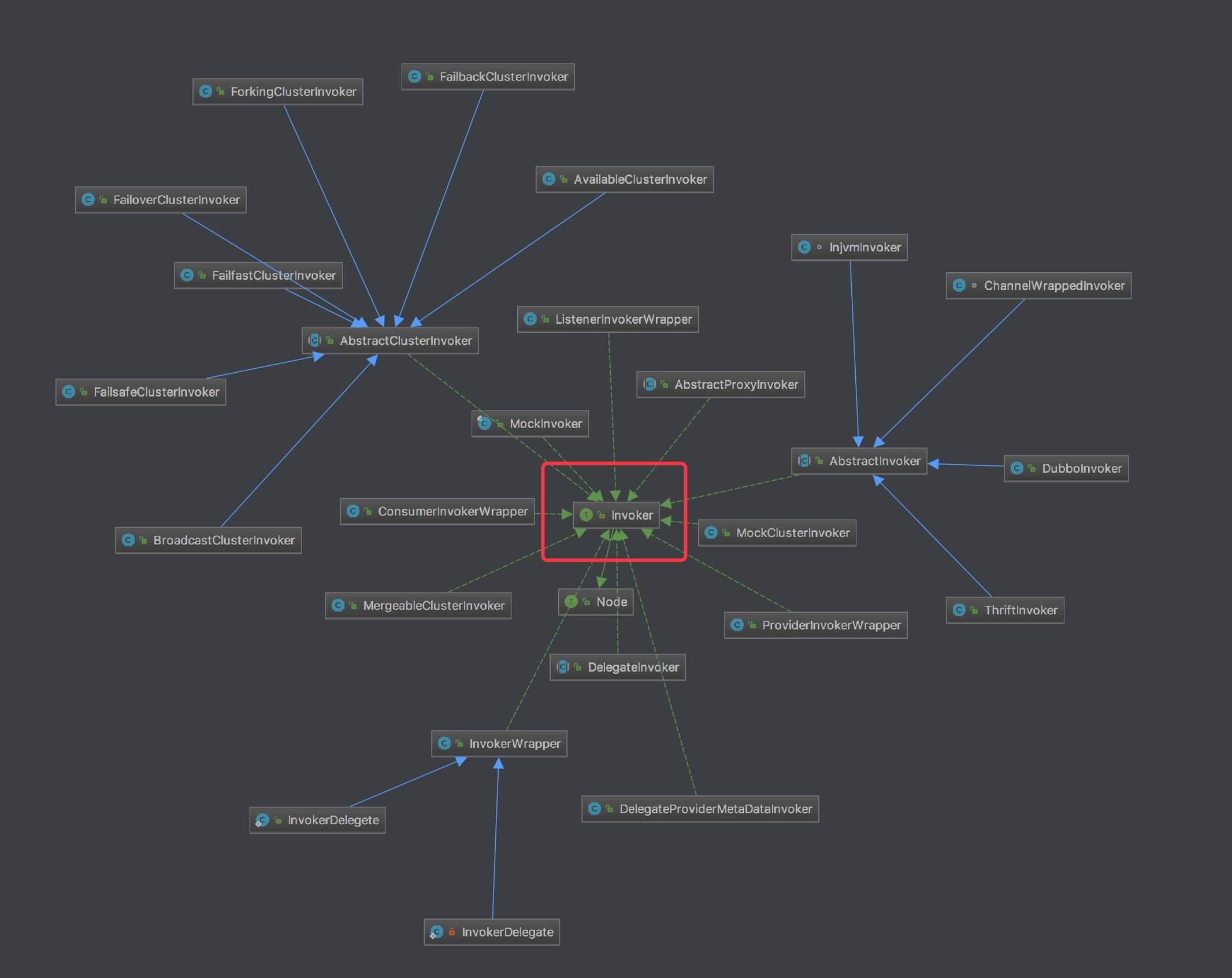
后续我们会详细分析。
4.2 Invocation
com.alibaba.dubbo.rpc.Invocation 。
Invocation 是会话域,它持有调用过程中的变量,比如方法名,参数等。
代码如下:
1
2
3
4
5
6
7
8
9
10
11
12
13
14
15
16
17
18
19
20
21
22
23
24
25
26
27
28
29
30
31
32
33
34
35
36
37
38
39
40
41
42
43
44
45
46
47
48
49
50
51
52
53
54
55
56
57
public interface Invocation {
    /**
     * get method name.
     *
     * @return method name.
     * @serial
     */
    String getMethodName();

    /**
     * get parameter types.
     *
     * @return parameter types.
     * @serial
     */
    Class<?>[] getParameterTypes();

    /**
     * get arguments.
     *
     * @return arguments.
     * @serial
     */
    Object[] getArguments();

    /**
     * get attachments.
     *
     * @return attachments.
     * @serial
     */
    Map<String, String> getAttachments();

    /**
     * get attachment by key.
     *
     * @return attachment value.
     * @serial
     */
    String getAttachment(String key);

    /**
     * get attachment by key with default value.
     *
     * @return attachment value.
     * @serial
     */
    String getAttachment(String key, String defaultValue);

    /**
     * get the invoker in current context.
     *
     * @return invoker.
     * @transient
     */
    Invoker<?> getInvoker();
}
- #getMethodName() 方法,获得方法名。
- #getParameterTypes()类型方法,获得方法参数数组。
- #getArguments() 方法,获得方法参数数组。
- #getAttachments() 等方法,获得隐式参数相关。
- 不了解的胖友,可以看看 《Dubbo 用户指南 —— 隐式参数》文档。
- 和 HTTP Request Header有些相似。
- #getInvoker() 方法,获得对应的 Invoker 对象。
4.2.1 类图
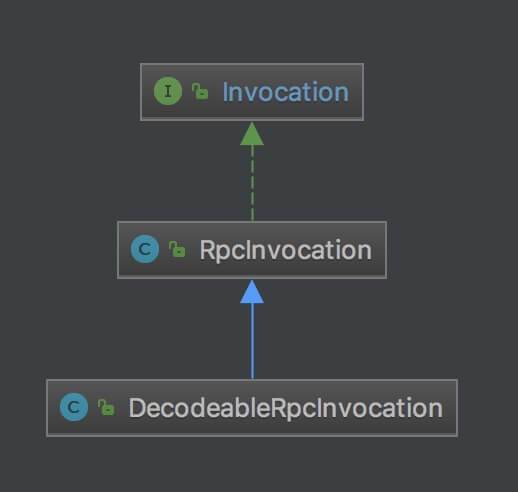
- com.alibaba.dubbo.rpc.RpcInvocation
- 点击查看,比较容易理解。
- com.alibaba.dubbo.rpc.protocol.dubbo.DecodeableRpcInvocation
- Dubbo 协议独有,后续文章分享。
4.3 Result
com.alibaba.dubbo.rpc.Result 。
Result 是会话域,它持有调用过程中返回值,异常等。
代码如下:
1
2
3
4
5
6
7
8
9
10
11
12
13
14
15
16
17
18
19
20
21
22
23
24
25
26
27
28
29
30
31
32
33
34
35
36
37
38
39
40
41
42
43
44
45
46
47
48
49
50
51
52
53
54
55
56
57
58
59
public interface Result {
    /**
     * Get invoke result.
     *
     * @return result. if no result return null.
     */
    Object getValue();

    /**
     * Get exception.
     *
     * @return exception. if no exception return null.
     */
    Throwable getException();

    /**
     * Has exception.
     *
     * @return has exception.
     */
    boolean hasException();

    /**
     * Recreate.
     * <p>
     * <code>
     * if (hasException()) {
     * throw getException();
     * } else {
     * return getValue();
     * }
     * </code>
     *
     * @return result.
     * @throws if has exception throw it.
     */
    Object recreate() throws Throwable;

    /**
     * get attachments.
     *
     * @return attachments.
     */
    Map<String, String> getAttachments();

    /**
     * get attachment by key.
     *
     * @return attachment value.
     */
    String getAttachment(String key);

    /**
     * get attachment by key with default value.
     *
     * @return attachment value.
     */
    String getAttachment(String key, String defaultValue);
}
- #getValue() 方法,获得返回值。
- #getException() 方法,获得返回的异常。
- #hasException() 方法,是否有异常。
- #recreate() 方法,实现代码如下:
1
2
3
4
5
6
7
8
9
10
// RpcResult.java
private Object result;
private Throwable exception;

public Object recreate() throws Throwable {
    if (exception != null) {
        throw exception;
    }
    return result;
}
- #getAttachments()返回等方法,获得的隐式参数相关。
- 不了解的胖友,可以看看 《Dubbo 用户指南 —— 隐式参数》文档。
- 和 HTTP Response Header有些相似。
4.3.1 类图
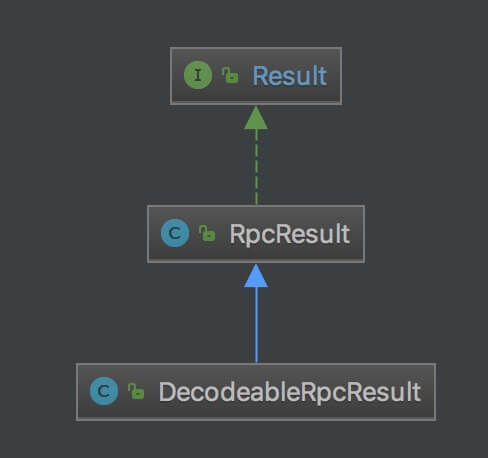
- com.alibaba.dubbo.rpc.RpcResult
- 点击查看,比较容易理解。
- com.alibaba.dubbo.rpc.protocol.dubbo.DecodeableRpcResult
- Dubbo 协议独有,后续文章分享。
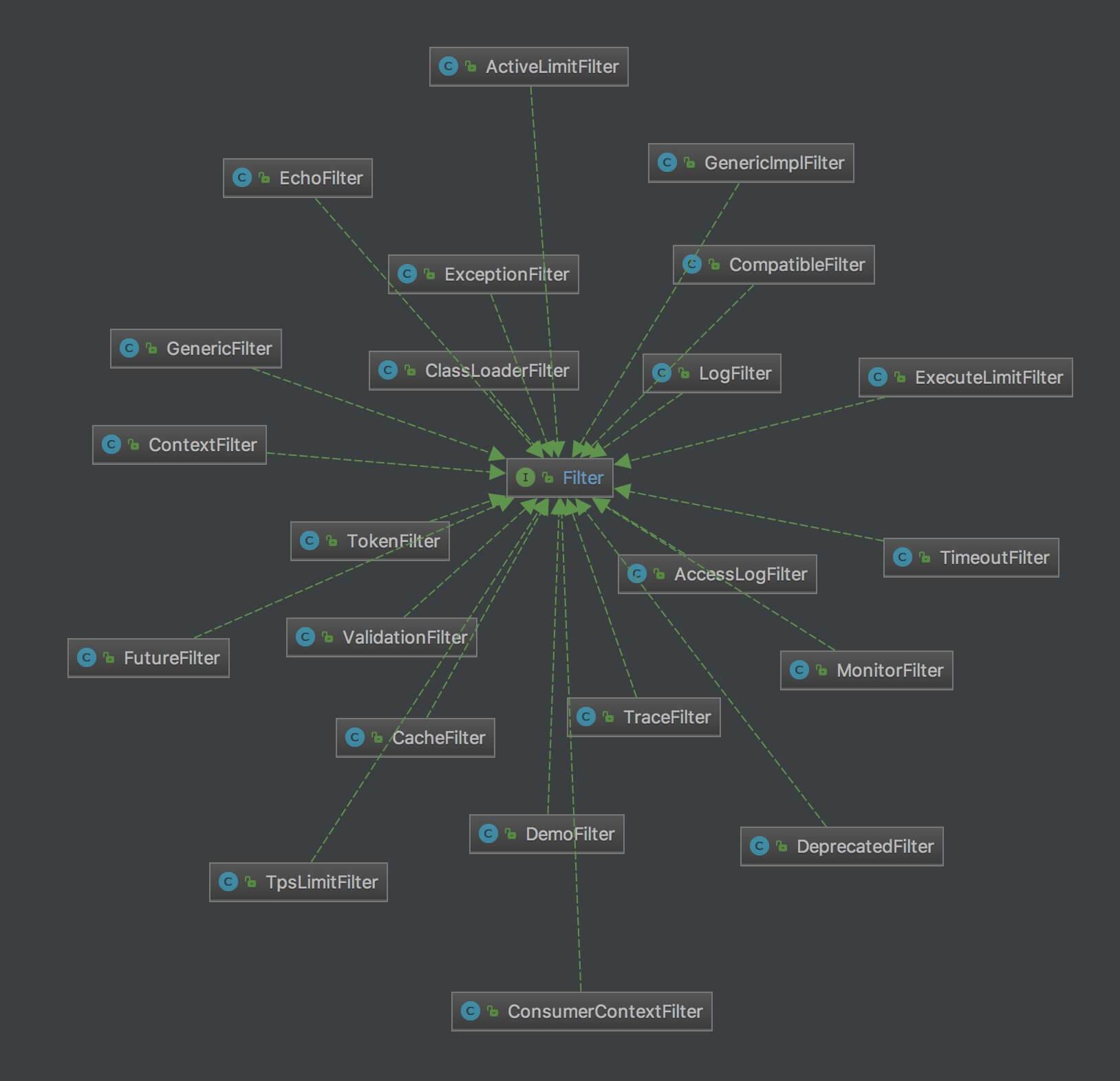
4.4 Filter
com.alibaba.dubbo.rpc.Filter 。
过滤器接口,和我们平时理解的 javax.servlet.Filter 基本一致。
代码如下:
1
2
3
4
5
6
7
8
9
10
11
12
13
14
15
16
17
18
19
public interface Filter {
    /**
     * do invoke filter.
     * <p>
     * <code>
     * // before filter
     * Result result = invoker.invoke(invocation);
     * // after filter
     * return result;
     * </code>
     *
     * @param invoker    service
     * @param invocation invocation.
     * @return invoke result.
     * @throws RpcException
     * @see com.alibaba.dubbo.rpc.Invoker#invoke(Invocation)
     */
    Result invoke(Invoker<?> invoker, Invocation invocation) throws RpcException;
}
- #invoke(…) 方法,执行 Invoker 的过滤逻辑。代码示例如下:
1
2
3
4
5
// 【自己实现】before filter
Result result = invoker.invoke(invocation);

// 【自己实现】after filter
return result;
4.4.1 类图
4.5 ProxyFactory
com.alibaba.dubbo.rpc.ProxyFactory ,代理工厂接口。
代码如下:
1
2
3
4
5
6
7
8
9
10
11
12
13
14
15
16
17
18
19
20
21
22
23
24
25
26
27
@SPI("javassist")
public interface ProxyFactory {
    /**
     * create proxy.
     *
     * 创建 Proxy ,在引用服务调用。
     *
     * @param invoker
     * @return proxy
     */
    @Adaptive({Constants.PROXY_KEY})
    <T> T getProxy(Invoker<T> invoker) throws RpcException;

    /**
     * create invoker.
     *
     * 创建 Invoker ,在暴露服务时调用。
     *
     * @param <T>
     * @param proxy
     * @param type
     * @param url
     * @return invoker
     */
    @Adaptive({Constants.PROXY_KEY})
    <T> Invoker<T> getInvoker(T proxy, Class<T> type, URL url) throws RpcException;
}
- #getProxy(invoker)引用服务方法,创建 Proxy ,在时调用。
- 方法参数如下:
- invoker 参数,Consumer 对 Provider 调用的 Invoker 。
- 服务消费着引用服务的 主过程《Dubbo 开发指南 —— 实现细节》如下图: FROM
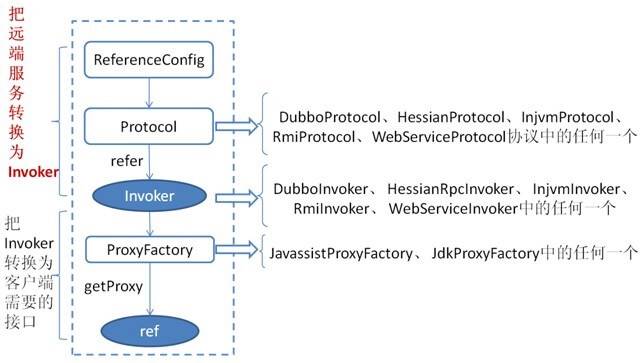
- 从图中我们可以看出,方法的 Service接口invoker 参数,通过 Protocol 将创建出 Invoker 。
- 通过创建 Service 的 Proxy ,实现我们在业务代理调用 Service 的方法时,透明的内部转换成调用Invoker 的#invoke(Invocation)方法。 如果还是比较模糊,木有关系,后面会有文章,专门详细代码的分享。
- 方法参数如下:
- #getInvoker(proxy, type, url)暴露服务方法,创建 Invoker ,在时调用。
- 方法参数如下:
- proxy 参数,Service 对象。
- type 参数,Service 接口类型。
- url 参数,Service 对应的 Dubbo URL 。
- 服务提供者暴露服务的 主过程《Dubbo 开发指南 —— 实现细节》如下图: FROM
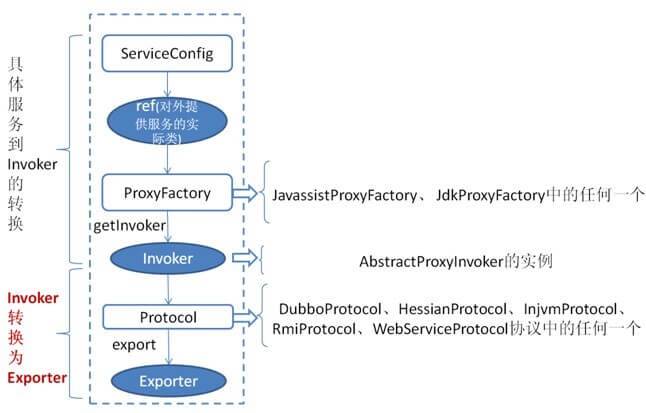
- 从图中我们可以看出,该方法创建的 Invoker ,下一步会提交给 Protocol ,从 Invoker 转换到 Exporter 。
- 方法参数如下:
4.5.1 类图
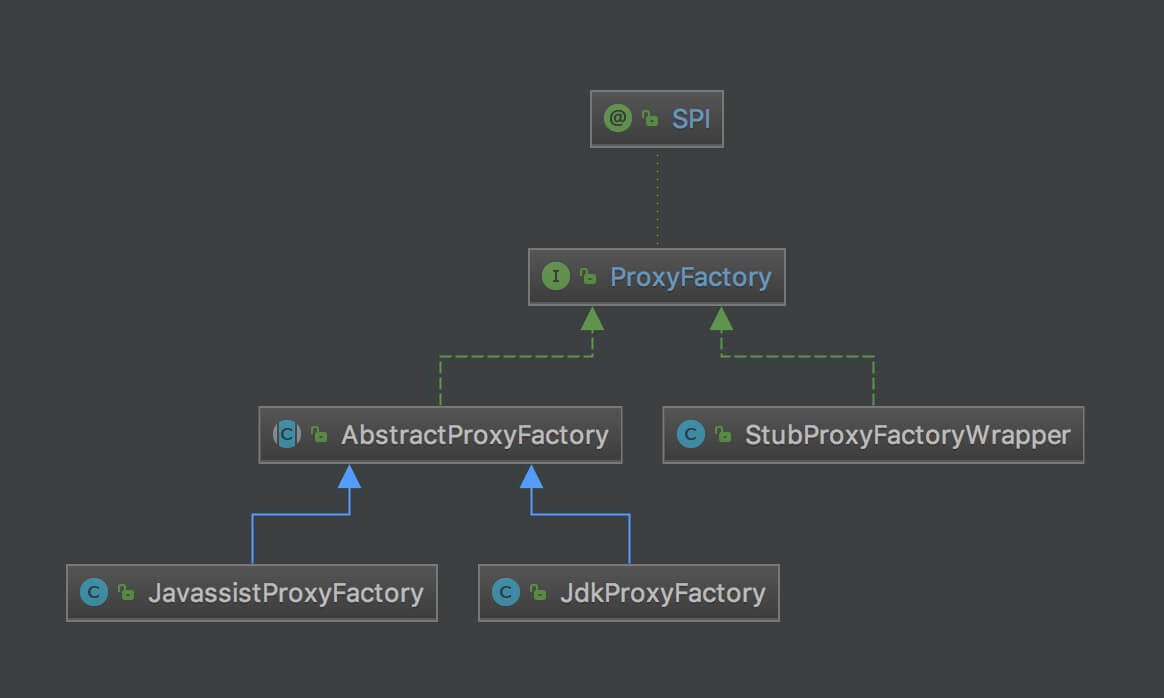
从图中,我们可以看出 Dubbo 支持 Javassist 和 JDK Proxy 两种方式生成代理。
具体如何实现,请看后面的文章。
4.6 Protocol
com.alibaba.dubbo.rpc.Protocol 。
Protocol 是服务域,它是 Invoker 暴露和引用的主功能入口。它负责 Invoker 的生命周期管理。
代码如下:
1
2
3
4
5
6
7
8
9
10
11
12
13
14
15
16
17
18
19
20
21
22
23
24
25
26
27
28
29
30
31
32
33
34
35
36
37
38
39
40
41
42
43
44
45
46
47
48
49
50
51
52
53
54
55
56
57
58
59
60
61
62
63
64
65
66
67
68
69
70
71
72
73
74
75
76
77
78
79
80
@SPI("dubbo")
public interface Protocol {
    /**
     * Get default port when user doesn't config the port.
     *
     * @return default port
     */
    int getDefaultPort();

    /**
     * Export service for remote invocation: <br>
     * 1. Protocol should record request source address after receive a request:
     * RpcContext.getContext().setRemoteAddress();<br>
     * 2. export() must be idempotent, that is, there's no difference between invoking once and invoking twice when
     * export the same URL<br>
     * 3. Invoker instance is passed in by the framework, protocol needs not to care <br>
     *
     * @param <T>     Service type
     * @param invoker Service invoker
     * @return exporter reference for exported service, useful for unexport the service later
     * @throws RpcException thrown when error occurs during export the service, for example: port is occupied
     */
    /**
     * 暴露远程服务:<br>
     * 1. 协议在接收请求时,应记录请求来源方地址信息:RpcContext.getContext().setRemoteAddress();<br>
     * 2. export() 必须是幂等的,也就是暴露同一个 URL 的 Invoker 两次,和暴露一次没有区别。<br>
     * 3. export() 传入的 Invoker 由框架实现并传入,协议不需要关心。<br>
     *
     * @param <T>     服务的类型
     * @param invoker 服务的执行体
     * @return exporter 暴露服务的引用,用于取消暴露
     * @throws RpcException 当暴露服务出错时抛出,比如端口已占用
     */
    @Adaptive
    <T> Exporter<T> export(Invoker<T> invoker) throws RpcException;

    /**
     * Refer a remote service: <br>
     * 1. When user calls `invoke()` method of `Invoker` object which's returned from `refer()` call, the protocol
     * needs to correspondingly execute `invoke()` method of `Invoker` object <br>
     * 2. It's protocol's responsibility to implement `Invoker` which's returned from `refer()`. Generally speaking,
     * protocol sends remote request in the `Invoker` implementation. <br>
     * 3. When there's check=false set in URL, the implementation must not throw exception but try to recover when
     * connection fails.
     *
     * @param <T>  Service type
     * @param type Service class
     * @param url  URL address for the remote service
     * @return invoker service's local proxy
     * @throws RpcException when there's any error while connecting to the service provider
     */
    /**
     * 引用远程服务:<br>
     * 1. 当用户调用 refer() 所返回的 Invoker 对象的 invoke() 方法时,协议需相应执行同 URL 远端 export() 传入的 Invoker 对象的 invoke() 方法。<br>
     * 2. refer() 返回的 Invoker 由协议实现,协议通常需要在此 Invoker 中发送远程请求。<br>
     * 3. 当 url 中有设置 check=false 时,连接失败不能抛出异常,并内部自动恢复。<br>
     *
     * @param <T>  服务的类型
     * @param type 服务的类型
     * @param url  远程服务的URL地址
     * @return invoker 服务的本地代理
     * @throws RpcException 当连接服务提供方失败时抛出
     */
    @Adaptive
    <T> Invoker<T> refer(Class<T> type, URL url) throws RpcException;

    /**
     * Destroy protocol: <br>
     * 1. Cancel all services this protocol exports and refers <br>
     * 2. Release all occupied resources, for example: connection, port, etc. <br>
     * 3. Protocol can continue to export and refer new service even after it's destroyed.
     */
    /**
     * 释放协议:<br>
     * 1. 取消该协议所有已经暴露和引用的服务。<br>
     * 2. 释放协议所占用的所有资源,比如连接和端口。<br>
     * 3. 协议在释放后,依然能暴露和引用新的服务。<br>
     */
    void destroy();
}
- 每个方法的说明,请细看方法的注释。
Dubbo 处理服务暴露的关键就在 Invoker 转换到 Exporter 的过程。下面我们以 Dubbo 和 RMI 这两种典型协议的实现来进行说明:
- Dubbo 的实现 Dubbo 协议的 Invoker 转为 Exporter 发生在 DubboProtocol 类的 export 方法,它主要是打开 socket 侦听服务,并接收客户端发来的各种请求,通讯细节由 Dubbo 自己实现。
- RMI 的实现 RMI 协议的 Invoker 转为 Exporter 发生在 RmiProtocol 类的 export 方法,它通过 Spring 或 Dubbo 或 JDK 来实现 RMI 服务,通讯细节这一块由 JDK 底层来实现,这就省了不少工作量。
4.6.1 类图
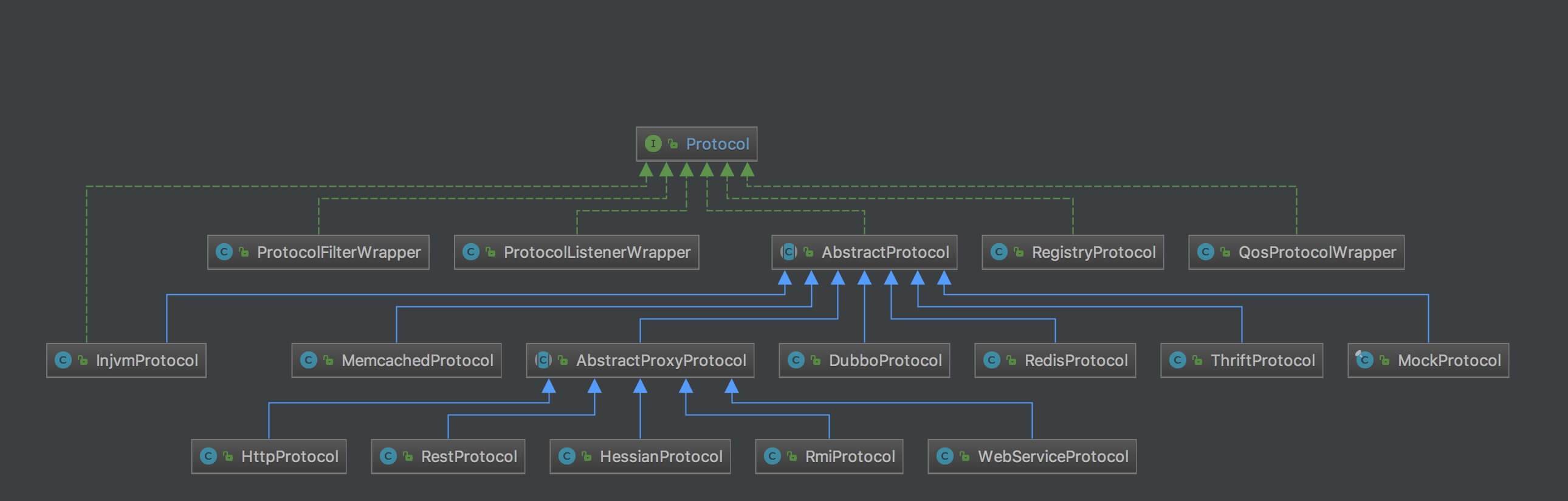
从图中,我们可以看出 Dubbo 支持多种协议的实现。
具体如何实现,请看后面的文章。
4.7 Exporter
com.alibaba.dubbo.rpc.Exporter 。
Exporter ,Invoker 暴露服务在 Protocol 上的对象。
代码如下:
1
2
3
4
5
6
7
8
9
10
11
12
13
14
15
16
17
public interface Exporter<T> {
    /**
     * get invoker.
     *
     * @return invoker
     */
    Invoker<T> getInvoker();

    /**
     * unexport.
     * <p>
     * <code>
     * getInvoker().destroy();
     * </code>
     */
    void unexport();
}
- #getInvoker() 方法,获得对应的 Invoker 。
- #unexport() 方法,取消暴露。
- Exporter 相比 Invoker 接口,多了 这个方法相同不同。通过实现该方法,使的 Invoker 在的 Protocol 实现的取消暴露逻辑。
4.7.1 类图

具体如何实现,请看后面的文章。
4.8 InvokerListener
com.alibaba.dubbo.rpc.InvokerListener ,Invoker 监听器。
代码如下:
1
2
3
4
5
6
7
8
9
10
11
12
13
14
15
16
17
18
19
20
21
22
23
@SPI
public interface InvokerListener {
    /**
     * The invoker referred
     *
     * 当服务引用完成
     *
     * @param invoker
     * @throws RpcException
     * @see com.alibaba.dubbo.rpc.Protocol#refer(Class, URL)
     */
    void referred(Invoker<?> invoker) throws RpcException;

    /**
     * The invoker destroyed.
     *
     * 当服务销毁引用完成
     *
     * @param invoker
     * @see com.alibaba.dubbo.rpc.Invoker#destroy()
     */
    void destroyed(Invoker<?> invoker);
}
4.8.1 类图
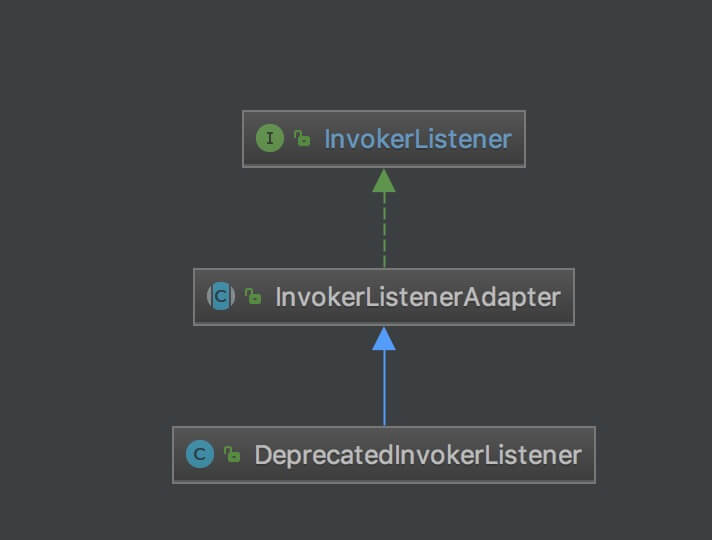
4.9 ExporterListener
com.alibaba.dubbo.rpc.ExporterListener ,Exporter 监听器。
代码如下:
1
2
3
4
5
6
7
8
9
10
11
12
13
14
15
16
17
18
19
20
21
22
23
24
@SPI
public interface ExporterListener {
    /**
     * The exporter exported.
     *
     * 当服务暴露完成
     *
     * @param exporter
     * @throws RpcException
     * @see com.alibaba.dubbo.rpc.Protocol#export(Invoker)
     */
    void exported(Exporter<?> exporter) throws RpcException;

    /**
     * The exporter unexported.
     *
     * 当服务取消暴露完成
     *
     * @param exporter
     * @throws RpcException
     * @see com.alibaba.dubbo.rpc.Exporter#unexport()
     */
    void unexported(Exporter<?> exporter);
}
4.9.1 类图
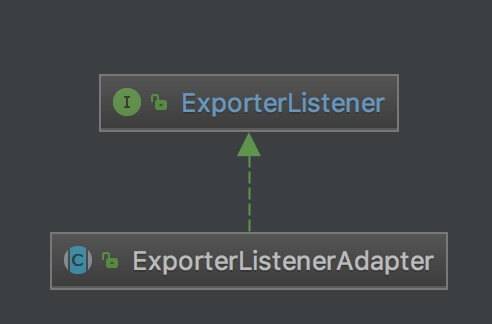
666. 彩蛋
不惊再次感叹,Dubbo 无论在使用文档,还是在开发文档,都做的非常完善。对于我们这些想要一窥 Dubbo 实现的”读者”来说,效率提升大大的。
咳咳咳,硬生生把这篇博客变成了摘抄的感觉。