集群容错(四)之LoadBalance实现
本文基于 Dubbo 2.6.1 版本,望知悉。
1. 概述
本文接 《精尽 Dubbo 源码解析 —— 集群容错(三)之 Directory 实现》 一文,分享 dubbo-cluster 模块, loadbalance 包,各种 LoadBalance 实现类。
LoadBalance 子类如下图:
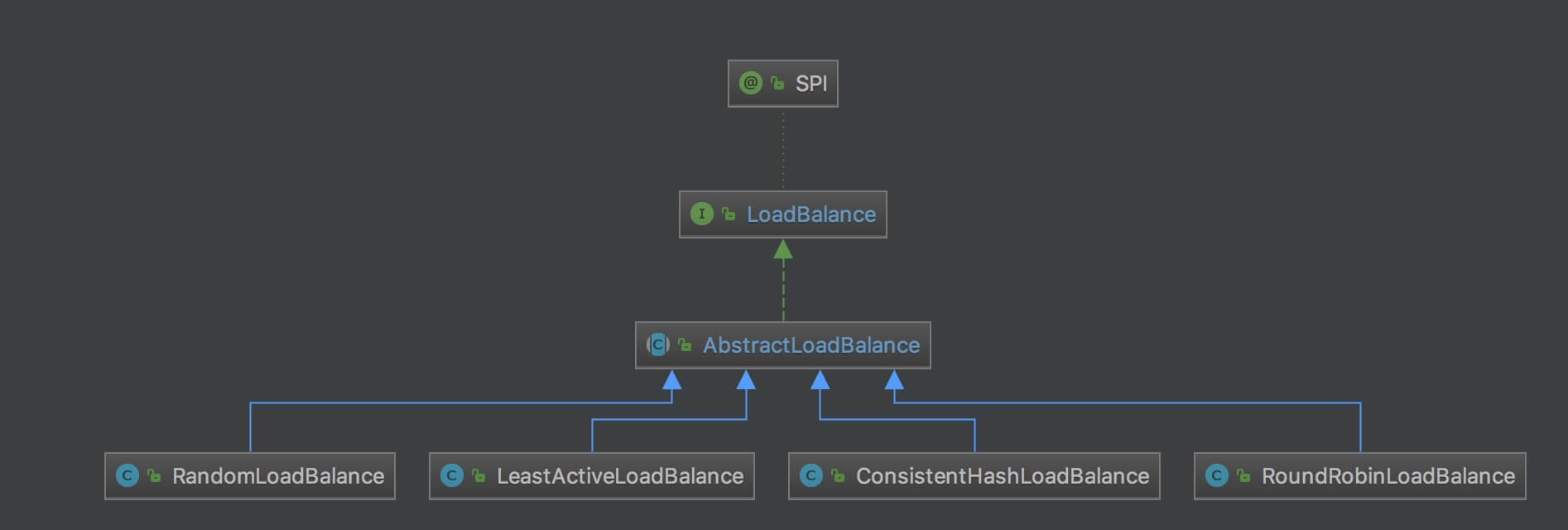
LoadBalance 子类
我们可以看到,目前一共有四个子类,意味着内置了四种负载均衡的选择算法。
老艿艿:本文对应 《Dubbo 用户指南 —— 负载均衡》 文档。
2. LoadBalance
com.alibaba.dubbo.rpc.cluster.LoadBalance , LoadBalance 接口。代码如下:
```plain text plain @SPI(RandomLoadBalance.NAME) public interface LoadBalance { /** * select one invoker in list. * * 从 Invoker 集合中,选择一个 * * @param invokers invokers. * @param url refer url * @param invocation invocation. * @return selected invoker. */ @Adaptive(“loadbalance”)
1
2
3
4
5
6
7
8
9
10
11
12
13
14
15
16
17
18
19
20
21
22
23
24
25
26

---

- @SPI(RandomLoadBalance.NAME)**拓展点随机**
注解,Dubbo SPI
,默认为
“random”
,即
。
- @Adaptive
注解,基于 Dubbo SPI Adaptive 机制,加载对应的 Cluster 实现,使用
URL.loadbalance
属性。
- #selectList<Invoker>, URL, Invocation)
接口方法,从 Invoker 集合中,选择一个。

# 3. AbstractLoadBalance

com.alibaba.dubbo.rpc.cluster.loadbalance.AbstractLoadBalance ,实现 LoadBalance 接口,LoadBalance 抽象类,提供了权重计算的功能。

## 3.1 select

#select(List<Invoker>, URL, Invocation)**实现**方法,默认只有一个 Invoker 时,直接选择返回。代码如下:

```plain text
plain @Override public <T> Invoker<T> select(List<Invoker<T>> invokers, URL url, Invocation invocation) {     if (invokers == null || invokers.isEmpty()) {         return null;     }     if (invokers.size() == 1) {         return invokers.get(0);     }     return doSelect(invokers, url, invocation); }
- 子类实现 抽象 #doSelect(List
, URL, Invocation) 方法,提供自定义的负载均衡策略。
```plain text plain protected abstract
1
2
3
4
5
6
7

---

## 3.2 getWeight

```plain text
plain protected int getWeight(Invoker<?> invoker, Invocation invocation) {     // 获得 weight 配置,即服务权重。默认为 100     int weight = invoker.getUrl().getMethodParameter(invocation.getMethodName(), Constants.WEIGHT_KEY, Constants.DEFAULT_WEIGHT);     if (weight > 0) {         long timestamp = invoker.getUrl().getParameter(Constants.REMOTE_TIMESTAMP_KEY, 0L);         if (timestamp > 0L) {             // 获得启动总时长             int uptime = (int) (System.currentTimeMillis() - timestamp);             // 获得预热需要总时长。默认为 10 * 60 * 1000 = 10 分钟             int warmup = invoker.getUrl().getParameter(Constants.WARMUP_KEY, Constants.DEFAULT_WARMUP);             // 处于预热中,计算当前的权重             if (uptime > 0 && uptime < warmup) {                 weight = calculateWarmupWeight(uptime, warmup, weight);             }         }     }     return weight; }
- 考虑到 JVM 自身会有预热默认自带了预热的过程静态 的过程,所以服务提供者一启动就直接承担 100% 的流量,可能会出现很吃力的情况。因此权重的计算, 。 #calculateWarmupWeight(uptime, warmup, weight) 方法,代码如下:
```plain text plain static int calculateWarmupWeight(int uptime, int warmup, int weight) { // 计算权重 int ww = (int) ((float) uptime / ((float) warmup / (float) weight)); // 权重范围为 [0, weight] 之间 return ww < 1 ? 1 : (ww > weight ? weight : ww); }
1
2
3
4
5
6
7
8
9

---

```plain text
- <font style="color:rgb(51, 51, 51);">计算权重的代码这么写看起来比较“绕”,我们来修改成 </font><font style="color:rgb(51, 51, 51);">(uptime / warmup) * weight</font><font style="color:rgb(51, 51, 51);"> ,是否就好理解多了,相当于</font>**<font style="color:rgb(51, 51, 51);">进度百分比 * 权重</font>**<font style="color:rgb(51, 51, 51);">。</font>
- <font style="color:rgb(51, 51, 51);">如下是我飞哥举的一个例子,感觉非常赞。</font><font style="color:rgb(51, 51, 51);">根据calculateWarmupWeight()方法实现可知,随着provider的启动时间越来越长,慢慢提升权重直到weight,且权重最小值为1,所以:</font>
    * <font style="color:rgb(51, 51, 51);">如果 provider 运行了 1 分钟,那么 weight 为 10,即只有最终需要承担的 10% 流量;</font>
    * <font style="color:rgb(51, 51, 51);">如果 provider 运行了 2 分钟,那么 weight 为 20,即只有最终需要承担的 20% 流量;</font>
    * <font style="color:rgb(51, 51, 51);">如果 provider 运行了 5 分钟,那么 weight 为 50,即只有最终需要承担的 50% 流量;
… …
- 如果 provider 运行了 10 分钟,那么 weight 为 100,即只有最终需要承担的 100% 流量;
- “weight” 配置项,默认为 100 。
- “warmup” 配置项,默认为 10 60 1000 = 10 分钟。
4. RandomLoadBalance
com.alibaba.dubbo.rpc.cluster.loadbalance.RandomLoadBalance ,实现 AbstractLoadBalance 抽象类,随机,按权重设置随机概率。
在一个截面上碰撞的概率高,但调用量越大分布越均匀,而且按概率使用权重后也比较均匀,有利于动态调整提供者权重。
```plain text plain 1: public class RandomLoadBalance extends AbstractLoadBalance { 2: 3: public static final String NAME = “random”; 4: 5: private final Random random = new Random(); 6: 7: @Override 8: protected
1
2
3
4
5
6
7
8
9
10
11
12
13
14
15
16
17
18
19
20
21
22
23
24
25
26
27
28
29
30
31
32
33
34
35
36
37
38
39

---

- 第 12 至 19 行:计算**总相同**
权重,并判断所有 Invoker 是否
权重。
- 第 20 至 33 行:权重**不相等**
,随机权重后,判断在哪个 Invoker 的权重区间中。
- 第 36 行:权重**相等优化**
,直接随机选择 Invoker 即可。相等于对【第 20 至 33 行】的
。

**算法说明**

FROM 飞哥的 [《dubbo源码-负载均衡》](https://www.jianshu.com/p/10c30d7b8b6a)

假定有3台dubbo provider:

- 10.0.0.1:20884, weight=2
- 10.0.0.1:20886, weight=3
- 10.0.0.1:20888, weight=4

随机算法的实现:totalWeight=9;

- 假设offset=1(即random.nextInt(9)=1)
1-2=-1<0?是,所以选中 10.0.0.1:20884, weight=2
- 假设offset=4(即random.nextInt(9)=4)
4-2=2<0?否,这时候offset=2, 2-3<0?是,所以选中 10.0.0.1:20886, weight=3
- 假设offset=7(即random.nextInt(9)=7)
7-2=5<0?否,这时候offset=5, 5-3=2<0?否,这时候offset=2, 2-4<0?是,所以选中 10.0.0.1:20888, weight=4

# 5. RoundRobinLoadBalance

com.alibaba.dubbo.rpc.cluster.loadbalance.RoundRobinLoadBalance ,实现 AbstractLoadBalance 抽象类,**轮循**,按公约后的权重设置轮循比率。

存在慢的提供者累积请求的问题,比如:第二台机器很慢,但没挂,当请求调到第二台时就卡在那,久而久之,所有请求都卡在调到第二台上。

```plain text
plain 1: public class RoundRobinLoadBalance extends AbstractLoadBalance {  2:   3:     public static final String NAME = "roundrobin";  4:   5:     /**  6:      * 服务方法与计数器的映射  7:      *  8:      * KEY:serviceKey + "." + methodName  9:      */ 10:     private final ConcurrentMap<String, AtomicPositiveInteger> sequences = new ConcurrentHashMap<String, AtomicPositiveInteger>(); 11:  12:     @Override 13:     protected <T> Invoker<T> doSelect(List<Invoker<T>> invokers, URL url, Invocation invocation) { 14:         String key = invokers.get(0).getUrl().getServiceKey() + "." + invocation.getMethodName(); 15:         int length = invokers.size(); // Number of invokers 16:         int maxWeight = 0; // The maximum weight 17:         int minWeight = Integer.MAX_VALUE; // The minimum weight 18:         final LinkedHashMap<Invoker<T>, IntegerWrapper> invokerToWeightMap = new LinkedHashMap<Invoker<T>, IntegerWrapper>(); 19:         int weightSum = 0; 20:         // 计算最小、最大权重,总的权重和。 21:         for (int i = 0; i < length; i++) { 22:             int weight = getWeight(invokers.get(i), invocation); 23:             maxWeight = Math.max(maxWeight, weight); // Choose the maximum weight 24:             minWeight = Math.min(minWeight, weight); // Choose the minimum weight 25:             if (weight > 0) { 26:                 invokerToWeightMap.put(invokers.get(i), new IntegerWrapper(weight)); 27:                 weightSum += weight; 28:             } 29:         } 30:         // 获得 AtomicPositiveInteger 对象 31:         AtomicPositiveInteger sequence = sequences.get(key); 32:         if (sequence == null) { 33:             sequences.putIfAbsent(key, new AtomicPositiveInteger()); 34:             sequence = sequences.get(key); 35:         } 36:         // 获得当前顺序号,并递增 + 1 37:         int currentSequence = sequence.getAndIncrement(); 38:         // 权重不相等,顺序根据权重分配 39:         if (maxWeight > 0 && minWeight < maxWeight) { 40:             int mod = currentSequence % weightSum; // 剩余权重 41:             for (int i = 0; i < maxWeight; i++) { // 循环最大权重 42:                 for (Map.Entry<Invoker<T>, IntegerWrapper> each : invokerToWeightMap.entrySet()) { // 循环 Invoker 集合 43:                     final Invoker<T> k = each.getKey(); 44:                     final IntegerWrapper v = each.getValue(); 45:                     // 剩余权重归 0 ,当前 Invoker 还有剩余权重,返回该 Invoker 对象 46:                     if (mod == 0 && v.getValue() > 0) { 47:                         return k; 48:                     } 49:                     // 若 Invoker 还有权重值,扣除它( value )和剩余权重( mod )。 50:                     if (v.getValue() > 0) { 51:                         v.decrement(); 52:                         mod--; 53:                     } 54:                 } 55:             } 56:         } 57:         // 权重相等,平均顺序获得 58:         // Round robin 59:         return invokers.get(currentSequence % length); 60:     } 61:      62: }
- 第 18 行: invokerToWeightMap 变量,Invoker 与其权重的映射。其中,IntegerWrapper 为 RoundRobinLoadBalance 的内部类。代码如下:
```plain text plain private static final class IntegerWrapper { // 权重值 private int value; // … 省略 构造 / getting / setting 方法 // 扣除一 public void decrement() { this.value–; } }
1
2
3
4
5
6
7
8
9
10
11
12
13
14
15
16
17
18
19
20
21
22
23
24
25
26
27
28
29
30
31
32
33
34
35
36
37
38
39
40
41
42
43
44
45
46
47
48
49
50
51
52
53
54
55
56
57
58
59
60
61
62
63
64

---

- 第 20 至 29 行:计算最小、最大权重,总的权重和,并初始化
invokerToWeightMap
。
    - 其中,最小权重用来判断,所有 Invoker 的权重是否都相等。
- 第 30 至 35 行:获得**对应的顺序计数器**
AtomicPositiveInteger 对象,作为
。
- 第 37 行:获得当前顺序号,并递增 + 1 。**注意头**
,递增要放后面,不然就不是从
开始了。
- 第 38 至 56 行:权重**不相等权重**
,顺序根据权重分配。因为顺序分配的过程需要考虑
,所以看起来比较“绕”。我们可以理解成:
    - 顺序发
mod
次牌
    - 每向一个 Invoker 发一次牌,它的剩余 **当且仅当向有剩余 weight 的 Invoker 发牌**
weight
减一。
。
    - 当没有可发的
mod
牌时,选择该 Invoker 。
- 第 59 行:权重**相等**
,直接平均顺序分配。相等于对【第 38 至 56 行】的优化。

FROM 飞哥的 [《dubbo源码-负载均衡》](https://www.jianshu.com/p/10c30d7b8b6a)

假定有3台权重都一样的dubbo provider:

- 10.0.0.1:20884, weight=100
- 10.0.0.1:20886, weight=100
- 10.0.0.1:20888, weight=100

轮询算法的实现:其调用方法某个方法(key)的 sequence 从 0 开始:

- sequence=0时,选择invokers.get(0%3)=10.0.0.1:20884
- sequence=1时,选择invokers.get(1%3)=10.0.0.1:20886
- sequence=2时,选择invokers.get(2%3)=10.0.0.1:20888
- sequence=3时,选择invokers.get(3%3)=10.0.0.1:20884
- sequence=4时,选择invokers.get(4%3)=10.0.0.1:20886
- sequence=5时,选择invokers.get(5%3)=10.0.0.1:20888

如果有3台权重不一样的dubbo provider:

- 10.0.0.1:20884, weight=50
- 10.0.0.1:20886, weight=100
- 10.0.0.1:20888, weight=150

调试过很多次,这种情况下有问题;留一个TODO;

# 6. LeastActiveLoadBalance

com.alibaba.dubbo.rpc.cluster.loadbalance.LeastActiveLoadBalance ,实现 AbstractLoadBalance 抽象类,**最少活跃调用数**,相同活跃数的随机,活跃数指调用前后计数差。

使慢的提供者收到更少请求,因为越慢的提供者的调用前后计数差会越大。

相比来说,LeastActiveLoadBalance 是 RandomLoadBalance 的**加强版**,基**于最少活跃调用数**。

```plain text
plain 1: public class LeastActiveLoadBalance extends AbstractLoadBalance {  2:   3:     public static final String NAME = "leastactive";  4:   5:     private final Random random = new Random();  6:   7:     @Override  8:     protected <T> Invoker<T> doSelect(List<Invoker<T>> invokers, URL url, Invocation invocation) {  9:         int length = invokers.size(); // 总个数 10:         int leastActive = -1; // 最小的活跃数 11:         int leastCount = 0; // 相同最小活跃数的个数 12:         int[] leastIndexes = new int[length]; // 相同最小活跃数的下标 13:         int totalWeight = 0; // 总权重 14:         int firstWeight = 0; // 第一个权重,用于于计算是否相同 15:         boolean sameWeight = true; // 是否所有权重相同 16:         // 计算获得相同最小活跃数的数组和个数 17:         for (int i = 0; i < length; i++) { 18:             Invoker<T> invoker = invokers.get(i); 19:             int active = RpcStatus.getStatus(invoker.getUrl(), invocation.getMethodName()).getActive(); // 活跃数 20:             int weight = invoker.getUrl().getMethodParameter(invocation.getMethodName(), Constants.WEIGHT_KEY, Constants.DEFAULT_WEIGHT); // 权重 21:             if (leastActive == -1 || active < leastActive) { // 发现更小的活跃数,重新开始 22:                 leastActive = active; // 记录最小活跃数 23:                 leastCount = 1; // 重新统计相同最小活跃数的个数 24:                 leastIndexes[0] = i; // 重新记录最小活跃数下标 25:                 totalWeight = weight; // 重新累计总权重 26:                 firstWeight = weight; // 记录第一个权重 27:                 sameWeight = true; // 还原权重相同标识 28:             } else if (active == leastActive) { // 累计相同最小的活跃数 29:                 leastIndexes[leastCount++] = i; // 累计相同最小活跃数下标 30:                 totalWeight += weight; // 累计总权重 31:                 // 判断所有权重是否一样 32:                 if (sameWeight && weight != firstWeight) { 33:                     sameWeight = false; 34:                 } 35:             } 36:         } 37:         // assert(leastCount > 0) 38:         if (leastCount == 1) { 39:             // 如果只有一个最小则直接返回 40:             return invokers.get(leastIndexes[0]); 41:         } 42:         if (!sameWeight && totalWeight > 0) { 43:             // 如果权重不相同且权重大于0则按总权重数随机 44:             int offsetWeight = random.nextInt(totalWeight); 45:             // 并确定随机值落在哪个片断上 46:             for (int i = 0; i < leastCount; i++) { 47:                 int leastIndex = leastIndexes[i]; 48:                 offsetWeight -= getWeight(invokers.get(leastIndex), invocation); 49:                 if (offsetWeight <= 0) { 50:                     return invokers.get(leastIndex); 51:                 } 52:             } 53:         } 54:         // 如果权重相同或权重为0则均等随机 55:         return invokers.get(leastIndexes[random.nextInt(leastCount)]); 56:     } 57:  58: }
- 第 16 至 36 行:计算注意 获得相同最小活跃数的数组( leastIndexes )和个数( leastCount )。 , leastIndexes 是重用的,所以需要 leastCount 作为下标。
- 每个 Invoker 的活跃数计算,通过 RpcStatus ,在 《精尽 Dubbo 源码分析 —— 过滤器(四)之 ActiveLimitFilter && ExecuteLimitFilter》 已经有详细解析。
- 第 38 行:如果只有一个最小则直接返回。
========== 如下部分,和 RandomLoadBalance 类似
- 第 42 至 53 行:权重不相等 ,随机权重后,判断在哪个 Invoker 的权重区间中。
- 第 55 行:权重相等优化 ,直接随机选择 Invoker 即可。相等于对【第 42 至 53 行】的 。
算法说明
FROM 飞哥的 《dubbo源码-负载均衡》
最小活跃数算法实现:假定有3台dubbo provider:
- 10.0.0.1:20884, weight=2,active=2
- 10.0.0.1:20886, weight=3,active=4
- 10.0.0.1:20888, weight=4,active=3
active=2最小,且只有一个2,所以选择10.0.0.1:20884
假定有3台dubbo provider:
- 10.0.0.1:20884, weight=2,active=2
- 10.0.0.1:20886, weight=3,active=2
- 10.0.0.1:20888, weight=4,active=3 active=2最小,且有2个,所以从[10.0.0.1:20884,10.0.0.1:20886 ]中选择;
接下来的算法与随机算法类似:
- 假设offset=1(即random.nextInt(5)=1) 1-2=-1<0?是,所以选中 10.0.0.1:20884, weight=2
- 假设offset=4(即random.nextInt(5)=4) 4-2=2<0?否,这时候offset=2, 2-3<0?是,所以选中 10.0.0.1:20886, weight=3
7. ConsistentHashLoadBalance
com.alibaba.dubbo.rpc.cluster.loadbalance.ConsistentHashLoadBalance ,实现 AbstractLoadBalance 抽象类,一致性 Hash,相同参数的请求总是发到同一提供者。
当某一台提供者挂时,原本发往该提供者的请求,基于虚拟节点,平摊到其它提供者,不会引起剧烈变动。
```plain text plain 1: public class ConsistentHashLoadBalance extends AbstractLoadBalance { 2: 3: /** 4: * 服务方法与一致性哈希选择器的映射 5: * 6: * KEY:serviceKey + “.” + methodName 7: */ 8: private final ConcurrentMap<String, ConsistentHashSelector<?» selectors = new ConcurrentHashMap<String, ConsistentHashSelector<?»(); 9: 10: @SuppressWarnings(“unchecked”) 11: @Override 12: protected
1
2
3
4
5
6
7
8
9
10
11
12
13
14
15
16
17
18
19
20
21
22
23
24
25
26

---

- 第 15 行:调用 **内存地址**
System#identityHashCode(Object)
方法,基于
invokers
集合,根据对象
来计算定义哈希值。
- 第 16 至 21 行:获得 ConsistentHashSelector 对象。若为空,或者定义哈希值变更(**说明 invokers 集合发生变化新的**
),进行创建
ConsistentHashSelector 对象。
- 第 22 行:调用
ConsistentHashSelector#select(invocation)
方法,选择一个 Invoker 对象。

## 7.1 ConsistentHashSelector

ConsistentHashSelector ,是 ConsistentHashLoadBalance 的**内部类**,一致性哈希选择器,基于 **Ketama** 算法。

老艿艿:下文参考 [《Ketama一致性Hash算法(含Java代码)》](http://langyu.iteye.com/blog/684087) 文章。从该文章中,我们可以看到,Spy Memcached Client 也采用这种算法。

### 7.1.1 构造方法

```plain text
plain /**  * 虚拟节点与 Invoker 的映射关系  */ private final TreeMap<Long, Invoker<T>> virtualInvokers; /**  * 每个Invoker 对应的虚拟节点数  */ private final int replicaNumber; /**  * 定义哈希值  */ private final int identityHashCode; /**  * 取值参数位置数组  */ private final int[] argumentIndex;    1: ConsistentHashSelector(List<Invoker<T>> invokers, String methodName, int identityHashCode) {   2:     this.virtualInvokers = new TreeMap<Long, Invoker<T>>();   3:     // 设置 identityHashCode   4:     this.identityHashCode = identityHashCode;   5:     URL url = invokers.get(0).getUrl();   6:     // 初始化 replicaNumber   7:     this.replicaNumber = url.getMethodParameter(methodName, "hash.nodes", 160);   8:     // 初始化 argumentIndex   9:     String[] index = Constants.COMMA_SPLIT_PATTERN.split(url.getMethodParameter(methodName, "hash.arguments", "0"));  10:     argumentIndex = new int[index.length];  11:     for (int i = 0; i < index.length; i++) {  12:         argumentIndex[i] = Integer.parseInt(index[i]);  13:     }  14:     // 初始化 virtualInvokers  15:     for (Invoker<T> invoker : invokers) {  16:         String address = invoker.getUrl().getAddress();  17:         // 每四个虚拟结点为一组,为什么这样?下面会说到  18:         for (int i = 0; i < replicaNumber / 4; i++) {  19:             // 这组虚拟结点得到惟一名称  20:             byte[] digest = md5(address + i);  21:             // Md5是一个16字节长度的数组,将16字节的数组每四个字节一组,分别对应一个虚拟结点,这就是为什么上面把虚拟结点四个划分一组的原因  22:             for (int h = 0; h < 4; h++) {  23:                 // 对于每四个字节,组成一个long值数值,做为这个虚拟节点的在环中的惟一key  24:                 long m = hash(digest, h);  25:                 virtualInvokers.put(m, invoker);  26:             }  27:         }  28:     }  29: }
- identityHashCode 字段,定义哈希值。
- replicaNumber每个虚拟节点数 字段, Invoker 对应的 ,默认为 160 。
- 可通过 自定义,对应【第 7 行】代码。
- argumentIndex 字段,选择 Invoker 时,计算 Hash 值的参数位置数组,默认为第一个参数。
- 可通过 自定义, 对应【第 8 至 13 行】代码。
- virtualInvokers 字段,虚拟节点与 Invoker 的映射关系。对应【第 14 至 28 行】进行初始化。
- 第 15 行:循环 每个 Invoker 对象。
- 第 18 行:循环四个 replicaNumber / 4 次,每 虚拟节点为一组,为什么这样呢?详细见【第 20 行】。
- 第 20 行:拼接 唯一名称 address + i 作为虚拟节点名的 。调用 #md5(value) 方法,计算 MD5 。代码如下:
```plain text plain private byte[] md5(String value) { MessageDigest md5; try { md5 = MessageDigest.getInstance(“MD5”); } catch (NoSuchAlgorithmException e) { throw new IllegalStateException(e.getMessage(), e); } md5.reset(); byte[] bytes; try { bytes = value.getBytes(“UTF-8”); } catch (UnsupportedEncodingException e) { throw new IllegalStateException(e.getMessage(), e); } md5.update(bytes); return md5.digest(); }
1
2
3
4
5
6
7

---

```plain text
    * **<font style="color:rgb(51, 51, 51);">MD5 是一个 16 字节长度的数组,将 16 字节的数组每四个字节一组,分别对应一个虚拟结点,这就是为什么上面把虚拟结点四个划分一组的原因</font>**
- <font style="color:rgb(51, 51, 51);">第 22 行:顺序</font>**<font style="color:rgb(51, 51, 51);">循环</font>**<font style="color:rgb(51, 51, 51);">每四个字节。</font>
- <font style="color:rgb(51, 51, 51);">第 24 行:调用 </font><font style="color:rgb(51, 51, 51);">#hash(byte[] digest, int number)</font><font style="color:rgb(51, 51, 51);"> 方法,对于</font>**<font style="color:rgb(51, 51, 51);">每四个字节</font>**<font style="color:rgb(51, 51, 51);">,组成一个 Long 值数值,做为这个虚拟节点的在环中的</font>**<font style="color:rgb(51, 51, 51);">惟一 KEY</font>**<font style="color:rgb(51, 51, 51);"> 。代码如下:</font>
```plain text plain private long hash(byte[] digest, int number) { return (((long) (digest[3 + number * 4] & 0xFF) « 24) | ((long) (digest[2 + number * 4] & 0xFF) « 16) | ((long) (digest[1 + number * 4] & 0xFF) « 8) | (digest[number * 4] & 0xFF)) & 0xFFFFFFFFL; }
1
2
3
4
5
6

---

```plain text
    * <font style="color:rgb(51, 51, 51);">x</font>
- <font style="color:rgb(51, 51, 51);">第 25 行:添加 Invoker 到 </font><font style="color:rgb(51, 51, 51);">virtualInvokers</font><font style="color:rgb(51, 51, 51);"> 中。</font>
7.1.2 select
```plain text plain public Invoker
1
2
3
4
5
6
7
8
9
10

---

- 调用 **方法参数**
#toKey(Object[] args)
方法,基于
,获得 KEY 。代码如下:

```plain text
plain private String toKey(Object[] args) {     StringBuilder buf = new StringBuilder();     for (int i : argumentIndex) {         if (i >= 0 && i < args.length) {             buf.append(args[i]);         }     }     return buf.toString(); }
- 调用 #md5(key) 方法,计算 MD5 值。
- 调用 #hash(digest, hash) 方法,计算 KEY 值。
- 调用 #selectForKey(hash) 方法,选一个 Invoker 对象。代码如下:
```plain text plain private Invoker
1
2
3
4
5
6
7
8
9
---
```plain text
# 666. 彩蛋
小文一篇,美滋滋!