序列化(一)之总体实现
本文基于 Dubbo 2.6.1 版本,望知悉。
1. 概述
从本文开始,我们来分享 Dubbo 的序列化的实现。在 《Dubbo 开发指南 —— 序列化扩展》 ,对序列化定义如下:
将对象转成字节流,用于网络传输,以及将字节流转为对象,用于在收到字节流数据后还原成对象。
- 所以,序列化实际上包含两部分。
- 有一个概念,我们需要强调一下:协议和序列化,是两件事情。举个例子,HTTP 是一种协议,可以有 XML 和 JSON 序列化( 数据交换 )的方式。同时,XML 和 JSON 不仅仅可以用在 HTTP 协议,也可以用在 HTTPS 等等协议中。所以,协议和序列化不是包含的关系,而是组合的关系。
序列化在 dubbo-common 项目的 serialize 模块实现。代码结构如下图:
在最新版本的 Dubbo 项目中,serialize 模块,已经独立成 dubbo-serialize 项目。
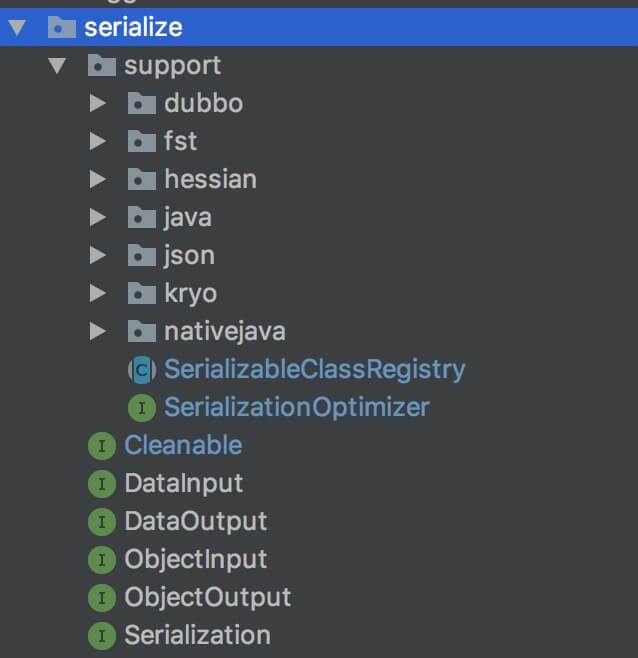
- 最外层,定义了 API 接口。
- support 包,提供了多种序列化的实现。
2. API 定义
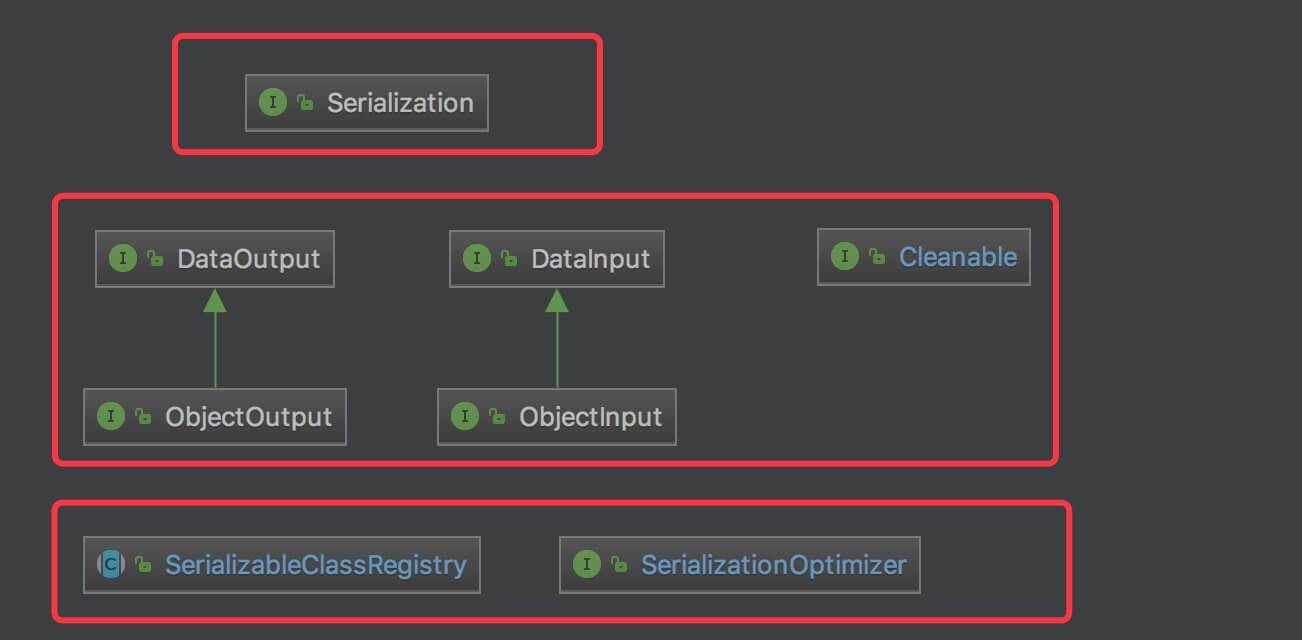
API 接口,类图如下:
2.1 Serialization
com.alibaba.dubbo.common.serialize.Serialization ,序列化接口。代码如下:
1
2
3
4
5
6
7
8
9
10
11
12
13
14
15
16
17
18
19
20
21
22
23
24
25
26
27
28
29
30
31
32
33
34
35
36
37
38
39
40
41
42
43
44
45
46
47
48
@SPI("hessian2")
public interface Serialization {

    /**
     * get content type id
     *
     * 获得内容类型编号
     *
     * @return content type id
     */
    byte getContentTypeId();

    /**
     * get content type
     *
     * 获得内容类型名
     *
     * @return content type
     */
    String getContentType();

    /**
     * create serializer
     *
     * 创建 ObjectOutput 对象,序列化输出到 OutputStream
     *
     * @param url URL
     * @param output 输出流
     * @return serializer
     * @throws IOException 当发生 IO 异常时
     */
    @Adaptive
    ObjectOutput serialize(URL url, OutputStream output) throws IOException;

    /**
     * create deserializer
     *
     * 创建 ObjectInput 对象,从 InputStream 反序列化
     *
     * @param url URL
     * @param input 输入流
     * @return deserializer
     * @throws IOException 当发生 IO 异常时
     */
    @Adaptive
    ObjectInput deserialize(URL url, InputStream input) throws IOException;

}
- @SPI(“hessian2”) 拓展点注解,Dubbo SPI,默认为 “hessian2” ,即未配置情况下,使用 Hessian 进行序列化和反序列化 。
- #getContentTypeId(), #getContentType() 方法,获得内容类型编号和名字。
- #serialize(…), #deserialize(…) 方法, 具体看注释。
- 虽然添加了 @Adaptive 注解, 但是实际上,不使用 Dubbo SPI Adaptive 机制,而是代码中,直接获取。例如:
1
2
3
4
5
// CodecSupport.java
public static Serialization getSerialization(URL url) {
    return ExtensionLoader.getExtensionLoader(Serialization.class).getExtension(
            url.getParameter(Constants.SERIALIZATION_KEY, Constants.DEFAULT_REMOTING_SERIALIZATION));
}
- Serialization 实现类,实现这两个方法,创建对应的 ObjectOutput 和 ObjectInput 实现类的对象。
2.2 DataInput
com.alibaba.dubbo.common.serialize.DataInput ,数据输入接口。方法如下:
1
2
3
4
5
6
7
8
9
10
11
12
boolean readBool() throws IOException;

byte readByte() throws IOException;
short readShort() throws IOException;
int readInt() throws IOException;
long readLong() throws IOException;
float readFloat() throws IOException;
double readDouble() throws IOException;

String readUTF() throws IOException;

byte[] readBytes() throws IOException;
- 从 InputStream 中,读取基本类型的数据。
2.2.1 ObjectInput
com.alibaba.dubbo.common.serialize.ObjectInput ,实现 DataInput 接口,对象输入接口。方法如下:
1
2
3
Object readObject() throws IOException, ClassNotFoundException;
<T> T readObject(Class<T> cls) throws IOException, ClassNotFoundException;
<T> T readObject(Class<T> cls, Type type) throws IOException, ClassNotFoundException;
- 在 DataInput 的基础上,增加读取对象的数据。
2.3 DataOutput
DataOutput 和 DataInput 相反。
com.alibaba.dubbo.common.serialize.DataOutput ,数据输出接口。方法如下:
1
2
3
4
5
6
7
8
9
10
11
12
13
14
15
16
void writeBool(boolean v) throws IOException;

void writeByte(byte v) throws IOException;
void writeShort(short v) throws IOException;
void writeInt(int v) throws IOException;
void writeLong(long v) throws IOException;
void writeFloat(float v) throws IOException;
void writeDouble(double v) throws IOException;

void writeUTF(String v) throws IOException;

void writeBytes(byte[] v) throws IOException;
void writeBytes(byte[] v, int off, int len) throws IOException;

// Flush buffer.
void flushBuffer() throws IOException;
- 向 InputStream 中,写入基本类型的数据。
2.3.1 ObjectOutput
com.alibaba.dubbo.common.serialize.ObjectOutput ,实现 DataOutput 接口,对象输出接口。方法如下:
1
void writeObject(Object obj) throws IOException;
- 在 DataOutput 的基础上,增加写入对象的数据。
2.4 Cleanable
com.alibaba.dubbo.common.serialize.Cleanable ,清理接口。方法如下:
1
void cleanup();
- 部分 Serialize 实现类,完成序列化或反序列化,需要做清理。通过实现该接口,执行清理的逻辑。
2.5 Optimizer 相关
2.5.1 SerializationOptimizer
com.alibaba.dubbo.common.serialize.support.SerializationOptimizer ,序列化优化器接口。方法如下:
1
2
3
4
5
6
7
8
public interface SerializationOptimizer {

    /**
     * @return 需要使用优化的类的集合
     */
    Collection<Class> getSerializableClasses();

}
在 Kryo 、FST 中,支持配置需要优化的类。业务系统中,可以实现自定义的 SerializationOptimizer 子类,进行配置。当然,使用文件也是一个选择,Dubbo 在实现考虑取舍的原因如下:
FROM 类注释
This class can be replaced with the contents in config file, but for now I think the class is easier to write
这个类可以替换为配置文件中的内容,但是现在我认为这个类更容易编写。
2.5.2 SerializableClassRegistry
com.alibaba.dubbo.common.serialize.support.SerializableClassRegistry ,序列化优化类的注册表。代码如下:
1
2
3
4
5
6
7
8
9
10
11
12
13
14
15
16
public abstract class SerializableClassRegistry {

    private static final Set<Class> registrations = new LinkedHashSet<Class>();

    /**
     * only supposed to be called at startup time
     */
    public static void registerClass(Class clazz) {
        registrations.add(clazz);
    }

    public static Set<Class> getRegisteredClasses() {
        return registrations;
    }

}
- #registerClass(clazz) 静态方法,注册。在 SerializationOptimizer#getSerializableClasses() 方法,获得的类的集合,会注册到 SerializableClassRegistry 中。
- #getRegisteredClasses() 静态方法,获得。在 Kryo 、FST 中,调用该方法,获得需要使用优化的类的集合。
2.5.3 初始化序列化优化器
在 DubboProtocol#optimizeSerialization() 方法中,初始化序列化优化器。代码如下:
1
2
3
4
5
6
7
8
9
10
11
12
13
14
15
16
17
18
19
20
21
22
23
24
25
26
27
28
29
30
31
32
33
34
35
36
37
38
39
40
41
42
/**
 * 已初始化的 SerializationOptimizer 实现类名的集合
 */
private final Set<String> optimizers = new ConcurrentHashSet<String>();

private void optimizeSerialization(URL url) throws RpcException {
    // 获得 `"optimizer"` 配置项
    String className = url.getParameter(Constants.OPTIMIZER_KEY, "");
    if (StringUtils.isEmpty(className) || optimizers.contains(className)) { // 已注册
        return;
    }

    logger.info("Optimizing the serialization process for Kryo, FST, etc...");

    try {
        // 加载 SerializationOptimizer 实现类
        Class clazz = Thread.currentThread().getContextClassLoader().loadClass(className);
        if (!SerializationOptimizer.class.isAssignableFrom(clazz)) {
            throw new RpcException("The serialization optimizer " + className + " isn't an instance of " + SerializationOptimizer.class.getName());
        }

        // 创建 SerializationOptimizer 对象
        SerializationOptimizer optimizer = (SerializationOptimizer) clazz.newInstance();
        if (optimizer.getSerializableClasses() == null) {
            return;
        }

        // 注册到 SerializableClassRegistry 中
        for (Class c : optimizer.getSerializableClasses()) {
            SerializableClassRegistry.registerClass(c);
        }

        // 添加到 optimizers 中
        optimizers.add(className);
    } catch (ClassNotFoundException e) {
        throw new RpcException("Cannot find the serialization optimizer class: " + className, e);
    } catch (InstantiationException e) {
        throw new RpcException("Cannot instantiate the serialization optimizer class: " + className, e);
    } catch (IllegalAccessException e) {
        throw new RpcException("Cannot instantiate the serialization optimizer class: " + className, e);
    }
}
- 胖友,直接看代码注释。
3. Dubbo 实现
在 《精尽 Dubbo 源码分析 —— 序列化(二)之 Dubbo 实现》 中,详细解析。
4. Kryo 实现
在 《精尽 Dubbo 源码分析 —— 序列化(三)之 Kryo 实现》 中,详细解析。
5. FST 实现
FST fast-serialization 是重新实现的 Java 快速对象序列化的开发包。序列化速度更快(2-10倍)、体积更小,而且兼容 JDK 原生的序列化。要求 JDK 1.7 支持。
文末,有性能相关测试的分享。
4.1 FstFactory
com.alibaba.dubbo.common.serialize.support.fst.FstFactory ,FST 工厂。代码如下:
1
2
3
4
5
6
7
8
9
10
11
12
13
14
15
16
17
18
19
20
21
22
23
24
25
26
27
28
29
30
31
32
public class FstFactory {

    /**
     * 单例
     */
    private static final FstFactory factory = new FstFactory();

    /**
     * 配置对象
     */
    private final FSTConfiguration conf = FSTConfiguration.createDefaultConfiguration();

    public static FstFactory getDefaultFactory() {
        return factory;
    }

    public FstFactory() {
        // 注册
        for (Class clazz : SerializableClassRegistry.getRegisteredClasses()) {
            conf.registerClass(clazz);
        }
    }

    public FSTObjectOutput getObjectOutput(OutputStream outputStream) {
        return conf.getObjectOutput(outputStream);
    }

    public FSTObjectInput getObjectInput(InputStream inputStream) {
        return conf.getObjectInput(inputStream);
    }

}
- factory 静态属性,单例。
- conf 属性,FST 配置对象。在构造方法中,将 SerializableClassRegistry 注册表需要使用优化的类,注册到 FSTConfiguration 中。SerializableClassRegistry#registerClass(Class … c) 方法,注释如下:
1
2
3
4
5
6
7
8
9
10
11
12
13
14
15
16
/**
 *
 * Preregister a class (use at init time). This avoids having to write class names.
 * Its a very simple and effective optimization (frequently > 2 times faster for small objects).
 * 预注册一个类(在初始化时使用)。这样可以避免编写类名。
 * 它是一种非常简单有效的优化(对于小对象来说,通常是>的2倍)。
 *
 * Read and write side need to have classes preregistered in the exact same order.
 * 客户端和服务端需要预先以完全相同的顺序注册。
 *
 *
 * The list does not have to be complete. Just add your most frequently serialized classes here
 * to get significant gains in speed and smaller serialized representation size.
 *
 * 这个列表并不一定要完整。只需在这里添加最常见的序列化类,以获得速度和较小的序列化表示大小的显著提高。
 */
- #getObjectOutput() 方法,获得 org.nustaq.serialization.FSTObjectOutput 对象,被 FstObjectOutput 调用。
- #getObjectInput() 方法,获得 org.nustaq.serialization.FSTObjectInput 对象,被 FstObjectInput 调用。
4.2 FstSerialization
com.alibaba.dubbo.common.serialize.support.fst.FstSerialization ,实现 Serialization 接口,FST 序列化实现类。代码如下:
1
2
3
4
5
6
7
8
9
10
11
12
13
14
15
16
17
18
19
20
21
22
23
public class FstSerialization implements Serialization {

    @Override
    public byte getContentTypeId() {
        return 9;
    }

    @Override
    public String getContentType() {
        return "x-application/fst";
    }

    @Override
    public ObjectOutput serialize(URL url, OutputStream out) throws IOException {
        return new FstObjectOutput(out);
    }

    @Override
    public ObjectInput deserialize(URL url, InputStream is) throws IOException {
        return new FstObjectInput(is);
    }

}
- “x-application/fst” ,类似 HTTP 协议的 Content-Types Header 。在 『6. JSON 实现』 类中,返回的是 “text/json” 。
4.3 FstObjectInput
com.alibaba.dubbo.common.serialize.support.fst.FstObjectInput ,实现 ObjectInput 接口,FST 对象输入实现类。
构造方法
1
2
3
4
5
private FSTObjectInput input;

public FstObjectInput(InputStream inputStream) {
    input = FstFactory.getDefaultFactory().getObjectInput(inputStream);
}
- input 属性,调用 FstFactory#getObjectInput(inputStream) 方法,获得。
实现方法
每个实现方法,直接调用 FSTObjectInput 对应的方法。比较特殊的是,#readBytes() 方法,代码如下:
1
2
3
4
5
6
7
8
9
10
11
12
13
14
15
16
@Override
public byte[] readBytes() throws IOException {
    int len = input.readInt();
    // 数组为空
    if (len < 0) {
        return null;
    // 数组为零
    } else if (len == 0) {
        return new byte[]{};
    // 数组 > 0
    } else {
        byte[] b = new byte[len];
        input.readFully(b);
        return b;
    }
}
- [ 字节数组长度, 字节数组内容 ]
4.4 FstObjectOutput
com.alibaba.dubbo.common.serialize.support.fst.FstObjectOutput ,实现 ObjectOutput 接口,FST 对象输出实现类。
构造方法
1
2
3
4
5
private FSTObjectOutput output;

public FstObjectOutput(OutputStream outputStream) {
    output = FstFactory.getDefaultFactory().getObjectOutput(outputStream);
}
- output 属性,调用 FstFactory#getObjectInput(outputStream) 方法,获得。
实现方法
每个实现方法,直接调用 FSTObjectInput 对应的方法。比较特殊的是,#writeBytes(byte[] v) 方法,代码如下:
1
2
3
4
5
6
7
8
9
10
@Override
public void writeBytes(byte[] v) throws IOException {
    // 空,写入 -1
    if (v == null) {
        output.writeInt(-1);
    // 有数组
    } else {
        writeBytes(v, 0, v.length);
    }
}
- [ 字节数组长度, 字节数组内容 ]
6. JSON 实现
基于 FastJSON 实现。
fastjson 是一个性能很好的 Java 语言实现的 JSON 解析器和生成器,来自阿里巴巴的工程师开发。
主要特点:
- 快速FAST (比其它任何基于Java的解析器和生成器更快,包括 jackson)
- 强大(支持普通JDK类包括任意Java Bean Class、Collection、Map、Date 或 enum)
- 零依赖(没有依赖其它任何类库除了JDK)
代码比较简单,和 『5. FST 实现』 类似,胖友自己查看:
- com.alibaba.dubbo.common.serialize.support.json.FastJsonSerialization
- com.alibaba.dubbo.common.serialize.support.json.FastJsonObjectInput
- com.alibaba.dubbo.common.serialize.support.json.FastJsonObjectOutput
需要注意的是,FastJsonObjectOutput#writeObject(Object) 方法的实现,代码如下:
1
2
3
4
5
6
7
8
9
10
11
12
13
@Override
public void writeObject(Object obj) throws IOException {
    SerializeWriter out = new SerializeWriter();
    // 序列化,写入对象
    JSONSerializer serializer = new JSONSerializer(out);
    serializer.config(SerializerFeature.WriteEnumUsingToString, true); // 枚举转字符串
    serializer.write(obj);
    // 写到,输出流
    out.writeTo(writer);
    out.close(); // for reuse SerializeWriter buf
    writer.println(); // 换行
    writer.flush();
}
7. Hessian2 实现
和其他 Web 服务的实现框架不同的是,Hessian 是一个使用二进制 Web 服务协议的框架,它的好处在于免除了一大堆附加的API包,例如 XML 的处理之类的 jar 包,这也就是为什么说它是一个轻量级的 Web 服务实现框架的原因,这个原因还在于手机上的应用程序可以通过 Hessian 提供的 API 很方便的访问 Hessian 的 Web 服务。
从介绍中,我们可以看到,Hessian 自己有自己的序列化的实现。但是,Hessian 在实现上,存在一些 Bug 和需要性能优化的点。例如:
BigDecimal 的反序列化
使用 Hessian 序列化包含 BigDecimal 字段的对象时会导致其值一直为0,不注意这个bug会导致很大的问题,在最新的4.0.51版本仍然可以复现。解决方案也很简单,指定 BigDecimal 的序列化器即可。
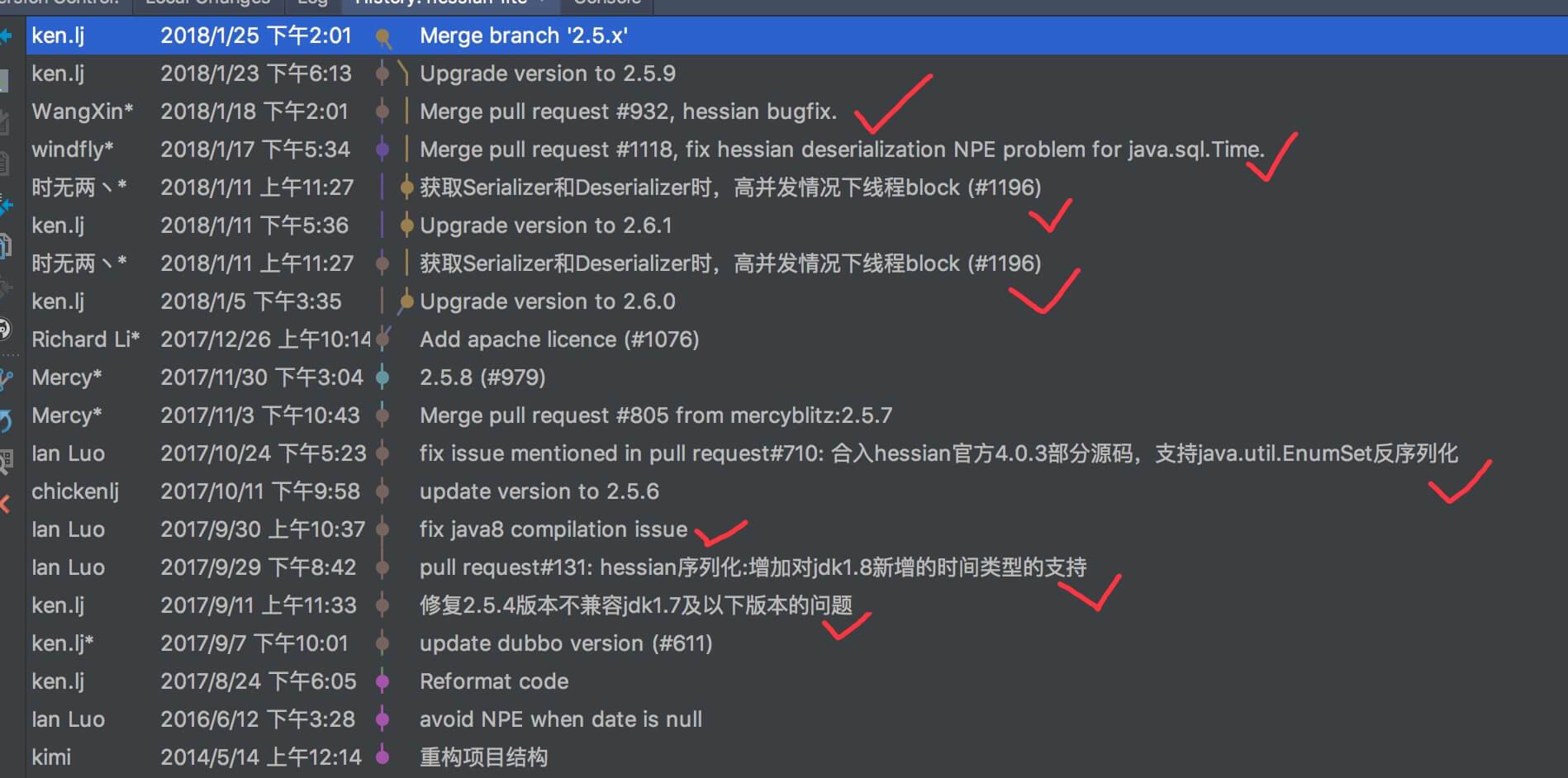
所以 Dubbo 维护了自己的 hessian-lite ,对 Hessian 2 的序列化部分的精简、改进、BugFix 。
提交历史如下:
代码比较简单,和 『5. FST 实现』 类似,胖友自己查看:
- com.alibaba.dubbo.common.serialize.support.hessian.Hessian2SerializerFactory
- com.alibaba.dubbo.common.serialize.support.hessian.Hessian2Serialization
- com.alibaba.dubbo.common.serialize.support.hessian.Hessian2ObjectInput
- com.alibaba.dubbo.common.serialize.support.hessian.Hessian2ObjectOutput
8. NativeJava 实现
旁白君:由于艿艿对 Java 原生的序列化,了解的比较粗浅,本小节更多的是把代码梳理干净。
nativejava ,基于 Java 原生( 自带 )的 Java 序列化实现,即使用 java.io.ObjectInputStream 和 java.io.ObjectOutputStream 进行序列化和反序列化。
代码比较简单,和 『5. FST 实现』 类似,胖友自己查看:
- com.alibaba.dubbo.common.serialize.support.nativejava.NativeJavaSerialization
- com.alibaba.dubbo.common.serialize.support.nativejava.NativeJavaObjectInput
- com.alibaba.dubbo.common.serialize.support.nativejava.NativeJavaObjectOutput
8.1 Java 实现
java ,在 『8. NativeJava 实现』 的基础上,实现了对空字符串和空对象的处理。如下是 JavaObjectOutput 对空字符串和空对象的序列化,代码如下:
1
2
3
4
5
6
7
8
9
10
11
12
13
14
15
16
17
18
19
20
21
// 【注意】JavaObjectOutput extends NativeJavaObjectOutput !!!

@Override
public void writeUTF(String v) throws IOException {
    if (v == null) { // 空字符串
        getObjectOutputStream().writeInt(-1);
    } else {
        getObjectOutputStream().writeInt(v.length()); // 长度
        getObjectOutputStream().writeUTF(v); // 字符串
    }
}

@Override
public void writeObject(Object obj) throws IOException {
    if (obj == null) { // 空
        getObjectOutputStream().writeByte(0); // 空
    } else {
        getObjectOutputStream().writeByte(1); // 非空
        getObjectOutputStream().writeObject(obj); // 对象
    }
}
代码比较简单,和 『NativeJava 实现』 类似,胖友自己查看:
- com.alibaba.dubbo.common.serialize.support.java.JavaSerialization
- com.alibaba.dubbo.common.serialize.support.java.JavaObjectInput
- com.alibaba.dubbo.common.serialize.support.java.JavaObjectOutput
8.2 CompactedJava
compactedjava ,在 『8.1 Java 实现』 的基础上,实现了对 ClassDescriptor 的处理。如下是 CompactedObjectOutputStream 对 ClassDescriptor 的写入,代码如下:
1
2
3
4
5
6
7
8
9
10
11
12
13
// 【注意】CompactedObjectOutputStream extends ObjectOutputStream !!!

@Override
protected void writeClassDescriptor(ObjectStreamClass desc) throws IOException {
    Class<?> clazz = desc.forClass();
    if (clazz.isPrimitive() || clazz.isArray()) {
        write(0);
        super.writeClassDescriptor(desc);
    } else {
        write(1);
        writeUTF(desc.getName());
    }
}
- 在 JavaObjectOutput 的创建时,根据 compact = true 时,使用 CompactedObjectOutputStream 输出流。代码如下:
1
2
3
public JavaObjectOutput(OutputStream os, boolean compact) throws IOException {
    super(compact ? new CompactedObjectOutputStream(os) : new ObjectOutputStream(os));
}
代码比较简单,胖友自己查看:
- com.alibaba.dubbo.common.serialize.support.java.CompactedJavaSerialization
- com.alibaba.dubbo.common.serialize.support.java.CompactedObjectInputStream
- com.alibaba.dubbo.common.serialize.support.java.CompactedObjectOutputStream
666. 彩蛋
推荐阅读: